
Vandaag of morgen in huis

Kwaliteit gegarandeerd

Welkomstaanbiedingen ontgrendelen: GRATIS bezorging | Tot 80% korting | Gratis 30 dagen JoyPlus-proefperiode
Download de app
An electric hob may seem simple to choose: decide how many cooking zones you need, pick a black glass model and check the price. In practice, the biggest differences come down to the connection, cut-out size, heating technology and controls. A model that’s ideal for a student room won’t necessarily suit a busy household.
A built-in hob rated at 6,000 to 7,400 watts may require a multi-phase connection. Some models come with a cable but no plug, and need to be connected by a qualified installer. So a standard socket isn’t always enough.
Before buying, check:
A compact electric hob rated at 2,000 to 3,000 watts is often easier to install, but you should still check that your existing circuit can handle the load.
A 60 cm hob is rarely exactly 60 cm wide. Its overall width might be around 59 cm, while the worktop cut-out may need to be about 56 cm wide. For an 80 cm hob, the cut-out is often around 78 cm, but this varies by model.
So always measure:
Use only the official dimension drawing for the product you’ve chosen. Even a small discrepancy could make installation impossible.
A hob with touch controls, a timer or a child lock can be convenient, but these features alone tell you little about cooking performance. First, look at the heating type and controls.
A residual heat indicator, automatic switch-off and child lock are useful safety features. They don’t replace supervision while you’re cooking.
For one person, a student room or as an extra cooking option, a 1-ring electric hob or 2-ring electric hob may be enough. Two zones are also handy in a small kitchen, holiday home or flat.
For families, a 4-ring electric hob makes more sense. Don’t just look at the number of zones: check their diameter too. An extendable or oval zone gives you more room for a roasting tin or large pan.
The maximum power rating determines how many zones can run on a high setting at the same time. A 2-ring model rated at 3,000 watts is compact, while 4-ring built-in models are often rated at around 6,000 to 9,300 watts. Induction models can also have a high connected load.
A higher wattage doesn’t automatically mean lower cooking costs. Energy use depends on the power setting, cooking time, pan and the way you cook. A timer with automatic switch-off can help stop a zone being left on unnecessarily.
A smooth black hob with a glass-ceramic surface is generally easy to wipe clean, but spilled sugar, salt or baked-on residue can cause scratches. Wait until the surface has cooled and don’t use an abrasive sponge.
At a minimum, look for:

Why it suits this type of buyer: This compact ceramic hob is designed for anyone who needs two zones and has space for a cut-out measuring around 26 × 49 cm.
The specifications give both the overall dimensions and the cut-out size. The timer, child lock and residual heat indicator are also clearly listed.
Two zones rated at 1.200 and 1.800 watts, nine settings, a total power rating of 3.000 watts and a glass surface that, according to the product description, can be cleaned with a damp cloth.

Why it suits this type of buyer: This 59 cm-wide induction model is ideal for anyone who values flexible cooking space, touch controls and smart features.
The product information lists a power rating of 7.400 watts, four zones, the overall dimensions and the required built-in measurements. Be sure to check the connection and make sure you have suitable pans before buying.
Four induction zones, a flex zone, automatic pan detection, a timer, a residual heat indicator, a child lock and SmartThings control, according to the product specifications.
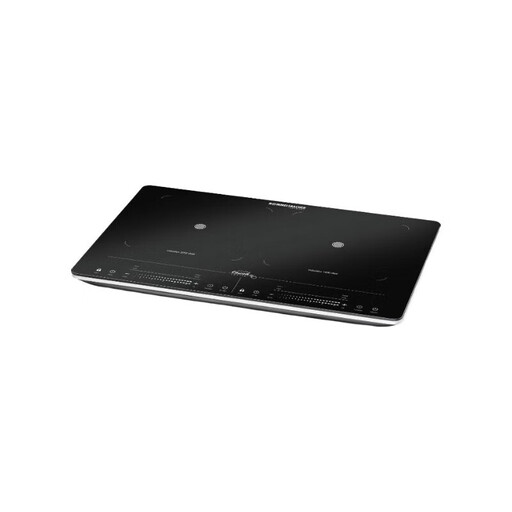
Why it suits this type of buyer: This portable two-zone induction hob is a good fit for a small kitchen, office or holiday home, or as an extra cooking surface.
The product description clearly states that you need pans with a ferromagnetic base. That way, you know in advance that not every type of cookware will be suitable.
Two zones rated at 1.400 and 2.000 watts, ten power settings, slider controls, pan detection, a residual heat indicator and a timer of up to 180 minutes.
We’ve put together a complete, up-to-date list of products that meet these strict selection criteria and the applicable European safety requirements.
It depends on the power rating. A portable model rated up to around 2.000 watts will often work on a single-phase connection, but always check the manual and plug type. More powerful built-in models often need a fixed or multi-phase connection. Ask a qualified installer to check the connection.
Its lifespan depends on how it’s used, installed and maintained. Scratches, a cracked glass surface or incorrectly connected wiring can cause problems. Use flat-based cookware, lift pans rather than sliding them, and clean the hob with suitable products. Switch the appliance off and have it checked if the glass surface cracks.
The cost depends on the power rating, cooking time and your energy tariff. A higher wattage can heat things more quickly, but it also uses more energy if you cook for a long time on a high setting. Use a suitably sized pan, keep a lid on it and make use of the timer to avoid unnecessary heating.
