
For cooks who like to simmer gently
You mainly use one casserole pan and want to turn the heat down once the stew has come to the boil. Compare the low heat settings, but don’t take a stated setting as proof of an even simmer.


Choose a hob that suits your pan and power connection, then decide whether you need one or two cooking zones and how you want to adjust the heat. Induction responds quickly to adjustments, but requires a compatible pan. A conventional electric hob may suit a pan that isn’t suitable for induction, but it retains residual heat and responds more slowly. A list of heat settings alone doesn’t show how evenly your stew will simmer.
You mainly use one casserole pan and want to turn the heat down once the stew has come to the boil. Compare the low heat settings, but don’t take a stated setting as proof of an even simmer.
You want to know whether your current pan is suitable for induction. Milieu Centraal recommends checking the base with a magnet. If induction isn’t suitable, you can compare conventional electric hobs.
You’re preparing a side dish alongside your stew and need room for a second pan. Compare the zone controls and check that the power connection is suitable for using both at the same time.
Start with your pan and the power connection available. Then choose between one cooking zone for your stew and two if you also want to prepare a side dish. Milieu Centraal explains that induction responds quickly to adjustments and requires a magnetisable pan base. The Consumentenbond points out that the available power also matters when cooking on multiple zones at once.
| What to consider | What to look for | Who is this important for? |
|---|---|---|
| Adjusting to a low heat | Compare the low heat settings and controls; a selected setting doesn’t prove how evenly your stew will simmer. | If I want to continue cooking gently after bringing my stew to the boil, I need to be able to turn the heat down easily. Around 36% of consumers put this first. |
| Existing casserole pan | For induction, check the base with a magnet to make sure it’s suitable, and compare the base size with the model’s stated range. | If you want to keep using your current pan, first check that it’s suitable for the hob. Around 29% of consumers put keeping their existing pan at the top of their buying priorities. |
| Using two pans at once | Compare the zone sizes, individual controls and total power with the power connection and other appliances on the same circuit. | If I’m making a side dish while my stew simmers, I need room for a second pan. Around 21% of consumers put cooking on multiple zones at once first. |
| Positioning and supervision | Follow the model’s positioning and connection instructions, keep flammable materials away and stay nearby while cooking. | If you need to decide where to put the hob in advance, you’ll want to know how much space and what kind of power connection it needs. Around 14% of consumers make easy, safe installation their top priority. |
Manufacturers may list heat settings or temperatures, but that doesn’t tell you how evenly your pan will simmer.
Compare the low heat settings and keep an eye on your stew while it’s cooking.
An induction hob only works with a suitable, magnetisable pan base. The pan must also fall within the model’s stated size range.
Check the base with a magnet and measure your pan before choosing a model.
If your pan isn’t suitable, you may need a different casserole pan.
With a freestanding hob, the available power connection may limit you when using several zones or appliances at the same time.
Compare the total power and connection instructions with what you want to use at the same time.
According to the Dutch government, the Netherlands has no fixed statutory warranty period. If a product is faulty, the retailer is your point of contact for your statutory rights.
Distinguish between an additional manufacturer’s warranty and your statutory rights, and keep your proof of purchase.
These examples show how specific models differ. A brand name alone says nothing about current availability or whether a model is suitable for every pan.
The KI120T is a freestanding single-zone induction hob, with a stated pan size range you can compare with the base of your casserole pan.
The KB1000684 is a freestanding single-zone induction hob to compare if you need a different pan size.
The KP-6245 is a conventional two-zone electric hob for anyone who wants to cook a stew and a side dish at the same time.
The KP 1091 is a conventional single-zone hob to compare if you want to keep using a rotary control and a non-induction pan.
The products below range from portable single-zone induction hobs to two-zone models, including a built-in hob. So first compare pan compatibility and decide whether you’re looking for a freestanding or built-in hob.
 Image unavailable
Suitable for one induction-compatible pan if you want to adjust the heat once your stew has come to the boil. The product description lists 2000 W, 10 levels, a temperature range of 60–240 °C and a timer of up to 240 minutes. These settings don’t guarantee an even simmer.
 Image unavailable
Suitable if you want to cook your stew alongside a second pan and control the zones separately. The product description lists 1500 W and 1000 W zones, five temperature settings and a smaller zone for simmering or keeping food warm. Follow the instructions on suitable cookware.
 Image unavailable
Suitable for one induction-compatible pan if you’re looking for a portable hob with a rotary control. The product information lists 1000 W and five power settings. Check that your pan base is suitable for induction.
 Image unavailable
Suitable for one induction-compatible pan if you’re looking for a compact, portable hob. The product name lists 220V/240V and 2100 W; the description mentions pan detection, overheat protection and touch controls.
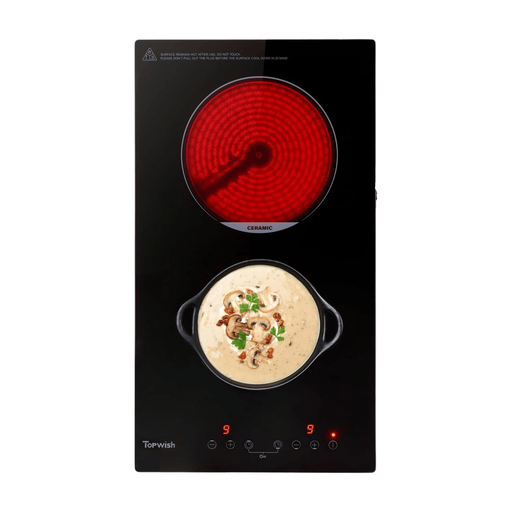 Image unavailable
Suitable if you’re looking for a built-in hob with two zones for cooking on both at once. The product description lists 1200 W and 1800 W zones, nine power settings and a timer of up to 90 minutes. The required cut-out is 26 × 49 cm and the stated total power is 3000 W.
Check that the base is magnetisable and compare its size with the range supported by the hob you’ve chosen. For example, Inventum lists 15–20 cm for the KI120T; this size range doesn’t automatically apply to other models.
According to the Consumentenbond, most freestanding induction hobs can be plugged into an earthed socket, but not all models. More powerful models may need a Perilex connection and modifications to the consumer unit. Follow the connection instructions for the exact model and take other appliances on the same circuit into account.
No. Brandweer Twente recommends staying near the hob while cooking and using a kitchen timer as a reminder.
If a product is faulty, the retailer is your point of contact for your statutory rights. According to the Dutch government, the Netherlands has no fixed statutory warranty period. A manufacturer’s warranty is additional and doesn’t replace your statutory rights.
For electrical appliances placed on the market in the Netherlands under the applicable EU rules, the manufacturer must carry out a conformity assessment, affix the CE marking and draw up an EU declaration of conformity. If you’re considering a specific offer, check the product identity and marking. A declaration for one model doesn’t automatically confirm the identity or marking of every item on offer.