If you mainly want to feel warm while sitting at your desk, a well-positioned infrared panel could meet that need. Just don’t expect it to heat the entire conservatory. If you also want to warm the air around your desk, compare a fan heater with a convector in terms of noise, space and how long you’ll use it, and bear in mind that heat can escape through the conservatory. Before buying, check the CE marking and the safety instructions for the specific model.
Which type of heater is right for you?
Desk worker who stays in one spot
If you usually sit in the same place and want some extra heat there from time to time, a directional infrared panel could be a good fit. Milieu Centraal describes infrared as radiant heat for a specific area; check that the direction and installation of your chosen model work for your desk.
Anyone using the whole conservatory
If you want to warm the air around your desk as well as yourself, compare a fan heater with a convector. Mill’s models come in different designs and with different settings, but their specifications alone don’t tell you how warm your conservatory will get.
Desk worker who values peace and quiet
If you’d rather not hear a fan while you’re concentrating, consider localised radiant heat or a convector. Check whether each model has a fan and which operating setting any noise information applies to.
What should you consider when choosing?
First decide whether you want to feel the heat where you sit or warm the air as well. Then consider how long you’ll use it, energy consumption and noise.
| What to consider |
What should you look for? |
Who is this for? |
| Heat where you sit |
Check the direction of the radiant heat, the installation position and the clearance around the heater. Think about which parts of your body need warming. |
If I mainly want to warm my regular workspace, I check whether the radiant heat reaches me. Around 33% of consumers give localised warmth the highest priority. |
| Warming the air too |
Compare convection and fan heating, the available settings and the space needed for installation. Don’t treat a stated maximum area as a guarantee for your conservatory. |
If I want warmer air beyond the spot where I’m sitting, I compare the different ways of heating the air. Around 25% of consumers say this is their main need. |
| Energy consumption |
Calculate consumption using the power setting in kW and the number of hours the heater is on. Allow for a thermostat switching the heater on and off. |
If I use a heater regularly, I want to know what my chosen setting and usage time mean for energy consumption. Around 25% of consumers prioritise keeping consumption under control. |
| A quiet working environment |
Check whether the model has a fan and which setting any stated noise level applies to. |
If fan noise distracts me while I’m reading, on a call or concentrating, quiet operation matters more. Around 17% of consumers make silence their top priority. |
Common mistakes when choosing
-
Assuming lower wattage means more efficient heating
Power alone doesn’t tell you how warm you’ll feel where you need it. A localised panel and a heater that warms the air also serve different purposes.
First decide where you want to feel the heat. Then calculate consumption using the power of your chosen setting and the time the heater is actually on.
-
Assuming the stated coverage area applies to your conservatory
A manufacturer’s coverage figure doesn’t guarantee that a model will heat the same area in a conservatory where heat can escape.
Take the glazing, draughts and how you use the conservatory into account. Don’t choose based on a square-metre figure alone.
-
Plugging a heater into an extension lead without checking
The Dutch Fire Service warns that cable reels can become hot. It recommends plugging high-powered appliances, such as electric heaters, directly into a wall socket rather than into a cable reel or extension lead.
Plan the installation near a suitable socket and follow the connection instructions for the exact model.
Brands to consider
ETHERMA
The LAVA DESK 2.0 is designed as an infrared heater fitted beneath a desk to provide localised warmth.
- ETHERMA lists 80 W, installation using screws or mounting adhesive, and a maximum surface temperature of 60 °C. These are manufacturer specifications, not the result of an independent comfort test.
- Check that the installation and heat output suit your desk. This model has not been shown to heat an entire conservatory.
Mill
The models mentioned offer a choice between a fan heater and a freestanding convector.
- According to Millstore, the CUS1800MECW has 1200 and 1800 W settings and a fan. The SG2000MEC has 750, 1250 and 2000 W settings, plus a mechanical thermostat.
- These specifications don’t show how the heaters will perform in a conservatory. Check noise levels and the safe clearance required for the specific model.
Eurom
The Mon Soleil 350 Wifi is an infrared panel designed for fixed wall installation near a workspace.
- Eurom lists 350 W, a thermostat and wall mounting.
- According to Eurom, a separately available stand is needed for freestanding use. The stated features don’t show that the panel will heat the entire conservatory.
Duux
The Threesixty² is a ceramic fan heater for anyone looking to warm the air as well.
- Duux lists a maximum output of 1800 W, fan settings and tip-over and overheat protection.
- The stated warm-up speed and suitable floor area aren’t an independent assessment of performance in a conservatory.
Rowenta
The SO2351F0 is a portable fan heater with two settings.
- Rowenta lists 1000 W in Eco mode and 2000 W in Turbo mode, as well as tip-over and overheat protection.
- The manufacturer’s claims about quiet operation and energy saving relate to specific settings. They don’t prove that the heater is quiet at maximum power or uses little energy.
Joybuy products
This selection includes fan heaters for anyone who also wants warm air around their desk. Check that each model’s intended use and installation are suitable for your conservatory.
 No image available
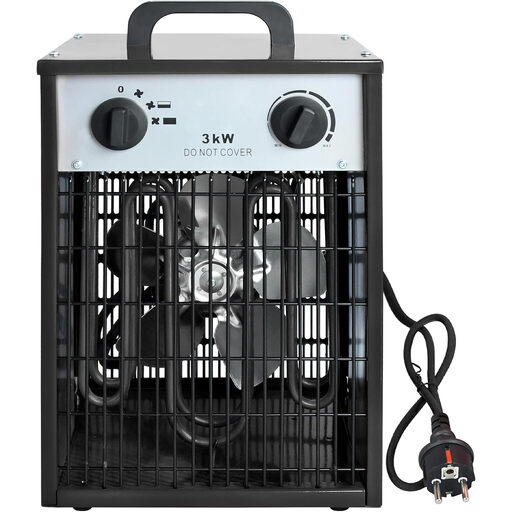
Electric fan heater, 3 kW
The product title mentions use in a workshop, garage, warehouse and on a building site. Check whether the manufacturer also approves it for use in your conservatory.
The title lists 3 kW, four heat settings and overheat protection. Check the connection and installation instructions for this model.
Joybuy
 No image available
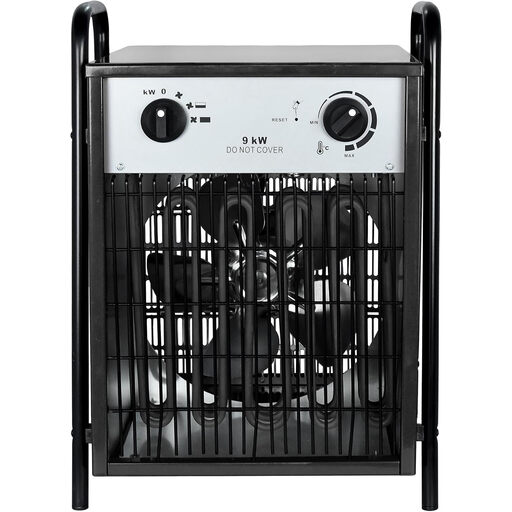
Electric fan heater, 9 kW
The product title mentions use in a workshop, garage, warehouse and on a building site. Check whether the manufacturer also approves it for use in your conservatory.
The title lists 9 kW, four heat settings and overheat protection. Check the connection and installation instructions for this model.
Joybuy
 No image available
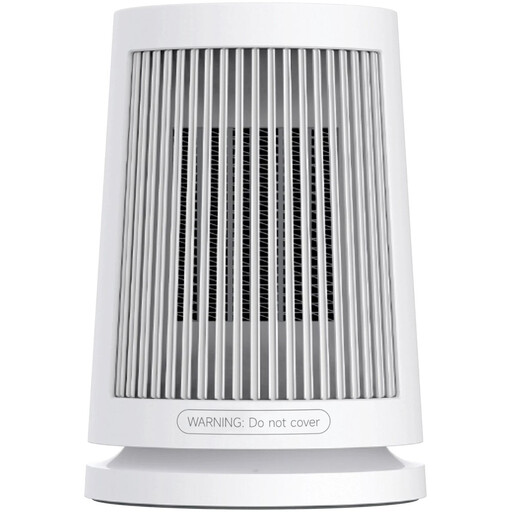
Xiaomi Desktop Heater, 600 W PTC Ceramic
The title describes a compact heater for a desk. Check that it can be positioned safely at your workspace in the conservatory.
The title lists 600 W, an adjustable thermostat, and tip-over and overheat protection. The description mentions 45° oscillation. The usage warnings state that it must not be used in a damp environment.
Joybuy
 No image available
OmniHeat ceramic fan heater, 1800 W
The product information mentions office use. Check that the recommended positioning suits your desk and the layout of your conservatory.
The title lists a timer, ECO mode, four heat settings, a thermostat, oscillation, and tip-over and overheat protection. The instructions require at least 1 metre of clearance from flammable materials.
Joybuy
 No image available
PELONIS ceramic fan heater, 2000 W
The product information mentions office use. Check that the recommended positioning is suitable for your workspace.
The title lists a timer, thermostat, ECO mode, and tip-over and overheat protection. The description mentions five heat settings. For indoor use only; keep the air vents clear and the heater away from water.
Joybuy
Frequently asked questions
Do you need to heat the whole conservatory to make your desk more comfortable?
Not necessarily. A suitably positioned infrared panel can provide warmth where you sit. If you also want warmer air elsewhere in the conservatory, air heating is better suited to that need. A stated maximum floor area doesn’t guarantee that a model will heat your conservatory sufficiently.
Can you plug a powerful electric heater into the extension lead by your computer?
The Dutch Fire Service recommends plugging high-powered appliances, such as electric heaters, directly into a wall socket rather than into a cable reel or extension lead. Follow the connection and installation instructions for your chosen model too.
How do you calculate the electricity used during a work session?
Multiply the power actually used in kilowatts by the number of hours the heating element is active. At 1200 W, heating for a full hour uses 1.2 kWh according to this calculation. If a thermostat switches the heater off in the meantime, the actual heating time will differ. Multiply the kWh by your own price per kWh to calculate the cost of the energy used.
Is CE marking compulsory for an electric heater in the Netherlands?
CE marking is compulsory for electrical products covered by the relevant Dutch regulations. The Netherlands Food and Consumer Product Safety Authority explains that the manufacturer uses it to declare that the product complies with the applicable EU requirements; CE marking is not the same as a compulsory independent inspection. Check the marking and safety information for the specific model.
Does an electric space heater need an EU energy label?
Not simply because it is an electric space heater. The European Commission states that electric local space heaters are outside the scope of the energy-labelling rules mentioned. The absence of such a label doesn’t mean that applicable product safety or ecodesign rules don’t apply.


