
Vandaag of morgen in huis

Kwaliteit gegarandeerd

Welkomstaanbiedingen ontgrendelen: GRATIS bezorging | Tot 80% korting | Gratis 30 dagen JoyPlus-proefperiode
Download de app
An electric heater is useful if you only want to heat a bedroom, home office or study. However, many buyers encounter the same problems: a unit is noisier than expected, electricity consumption is disappointing or the heat does not spread sufficiently around the room. The right choice therefore depends on more than just wattage or an attractive offer.
A 2000-watt electric heater can provide heat quickly, but at maximum power it also uses 2 kWh per hour. The cost depends on your energy tariff and how long the heating element remains active. A lower setting, thermostat or ECO function can limit usage, but does not automatically make a unit energy-efficient.
Also watch out for conflicting information. Some product descriptions list different power ratings. Before buying, check the technical specifications, the manual and the actual power output for each setting.
A fan heater uses a fan to distribute warm air. This works quickly, but it can be noticeable when you are sleeping, on a video call or studying. If a decibel rating is provided, you can compare models more effectively. Bear in mind, however, that measurement conditions may vary. A stated value of 24, 34 or 50 dB is therefore primarily a product specification, not a guarantee that everyone will experience the noise in the same way.
A convector heater without a fan is generally quieter. The heat spreads more gradually through natural air circulation.
A heater with tip-over protection switches off if the unit falls over, according to the product description. Overheat protection can switch the appliance off if its internal temperature becomes too high. These features are useful, but they do not prevent every risk.
Always place an electric heater on a level, hard and stable surface. Keep curtains, bedding, paper and furniture well away, never cover the air inlet or outlet, and do not use the unit in a damp room unless it is specifically designed for that purpose. Unplug it before moving or cleaning.
For a small personal workspace, 600 to 1000 watts may be sufficient as supplementary electric heating. Models rated at 1500 to 2000 watts are often offered for bedrooms or living rooms. The capacity you need depends on factors including:
A fan heater or ceramic heater provides quickly noticeable warmth near the unit. A convector heater is more suitable when you want to distribute the temperature more gradually around the room. An oil-filled radiator retains some heat for a while after being switched off, but is usually heavier and more difficult to move.
A ceramic heater often uses PTC technology. PTC stands for Positive Temperature Coefficient: as the temperature rises, the heating element’s electrical resistance changes. According to the product descriptions from the relevant brands, this contributes to stable heat output.
Describe such benefits carefully. A PTC element does not automatically mean that you will pay less. Actual consumption is mainly determined by the power rating, set temperature, operating time and how the thermostat works.
A heater with a thermostat can adjust its heat output once the desired temperature has been reached. Check whether the temperature is set digitally or mechanically, and what range is available.
A heater with a timer is useful when you want the unit to switch off automatically after a certain period. Models may offer, for example, 12 or 24 hours. A heater with remote control is convenient beside the bed or desk, but check that the remote control is actually included.
Oscillation can spread warm air over a wider area. This is particularly useful when several people are in the room. However, it does not make the unit suitable for a larger room than the manufacturer specifies.
The selection below is based on verifiable specifications such as power, controls, noise level, timer, room guidance and safety features. Manufacturer claims, such as energy-saving claims, are identified as such.

Why it suits this profile: This compact fan heater offers fan-only, 750W, 1500W and ECO modes. The LED display, remote control and 1–12-hour timer are practical for a bedroom, desk or student room.
The different settings mean you do not have to heat continuously at 1500W. Overheat protection and a tip-over switch are included, according to the product information.
PTC ceramic element, wide oscillation, 12-hour timer and remote control.

Why it suits this profile: For people working from home and households that value precise control, this model offers a thermostat range of 5–35 °C, 70° oscillation, a remote control and a 12-hour timer.
The manufacturer states a noise level of 25–42 dB and multiple safety layers. Before buying, check that the stated room size of 15–25 m² is suitable for your insulation.
2000W PTC heating, degree-by-degree temperature adjustment, and tip-over and overheat protection.
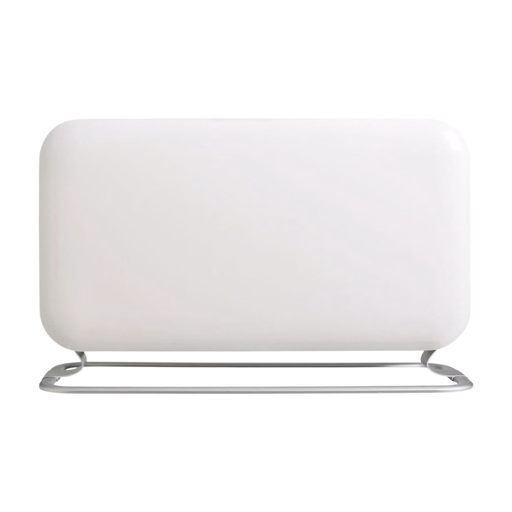
Why it suits this profile: This convector heater is designed for rooms of up to 20 m² and combines 2000W of power with a thermostat, LED display and fan for improved heat distribution.
The manufacturer states that it operates quietly, so fan noise does not have to be an unavoidable feature. The thermostat helps regulate the heat instead of heating continuously at maximum power.
2000W power, three settings, LED display and a stated cable length of 160 cm.
We have put together a complete, up-to-date list of products that fully meet these strict selection criteria and the applicable European safety regulations.
A 1500-watt unit uses a maximum of 1.5 kWh per hour. A 2000-watt model uses a maximum of 2 kWh per hour. Actual consumption is lower when a thermostat regularly switches the heating element off. Multiply the consumption by your current price per kWh to calculate the cost.
It can be, provided the model is suitable for indoor use and placed in a stable, unobstructed location. A heater with a timer, thermostat and tip-over protection is practical. Do not place the unit on bedding, keep textiles at a safe distance and do not leave it running unnecessarily while you sleep. Always check the manual for the specific model.
Lifespan depends on build quality, use, storage and maintenance. A ceramic heater and fan heater are portable and heat up quickly. A convector heater is often intended for a fixed position. An oil-filled radiator is heavy, but operates without a fan. When buying, look at the warranty, parts information, safety instructions and the conditions for normal household use.
