
Vandaag of morgen in huis

Kwaliteit gegarandeerd

Welkomstaanbiedingen ontgrendelen: GRATIS bezorging | Tot 80% korting | Gratis 30 dagen JoyPlus-proefperiode
Download de app
An electric heater seems simple: plug it in and turn on the heat. Yet many people end up buying a model that is not suitable for their space or intended use. An appliance that is too powerful may use more electricity than necessary, while a small model will have little effect in a cold living room.
It is also worth looking beyond marketing claims. “Heats up in seconds” mainly says something about the airflow at the outlet, not necessarily how quickly an entire room reaches the desired temperature. Likewise, a description such as “energy-efficient” does not mean that the maximum power output is lower. Always check the technical specifications.
Looking only at the wattage
An electric heater rated at 2000W can produce warm air quickly, but at maximum power it also uses 2 kWh per hour. For a small desk or student bedroom, 600W to 1500W may be enough. The right power level depends on the size of the room, its insulation and how quickly you want it to heat up.
Treating the stated room size as a guarantee
Manufacturers sometimes list a recommended room size, but results vary from one home to another. An open-plan living room, high ceilings and draughts require more power than a well-insulated bedroom. Treat the stated square metres as a guideline rather than a fixed promise.
Relying on safety features instead of staying alert
A heater with tip-over protection and overheat protection is more practical for everyday use, but always place the appliance on a flat, stable and dry surface. Keep curtains, bedding and furniture at a safe distance, and never cover the heater.
Power is measured in watts. A 2000W model theoretically uses 2 kWh when running continuously at full power for one hour. Calculate the actual cost as follows:
power in kW × usage time × your electricity tariff
An energy-efficient electric heater does not automatically use less electricity simply because it has a ceramic element. However, a thermostat, ECO mode and timer can help limit operation once the desired temperature has been reached. According to DREO’s own information, smart power control can save up to 40% energy; this is a brand claim and not a guaranteed saving for every home.
A ceramic heater or ceramic fan heater often uses a PTC element and a fan. This type provides noticeable warmth quickly and is suitable for a workspace, bedroom or study. The fan can, however, make some noise.
A convector heater warms the air through natural convection. Some models also have a fan for faster heat distribution. This type is often suitable for a quiet living room or office.
An oil-filled radiator generally heats up more gradually and continues to give off heat for some time after being switched off. The trade-off is a higher weight. A 1000W model may be a good option for long-lasting, consistent heating in a medium-sized room.
A heater with a thermostat reduces its output or switches off once the set temperature has been reached. A heater with a timer is useful when you want it to stop operating after a set period. With a heater with remote control, you can change the temperature, mode or oscillation without getting up.
Noise levels matter in a bedroom or home office. A quiet heater for bedroom use should not only have a low quoted decibel level; beeps and a bright display can also be distracting. Oscillation, such as 70° or 90°, distributes warm air across a wider area.
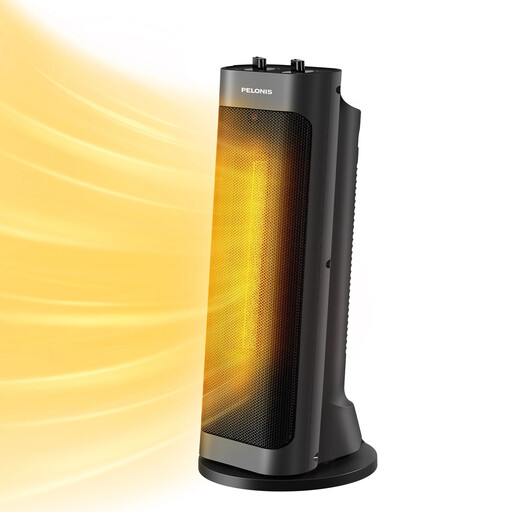
Why it suits this profile: A portable heater with four heat settings, a thermostat and 70° oscillation for an office, bedroom or study.
The power output is adjustable, so you do not have to heat continuously at 2000W. Tip-over and overheat protection are listed in the product description.
PTC ceramic heating, carry handle, thermostat and a quoted noise level of 50 dB.

Why it suits this profile: Designed for anyone who values precise temperature control, remote control and a low quoted noise level.
The product specifications state 25–42 dB, a thermostat range of 5–35°C and a 12-hour timer. Check the current settings before buying.
2000W PTC element, 70° oscillation, remote control and multiple safety features according to the product description.

Why it suits this profile: For anyone specifically looking for a bathroom heater with wall mounting, a timer and a towel rail.
Its IPX2 rating and stated suitability for bathrooms make it more appropriate for this use than a standard fan heater. Follow the installation and clearance instructions.
Two settings of 1400W and 2000W, programmable weekly timer and overheat protection according to the product information.
Use an electric heater directly from a suitable wall socket, and do not connect several high-powered appliances to the same extension lead. Maintain at least the clearance specified in the manual; for many models, this is around one metre from flammable materials. A standard heater is not suitable for a damp bathroom. Only choose a model that is explicitly designed for this purpose and states the appropriate IP rating.
A heater with tip-over protection switches off when the appliance tips over. Overheat protection can switch the appliance off if it reaches too high a temperature. These features reduce risks, but they do not replace supervision. Do not leave a heater covered or running unattended, and unplug it before moving or cleaning it.
We have put together a complete, up-to-date list of products that fully meet these strict selection criteria and the applicable European safety regulations.
This depends on the insulation, ceiling height and draughts. A 600W model may be sufficient for a small desk area. For a bedroom or office, models from 1000W to 1500W are often more practical. A larger or poorly insulated room may require more power, but always check the recommended room size in the product details.
Not necessarily. Maximum consumption is mainly determined by the wattage and how long the heater is used. A thermostat, timer or ECO mode can limit how long the heater is switched on. So do not compare the “energy-efficient” label alone; also consider the power rating, heat settings and how the thermostat operates.
Follow the instructions for the specific model. Ideally, use a timer and position the appliance away from bedding, curtains and other flammable materials. Switch the heater off and unplug it when you do not need it.
