
Vandaag of morgen in huis

Kwaliteit gegarandeerd

Welkomstaanbiedingen ontgrendelen: GRATIS bezorging | Tot 80% korting | Gratis 30 dagen JoyPlus-proefperiode
Download de app
An electric heater can quickly make a cold bedroom, home office or study more comfortable. However, it is not wise to look only at wattage or promises such as “instant heat”. A 2000W heater can provide powerful heating, but it also uses more electricity when running continuously at full power. And while a compact model is convenient, it is not automatically suitable for a 30 m² living room.
The main pitfalls:
A fan heater blows warm air directly into the room. This means you feel the heat quickly, which is useful when you arrive home to a cold room or need extra heat temporarily. However, the fan noise may be noticeable.
A ceramic heater, also known as a ceramic PTC heater, uses a ceramic heating element. PTC stands for Positive Temperature Coefficient. In the product descriptions of these models, the element is combined with a fan to distribute warm air. Always check the stated noise level: for example, one DREO model lists 25–42 dB, while the PELONIS 2000W PTC Ceramic Fan Heater lists 50 dB.
A convector heater warms the air flowing through the appliance and distributes it more gradually. This type is suitable for users who want to heat a room for longer periods and prefer minimal noise. According to the product information, the Mill SG2000LED has a stated power output of 2000W, an electronic thermostat and an additional fan for heat distribution. When choosing a convector heater, pay attention to its dimensions and weight: a model with a wider panel is less convenient to move than a portable heater.
Power is measured in watts. A 2000W heater can deliver heat quickly, but consumption is also higher at maximum power. A simple calculation:
The actual cost depends on your electricity tariff. Use the following formula: power in kW × hours of use × price per kWh. A heater with a thermostat can switch off the heating element once the set temperature has been reached. This may limit consumption compared with continuous heating, but it does not guarantee a particular percentage saving.
Also check the stated coverage area. The available product information mentions models for approximately 10 to 30 m². Treat this as a guideline. Ceiling height, draughts, insulation and the outdoor temperature all affect the result.
For a bedroom, office or workspace, a quiet heater is often more important than an especially powerful airflow. A fan will always produce some noise, so compare the stated decibel level whenever this information is available.
An oscillating heater turns from side to side horizontally. For example, the models in the range have an oscillation angle of 70° or 90°. This helps distribute warm air across a larger part of the room. For one person sitting at a desk, this feature is less essential than in a living room with several seating areas.
A heater with a timer is useful if you do not want to switch the appliance off manually. Some models offer a timer of up to 12 hours, while others run for up to 24 hours. A heater with a remote control is convenient when you are in bed or sitting on the sofa. Also check whether it has an adjustable thermostat, multiple heat settings or an ECO mode.
At a minimum, look for:

Why it suits this profile: Weighing 930 grams, this compact model is designed for a desk, bedroom or other small space where targeted supplementary heating may be enough.
The lower power output helps prevent you from choosing a 2000W model for a small workspace. The product specifications also list tip-over protection and dual overheat protection.
600W, 45° oscillation, PTC ceramic heating and a compact size of 18.8 × 14.2 × 18.8 cm.

Why it suits this profile: According to the product description, this model is designed for rooms measuring 15–25 m² and offers temperature control, a remote control, a timer and oscillation.
You get more information than just the wattage: the stated noise level is 25–42 dB and the thermostat ranges from 5–35°C. The manufacturer also lists several layers of safety protection.
2000W, 70° oscillation, 12-hour timer, remote control and temperature adjustment in 1°C increments.
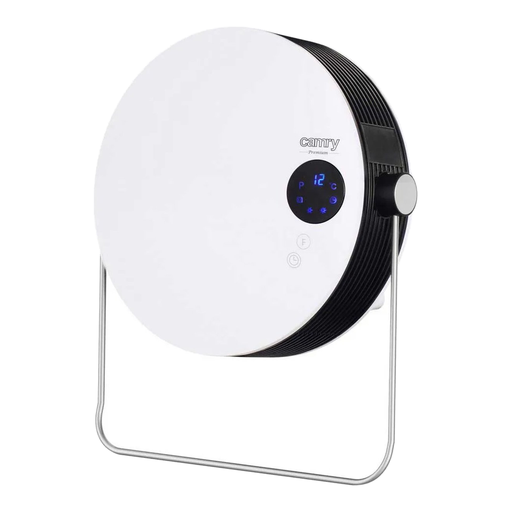
Why it suits this profile: For bathroom-focused use, this wall-mounted model has an IPX2 rating, towel rack and programmable weekly timer, according to the product information.
The IPX2 rating is clearly stated, so you do not have to guess whether a standard model is suitable for a damp room. Always check the installation instructions, however.
1400W and 2000W, thermostat from 10–49°C, overheat protection and up to six periods per day.
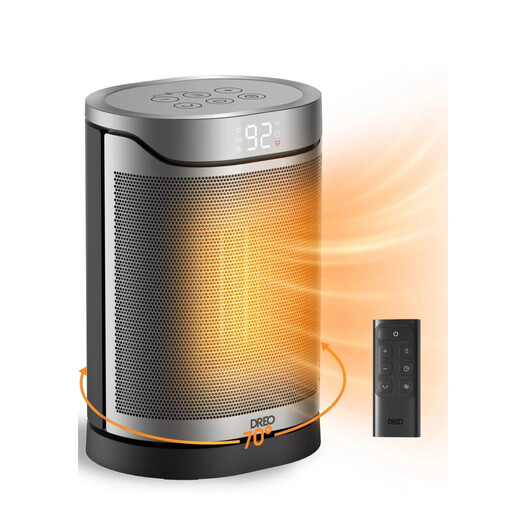
Why it suits this profile: The stated 25–42 dB noise level, remote control and temperature range of 5–35°C make it suitable for a home office, bedroom or study.
The product lists both the noise level and three power settings of 900W, 1300W and 1500W. This lets you tailor usage more effectively than with a simple on/off switch.
1500W PTC heating, 12-hour timer, remote control, tip-over protection and overheat protection.
We have compiled a complete, up-to-date list of products that fully meet these strict selection criteria and the applicable European safety regulations.
Place the heater on a hard, level and stable surface. Do not use a fan heater in the immediate vicinity of a bath, shower or swimming pool unless the product has been expressly designed for this purpose and the installation requirements are followed. A standard electric supplementary heater is not a bathroom heater.
Also bear the following points in mind:
For small areas, 600W may be sufficient. For bedrooms, home offices and rooms of approximately 10 to 20 m², models ranging from 1200W to 2000W are often available. Do not look only at the floor area; also consider insulation, draughts and ceiling height.
This depends on the energy price, the efficiency of your heating system and which room you are heating. An electric heater can be practical if you only want to heat one workspace or room temporarily. Calculate consumption using the power in kW, the duration of use and your price per kWh.
Only use a model whose manual permits this, and choose a timer or thermostat when available. Make sure there is sufficient clear space around it and place it on a stable surface. A timer and safety features reduce certain risks, but they are not a substitute for supervision and correct use.
