
Vandaag of morgen in huis

Kwaliteit gegarandeerd

Welkomstaanbiedingen ontgrendelen: GRATIS bezorging | Tot 80% korting | Gratis 30 dagen JoyPlus-proefperiode
Download de app
An electric heater can be useful for a cold home office, bedroom or student room. However, there are major differences between models. A low purchase price says little about noise levels, ease of use or safety. Terms such as “energy-efficient”, “heats up quickly” and “quiet” should always be considered alongside the technical specifications.
A 2,000-watt heater can bring a room up to temperature quickly, but at maximum power it also uses 2 kWh per hour. The actual cost depends on your energy tariff, the selected setting and how long the thermostat switches the heating element on.
An energy-efficient heater does not therefore automatically mean that the appliance uses little electricity. Pay particular attention to:
According to Bear’s own information, the DNQ-C20H5 uses 90° oscillation to distribute air over a wide area. PELONIS states that its model has 70° oscillation and a noise level of 50 dB. DREO gives a range of 25–42 dB for certain models. These figures are useful for comparing models, but the heat and noise you experience can also depend on the distance, floor, furniture arrangement and selected setting.
An oscating heater can distribute warm air over a larger area. For one person sitting at a desk, however, this feature is less important than a steady airflow and a compact design.
Tip-over protection and overheat protection are important features, but they do not make incorrect use risk-free. Place an electric heater on a stable, level surface. Keep curtains, bedding, paper and furniture at least 1 metre away from the air outlet, unless the manual specifies a different distance. Never cover the heater and do not use it in a damp area.
Also check that the plug, cable and casing are undamaged. A heater should be connected directly to a suitable wall socket; avoid using a multi-socket extension lead with several high-powered appliances.
Many compact models have a power output of 1,500 to 2,000 watts. This is mainly suitable for supplementary local heating or a small to medium-sized room. Do not look only at the stated coverage area; also consider insulation, ceiling height and draughts.
A PTC ceramic heater uses a ceramic heating element. Brands often associate this with rapid heating and stable warmth. According to PELONIS and DREO’s own information, their models produce warm air quickly; these speed claims come from the brands themselves and do not guarantee the same heating performance in every Dutch home.
A heater with a thermostat switches the heating element on or off around a set temperature. This is more practical than a heater that simply continues heating on a high or low setting.
Also look out for:
For a bedroom or home office, a quiet bedroom heater is often more important than an extra-high heat setting. Check the stated dB range and whether it applies to the lowest setting or to all settings. An electric fan heater will generally make some noise as it moves air; a convection heater may operate more quietly, but it often takes up more floor space.
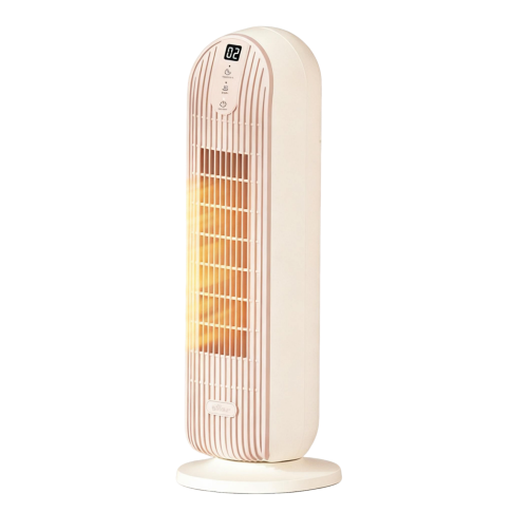
Why it suits this profile: The two power settings of 1,200 and 2,000 watts offer a simple way to adjust electricity use to suit the situation. The concealed handle makes it practical to move the heater between your workspace and living room.
The product description mentions 90° oscillation, a timer of up to 12 hours and several safety features. Check the manual before use and position the appliance away from flammable materials.
PTC ceramic element, two power settings, 90° oscillation, display and timer of up to 12 hours.

Why it suits this profile: This model combines an adjustable thermostat from 5–35 °C with a remote control, 70° oscillation and a timer of up to 12 hours. It is well suited to users who value precise control and low noise levels.
The stated noise level of 25–42 dB and the thermostat make the choice easier to assess than relying solely on a claim such as “quiet” or “energy-efficient”. The stated saving of up to 40% is based on DREO’s own information.
2,000 watts, temperature control from 5–35 °C, remote control, child lock, tip-over protection and overheat protection.
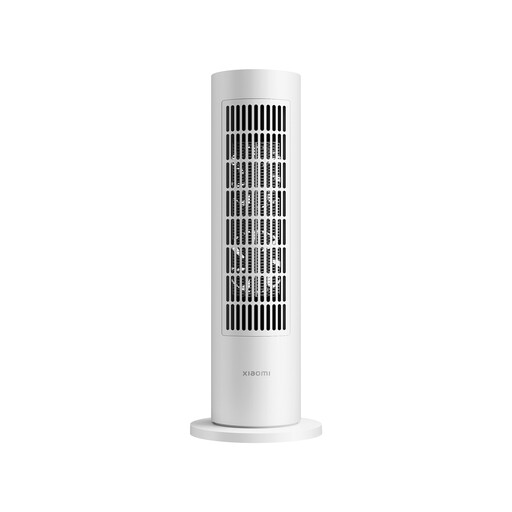
Why it suits this profile: The 50 cm tower design takes up relatively little floor space. Control via the Mi Home app, thermostat, timer and oscillation are useful for anyone who regularly wants to adjust the heater remotely.
Control is not exclusively local: according to the product information, the app is required for full functionality. Check the Wi-Fi and app requirements in advance. Tip-over and overheat protection are listed, but correct positioning remains essential.
2,000 watts, PTC ceramic heating, app and voice control, thermostat, timer and slim tower design.
Use this short checklist:
A compact heater is suitable for a desk, student room or small home office. For quiet, prolonged heating, a convection heater such as the Mill SG2000LED may be more appealing. The manufacturer states that it has an electronic thermostat, three settings and quiet operation. With this type too, it is important to check the stated room size, positioning distance and ventilation instructions.
We have put together a complete, up-to-date list of products that fully meet these strict selection criteria and the applicable European safety regulations.
A 2,000-watt model uses a maximum of 2 kWh per hour. At a tariff of, for example, €0,30 per kWh, this works out at €0,60 per hour on the highest setting. A thermostat or ECO mode can reduce average consumption because the heating element does not run continuously at full power.
It can be, provided the model is intended for this use and is positioned safely. Ideally, choose a quiet bedroom heater with a timer, thermostat, tip-over protection and overheat protection. Do not place the appliance on bedding or a soft surface, do not cover it and keep it away from curtains and other flammable materials. Always follow the manual and never leave a running heater unattended.
A ceramic heater uses a ceramic element, often a PTC element, to produce heat. An electric fan heater distributes that heat using a fan. Many modern models are both: they combine PTC ceramic heating with a fan. For this reason, focus mainly on the noise level, thermostat, power output and safety features rather than just the product name.
