
Vandaag of morgen in huis

Kwaliteit gegarandeerd

Welkomstaanbiedingen ontgrendelen: GRATIS bezorging | Tot 80% korting | Gratis 30 dagen JoyPlus-proefperiode
Download de app
An electric heater is useful when you only want to heat a home office, bedroom or cold corner. However, there is a wide range to choose from, from compact ceramic heaters to fan heaters with Wi-Fi. Marketing copy often mentions rapid heating, low energy consumption or quiet operation, but these claims only mean something when you check the specifications.
A 2000 W heater can warm a room faster than a 600 or 1000 W model, but it also uses more electricity when running continuously at full power. Maximum power is therefore not the same as efficiency.
Look for the number of heat settings, a thermostat and a timer. These can help prevent the heater from running for longer or at a higher power than necessary. An ECO mode may adjust the power automatically, but always check how the manufacturer describes this feature. According to information provided by PELONIS and DREO, among others, their ECO or automatic control adjusts operation based on the ambient temperature. This is a product claim, not a guarantee of a specific saving.
A recommended area, such as 15 to 25 m², depends on insulation, ceiling height, outdoor temperature and the desired temperature. A heater described as suitable for 20 m² may perform differently in a poorly insulated room than in a well-insulated home office.
Use the stated area as a guide. For a small space under your desk, a compact portable heater is often a more sensible choice than a heavy 2000 W model.
Overheat protection and tip-over protection are important features, but they do not make improper use safe. Never cover a heater, and keep it clear of curtains, bedding, paper and furniture. Do not use an electric heater in a damp room unless the model is specifically designed for this purpose and has the appropriate IP rating.
For a bedroom, student room or office, models of around 600 to 1500 W are often practical. An 1800 or 2000 W model can provide greater heating capacity for a larger living room. Also consider the type:
A heater with a thermostat can monitor the set temperature and switch the heating element on and off. This is useful when working from home or sleeping. A heater with a timer switches off after a set period. Check whether the timer can be set for, for example, 12 or 24 hours, and whether it is controlled using buttons, a remote control or an app.
A display is convenient, but not essential. For straightforward use, a mechanical thermostat may be sufficient. Smart Wi-Fi control is particularly useful if you want to set heating schedules remotely.
If you are looking for a quiet heater, check whether the noise level is actually stated in dB. “Quiet” without a measurement is difficult to compare. The product description for the DREO Solaris SH628 states 25–42 dB; other models only mention “quiet” or “silent operation”. Treat these descriptions as information from the brand, not as a standardised measurement.
Place the heater on a hard, level surface, keep the air inlet and outlet clear, and preferably plug the appliance directly into a suitable wall socket. Do not use the same connection for multiple high-powered appliances.

Why it suits this profile: Weighing 0.93 kg, this compact model is suitable for a desk, bedroom or small personal space where high heating power is not required.
Its low stated power helps prevent you from automatically choosing a 2000 W model for a small desk. The product description also lists tip-over and overheat protection.
PTC ceramic element, 45° oscillation, thermostat and automatic switch-off according to the product information.

Why it suits this profile: This model combines 2000 W of power with a remote control, oscillation, timer and adjustable thermostat for everyday use in a medium-sized room.
The product specifications state a thermostat range of 5–35°C and a 12-hour timer. The stated noise level of 25–42 dB makes comparison more meaningful than relying solely on the word “quiet”.
PTC heating, 70° oscillation, child lock, and tip-over and overheat protection according to the stated specifications.
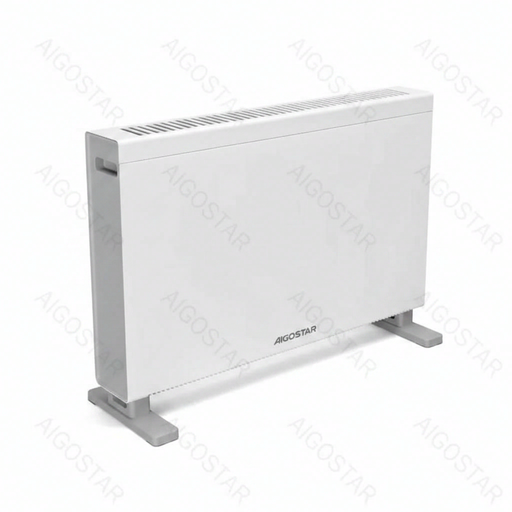
Why it suits this profile: According to the product description, this convector heater is designed for approximately 20 to 25 m² and has two power settings for longer-term use in living spaces or work areas.
The product information lists a 24-hour timer, 1250 W and 2000 W settings, and LED controls. This allows you to match the operating time and power more precisely to your needs.
Natural convection, remote control, carry handle, and tip-over and overheat protection according to the product specifications.

Why it suits this profile: Weighing 1.51 kg, this model has a handle and is suitable for rooms of up to 15 m² according to the product information.
The product description states a noise level of 24 dB(A), so you do not have to rely solely on a general claim such as “quiet heater”.
Two power settings of 600 and 1500 W, three temperature settings, and automatic switch-off if the heater tips over or overheats.
You can calculate consumption using this simple formula:
power in kW × number of hours used × electricity price per kWh = estimated cost
A 2000 W heater uses 2 kWh per hour when operating at full power. A 600 W model uses 0.6 kWh per hour in the same situation. In practice, a thermostat may switch the heating element off periodically, meaning actual consumption may be lower. The result depends on your set temperature, insulation and electricity tariff.
An energy-efficient heater is therefore not simply one with low wattage. Choose a suitable power rating, use the thermostat and set a timer when you do not need heat all day.
We have put together a complete, up-to-date list of products that fully meet these strict selection criteria and the applicable European safety regulations.
It can be, provided the model is suitable for the room and can be positioned with plenty of space around it. A timer, thermostat and clearly stated noise level are useful features. Do not place the heater against bedding, curtains or other flammable materials, and always follow the instructions.
Its lifespan depends on usage, maintenance, storage, and the quality of the plug and cable. Only clean the appliance when it is switched off and unplugged. Stop using a heater if it has a damaged cable, smells of burning, produces sparks or shows visible damage. The statutory guarantee in the EU is at least two years for many of the models mentioned; check the specific product page for the current terms and conditions.
For powerful models, plugging directly into a suitable wall socket is the safer option. An extension lead or power strip can become hot under a high load. Also, do not connect multiple high-powered appliances to the same outlet.
