
Vandaag of morgen in huis

Kwaliteit gegarandeerd

Welkomstaanbiedingen ontgrendelen: GRATIS bezorging | Tot 80% korting | Gratis 30 dagen JoyPlus-proefperiode
Download de app
An electric heater can quickly make a cold bedroom, home office or bathroom more comfortable. However, many households buy a model that is not suited to the room or intended use. A high wattage, for example, does not automatically mean that a heater warms more efficiently. Features such as a thermostat, timer or oscillation may also be less useful if the basic safety features or coverage are not right.
Product pages sometimes state a generous coverage area, but this depends on insulation, ceiling height, draughts and the desired temperature. A 2,000-watt fan heater can distribute warm air quickly, but it is not designed to heat a poorly insulated home in its entirety.
Always check the stated coverage area and use it as a guideline. For a 10 m² bedroom, a compact model is often more practical than a powerful heater that runs continuously at full power.
An electric heater converts electricity into heat. Its power rating largely determines its maximum consumption:
The actual cost depends on your energy tariff and how long you use the heater. A heater with a thermostat can switch off once the set temperature has been reached, but that does not mean the appliance always uses 40% less electricity. According to Dreo’s own information, adaptive control can deliver up to 40% energy savings on certain models; this is a brand claim, not a guaranteed saving for every home.
An electric heater should be placed in a clear space, on a flat surface and a safe distance from curtains, furniture, bedding and other flammable materials. Never cover the appliance, and preferably plug a powerful model directly into a suitable socket.
At a minimum, check for:
A ceramic heater or ceramic fan heater often uses a PTC heating element. PTC stands for Positive Temperature Coefficient: the electrical resistance changes as the element gets hotter. This type of element is widely used in portable models, but the power rating still determines the maximum heat output.
For quick supplementary electric heating, you can use the following as a general guide:
Always treat the stated coverage area as an indication, not a guarantee.
A fan heater distributes heat faster than a model without a fan, but it can be audible. A stated noise level of, for example, 25–42 dB may make a model suitable for a bedroom or home office, although perceived noise also depends on the fan setting.
A quiet electric heater is especially useful when you work, study or sleep. Also look for a mute function, a display that can be dimmed at night and the option to reduce the fan speed.
A heater with a thermostat regularly switches the heat on and off around a set temperature. A heater with a timer prevents the appliance from running for longer than necessary. A remote control is convenient when the heater is placed next to a desk or bed.
Oscillation helps distribute warm air across a wider area, but it does not alter the maximum power. So choose the right capacity first, then consider additional features such as an oscillating heater, remote control or eco mode.
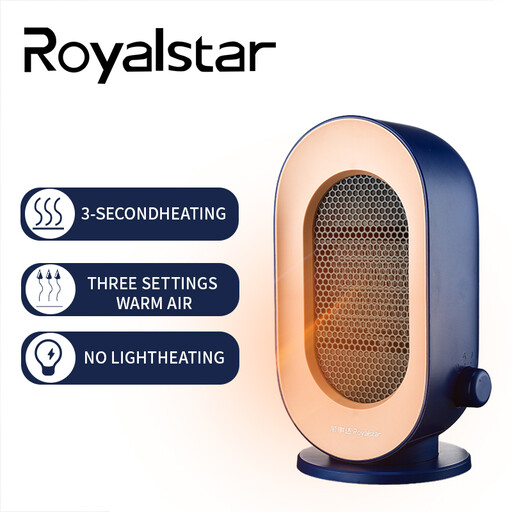
Why it suits this profile: The low power rating is suitable for localised use at a desk, in a student room or at a workstation. Its compact size makes it easy to move around.
The stated power rating is clearly 600W, so you are unlikely to mistake this model for a heater designed for a large room. Do not use it in a damp environment.
Three heat settings, 600W power and tip-over and overheat protection according to the product information.

Why it suits this profile: This model is designed for medium-sized to larger rooms of around 15–25 m², with thermostat control, a remote control and wide air distribution.
The product specifications state both the coverage area and the noise level of 25–42 dB. This allows you to compare capacity and noise comfort in advance.
2000W, 70° oscillation, 12-hour timer, temperature setting from 5–35°C and multiple safety features according to the product description.

Why it suits this profile: The wall mounting, towel rail and programmable weekly timer are well suited to everyday use in a bathroom.
The IPX2 rating and overheat protection are explicitly stated. Even so, position the appliance according to the manual and not directly next to splashing water.
1400W and 2000W settings, temperature control from 10–49°C, an LCD display and up to six programmable periods per day.
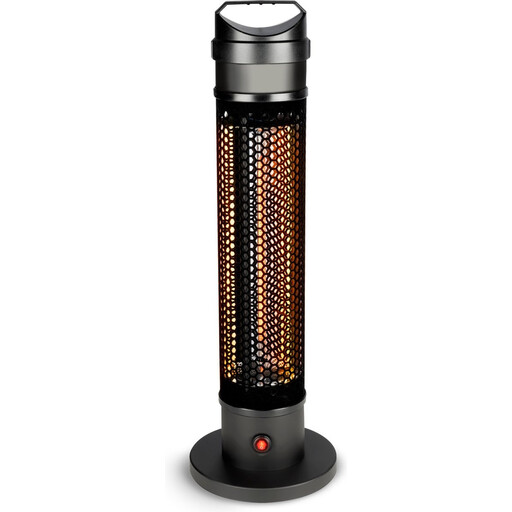
Why it suits this profile: Infrared heat is directed at people and a limited area, for example on a patio or in a study corner.
The stated capacity is limited: the product information gives 2–3 m² in the overview and 5 m² in the technical specifications. So do not expect it to heat an entire room.
800W power, 360° heat distribution, IP44 rating and tip-over protection according to the product details.
We have put together a complete, up-to-date list of products that fully meet these strict selection criteria and the applicable European safety regulations.
That depends on the room’s size, insulation and draughts. For a small workstation, 600 to 800 watts may be enough. For a room of around 10–20 m², 1,500 watts is often the more suitable choice. A 15–25 m² space may need a 2,000-watt model, but always check the manufacturer’s stated coverage area and the conditions in your home.
Not necessarily. An electric heater can be cost-effective when you only heat the room where you work or sit, rather than the whole home. Calculate consumption using: power in kW × usage time in hours × your electricity tariff. A thermostat and timer can limit unnecessarily long running times, but they do not automatically reduce the power used during every heating cycle.
Only use a heater in accordance with the manual. For a bedroom, tip-over protection, overheat protection, a timer and a low noise level are important considerations. In a bathroom, the model must be suitable for the environment and have an appropriate IP rating. Keep it away from water, do not cover the appliance and have it wall-mounted in accordance with the instructions.
