
Vandaag of morgen in huis

Kwaliteit gegarandeerd

Welkomstaanbiedingen ontgrendelen: GRATIS bezorging | Tot 80% korting | Gratis 30 dagen JoyPlus-proefperiode
Download de app
An electric heater can quickly provide extra warmth in a bedroom, home office, living room, garage or study. However, a high wattage isn’t automatically the right choice. A compact 600-watt heater can be handy on a desk, while a poorly positioned 2000-watt heater may use a lot of electricity without heating the room evenly.
As a Joybuy Product Recommendation Officer, I assess product information based on practical features. Before buying a ceramic heater, electric fan heater or ceramic fan heater, look out for these three common pitfalls.
A rating of 1500 or 2000 watts tells you how much electricity the heater uses at maximum power. It doesn’t, by itself, tell you how many square metres the heater is suitable for. Insulation, ceiling height, draughts and your preferred temperature all play a part.
A portable heater with a 2000-watt rating may be suitable for a larger living room or office, but at its highest setting it uses around 2 kWh per hour. A 600-watt model uses up to around 0.6 kWh per hour, but is mainly intended for a smaller area, such as a desk or beside a bed.
An ECO mode, thermostat or lower power setting can help reduce the time spent heating at full power. However, how long you use the heater has the biggest impact on energy consumption. According to DREO’s own product information, certain models can save up to 40% energy through smart power control and thermostat management. This is a brand claim based on specific conditions, not a guaranteed saving for every home.
So work it out for yourself: power in kW × hours of use = energy used in kWh. A heater with a thermostat that switches on and off may use less energy than one running continuously at full power, but the result depends on the room and the settings.
A heater with tip-over protection will usually switch off if the appliance is knocked over. A heater with overheat protection can cut the power if its internal temperature gets too high. These are useful features, but they don’t remove the need to position the heater carefully and keep an eye on it.
Place the heater on a hard, level surface, keep it at least about one metre away from curtains, bedding and furniture, and never cover it. Don’t use it in a damp room unless the instructions explicitly allow this. Also check that the plug and cable are in good condition, and that CE marking and Dutch safety information are provided.
Many models use a ceramic PTC element. PTC stands for Positive Temperature Coefficient. The element’s electrical resistance changes as it gets warmer. This can help the heater operate steadily, but it doesn’t automatically mean every model is equally quiet, efficient or durable.
An adjustable thermostat is more useful than a simple on/off switch. You can set your preferred temperature, and the heater can reduce how often it runs once the room has warmed up. A heater with a timer is handy for setting a specific heating period in advance. Check the timer range: some models offer 1 to 12 hours, while others go up to 24 hours.
Multiple settings, such as 750 and 1500 watts, give you more control over energy use. A heater with a remote control or app control is convenient from the sofa or bed, but check whether all the functions are available without the app.
A fan heater makes some noise as it moves air. For a bedroom or office, a stated noise level of around 24 to 42 dB may be worth considering. So compare claims such as “whisper-quiet” with the specific dB figure.
Oscillation helps distribute warm air over a wider area. An angle of 45°, 70° or 90° is particularly useful if there are several people in the room or you’re not sitting directly in front of the heater.
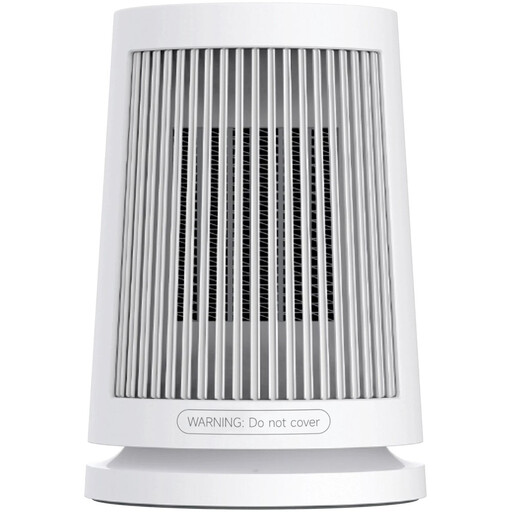
Why it suits this profile: This compact 0.93 kg model is designed for a desk, bedroom or other small space where targeted supplementary heating is all you need.
Its lower power rating means you don’t need to heat a small desk area unnecessarily with 1500 or 2000 watts. The product specifications also list a thermostat, tip-over protection and overheat protection.
600 watts, 45° oscillation, compact dimensions of 14,2 × 13,2 × 18,8 cm and automatic shut-off if knocked over.
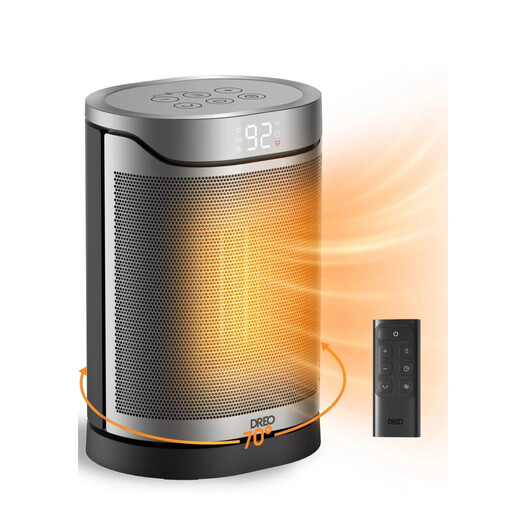
Why it suits this profile: For a bedroom, office or living room, useful features include the adjustable temperature, remote control and stated noise level of 25–42 dB.
The product specifications list three power settings, thermostat control and several safety features. According to DREO’s own information, the claimed energy saving of up to 40% depends on the conditions of use.
Temperature adjustable from 5–35 °C, 70° oscillation, 12-hour timer, remote control and CE+CB certification listed in the product information.
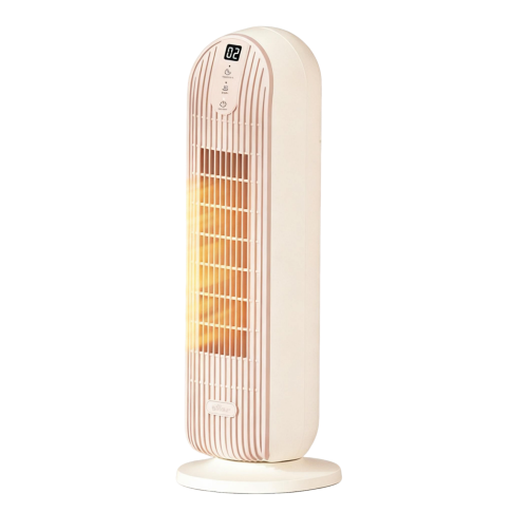
Why it suits this profile: The combination of 1200 and 2000 watts, 90° oscillation and a timer of up to 12 hours makes it suitable for larger rooms, offices or use by several people.
The two power settings let you avoid heating continuously at maximum power. The listing also mentions tip-over protection and several other safety features.
90° heat distribution, digital display, concealed handle, low noise level according to the product information and adjustable timer.
We’ve put together a complete, up-to-date list of products that meet these strict selection criteria and the applicable European safety requirements.
It depends on the power rating and how long you use it. A 1500-watt heater running continuously uses around 1.5 kWh per hour. Multiply this by your energy tariff to calculate the cost. A thermostat or ECO setting can reduce the number of hours the heater actively runs, but check how much energy it actually uses in your room.
It can be, provided the model is designed for indoor use and has a thermostat, timer, tip-over protection and overheat protection. Also check the stated noise level. Keep the heater clear of bedding and curtains, and always follow the instructions. Don’t leave it running unattended if the instructions advise against this.
Lifespan varies depending on the model, how often it’s used and how well it’s maintained. Keep the air inlets free of dust, only move the appliance once it has cooled down, and don’t use a damaged cable or plug. Keep your proof of purchase and warranty details. In many cases, consumers in the EU are entitled to a minimum two-year legal guarantee, while additional manufacturer warranty terms may vary by brand and product.
