
Vandaag of morgen in huis

Kwaliteit gegarandeerd

Welkomstaanbiedingen ontgrendelen: GRATIS bezorging | Tot 80% korting | Gratis 30 dagen JoyPlus-proefperiode
Download de app
An electric heater can quickly make a cold bedroom, home office or student room more comfortable. However, a high wattage is not automatically the right choice. A model that is too noisy, lacks a good thermostat or has to be placed awkwardly may disappoint after a few weeks.
It is therefore worth paying attention to the features that make a real difference in everyday use. Below, you’ll find out which pitfalls to avoid, how to assess power and functions, and which models suit different situations.
A ceramic fan heater can quickly blow out warm air, but that does not mean a large room will be heated evenly. Manufacturers use different conditions when stating the recommended room size. So, as well as the recommended number of square metres, look at power, airflow and oscillation.
A 2000-watt heater is generally intended for fast supplementary heating in small to medium-sized rooms. For a desk or bedside area, 600 to 1000 watts may be sufficient. More power also means a higher maximum energy consumption.
An electric heater converts electricity directly into heat. Maximum energy consumption is mainly determined by the wattage and how long the heater is used. A 2000-watt appliance running at full power for one hour uses a maximum of 2 kWh. At a lower power setting, or when a thermostat temporarily switches off the heating element, actual consumption will be lower.
Features such as ECO mode, a thermostat and a timer can help prevent unnecessary heating for too long. Savings claims, such as a specific percentage, come from the product description or are based on the brand’s own research. Treat them as an indication and focus mainly on comparing the settings you will actually use.
A heater with tip-over protection and overheat protection provides an additional automatic shut-off function. Correct positioning is still essential, however. Place the heater on a hard, level surface, never cover it, and keep textiles, curtains, paper and bedding at least approximately one metre away. If the manual requires it, preferably plug the heater directly into a wall socket.
For a small workspace or personal area, a compact 600-watt heater can be practical. For a bedroom, study or living room, 1500 to 2000 watts is more common. Bear in mind that the stated heating range varies from model to model. For example, the Mill SG2000LED is described as suitable for rooms of up to 20 m², while the PELONIS 2000 W PTC Ceramic Fan Heater is intended, according to the product information, for rooms of around 10 m².
Use the stated room sizes as a guide rather than a guarantee. High ceilings, average insulation, open doors and cold external walls all affect the result.
“Quiet electric heater” is not a fixed technical standard. Compare the stated noise level in decibels instead. The Philips CX2120/01 lists 24 dB(A), while several ceramic models are specified at around 34 to 50 dB. Measurement conditions may vary.
A heater with a thermostat can follow the set temperature more effectively than a simple on/off switch. A heater with a timer is useful when you want to set a switch-off time in advance. A heater with a remote control or app control is practical if the appliance is next to your bed or under a desk.
Also check for:
A CE marking indicates that the manufacturer declares the product complies with relevant EU regulations. It is not a general quality ranking. Only use a bathroom heater when the product information explicitly permits it. For example, the Camry CR 7747 lists IPX2 and is designed for wall mounting in the bathroom. Positioning and electrical connection must still be carried out according to the manual.
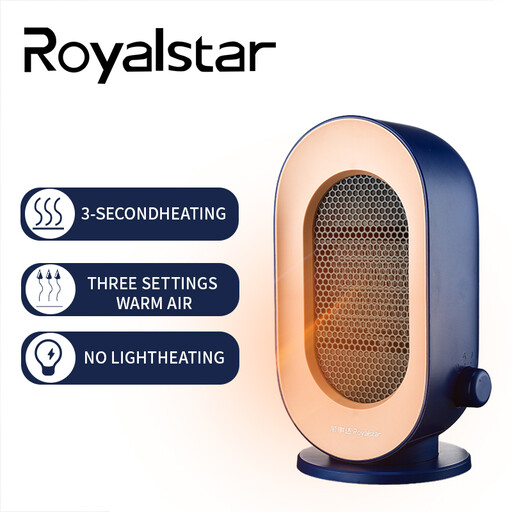
Why it suits this profile: This compact portable heater is designed for a desk, small room or personal workspace where lower power is preferred.
The lower power prevents you from using a 2000W model straight away for a small area. The product information lists three heat settings, along with tip-over and overheat protection.
600W power, three settings and a compact design that is easy to move around.

Why it suits this profile: This model is a good fit for anyone who values low noise, portability and clear safety features in a bedroom or home office.
The stated 24 dB(A) makes the noise level easy to verify. Philips also lists two power settings of 600W and 1500W, rather than just one maximum power level.
1500W maximum power, a product weight of 1.51 kg, and automatic shut-off in the event of tipping or overheating.

Why it suits this profile: The wall mounting, towel rail and programmable weekly timer make this model specifically suited to a bathroom where the product information confirms it can be used.
Rather than using an ordinary portable heater in a damp area, this model lists IPX2, overheat protection and a wall-mounting solution.
Two settings of 1400W and 2000W, a temperature setting from 10 to 49°C, and up to six programmable periods per day.

Why it suits this profile: According to the product specifications, this model combines high power with a remote control, timer, oscillation and a stated noise level of 25 to 42 dB.
The adjustable thermostat from 5 to 35°C and timer of up to 12 hours provide more control than simply switching the heater on and off manually. The safety features include tip-over and overheat protection.
2000W power, 70° oscillation, remote control and temperature adjustment by degree, according to the product information.
We have put together a complete, up-to-date list of products that fully meet these strict selection criteria and the applicable European safety regulations.
Do not place an electric heater directly below a socket unless the manual permits this. Keep the air inlet and outlet clear, and do not use the appliance next to a bath, shower or swimming pool. A compact heater intended for bedroom use should be placed on a stable, hard surface, never on bedding or a soft carpet.
Do not leave children or pets unsupervised near a switched-on heater. The casing and grille can become hot. Switch off the appliance and unplug it before moving or cleaning it.
This depends on the wattage and your electricity tariff. A 2000-watt heater running at full power uses a maximum of 2 kWh per hour. A 600-watt model uses a maximum of 0.6 kWh under the same conditions. Actual consumption may be lower when using a thermostat, a lower setting or ECO mode.
Not automatically. The ceramic PTC element can provide fast heat and several control settings, but energy consumption is mainly determined by the selected power level and how long the heater is used. Compare wattage, thermostat, ECO mode and timer rather than relying solely on the word “ceramic”.
Its lifespan depends on use, storage, maintenance and product quality. Keep the ventilation openings free of dust in accordance with the manual, avoid moisture, and do not use the appliance if the cable or casing is damaged. Keep your proof of purchase and warranty details; in the Netherlands, statutory warranty also applies depending on the circumstances of the product and purchase.
