
Vandaag of morgen in huis

Kwaliteit gegarandeerd

Welkomstaanbiedingen ontgrendelen: GRATIS bezorging | Tot 80% korting | Gratis 30 dagen JoyPlus-proefperiode
Download de app
An electric heater may seem simple to choose: plug it in, select the power setting and you’re done. Yet many households buy a model that is not well suited to the room or their everyday needs. A small fan heater, for example, can provide heat quickly but may be less suitable for prolonged use in a living room. A powerful model, meanwhile, may use unnecessarily large amounts of electricity in a compact home office.
Joybuy Product Recommendation Officer filters the most important product specifications and turns them into practical choices. This helps you see what to look for when choosing supplementary electric heating, without relying solely on marketing claims.
A higher wattage does not automatically mean that a room will heat up faster or more evenly. Insulation, ceiling height, draughts and the layout of the room also play a part. A 2,000 or 2,200-watt heater may be suitable for a larger room, while 1,200 watts may be enough for a well-insulated bedroom or home office.
Always check the stated maximum room size. These figures are guidelines from the product description, not a guarantee for every home.
A fan heater actively distributes warm air, so it can often heat an area quickly. The trade-off is that the fan makes a noise. A convector heater generally works without a fan and is better suited to prolonged use while sleeping, studying or working from home.
Pay attention to how a brand describes noise output. If the product specifications do not include a measured figure, you cannot compare the noise level reliably.
Wi-Fi, an app and a timer are useful, but they do not replace stable positioning and correct use. First check whether the heater has features such as overheating protection and, for portable models, a tip-over safety switch. Never cover a heater, and keep curtains, bedding, clothing and paper at a safe distance.
Where possible, plug an electric heater directly into a suitable socket. Always follow the instructions and check the cable, plug and casing before use.
Power is measured in watts. The range includes models rated at 1,200, 1,400, 1,800, 2,000 and 2,200 watts, among others. A practical guide:
An energy-efficient electric heater is not simply a matter of choosing the lowest wattage. A heater with a thermostat can monitor the set temperature and switch the heating element on and off periodically. The actual cost depends on the power rating, usage time, set temperature and your electricity tariff.
A ceramic heater uses a ceramic, often PTC-based, heating element. This type is common in compact fan heaters and tower heaters. Warm air is usually distributed by a fan.
A convector heater warms the air without necessarily using a fan. This suits anyone who wants minimal noise while working or sleeping. A tower heater takes up relatively little floor space thanks to its vertical design, but you should still check its stability and dimensions.
A thermostat means you do not have to keep adjusting the heater manually. A timer set for, for example, 1 to 12 hours can be useful when you want to use a portable heater temporarily. With a smart Wi-Fi heater, you get additional control through an app, but check beforehand whether you need an account, Wi-Fi connection or specific app.
Also look at the number of heat settings. Two or three settings give you more control than one fixed setting, while an electronic display can show the temperature clearly.
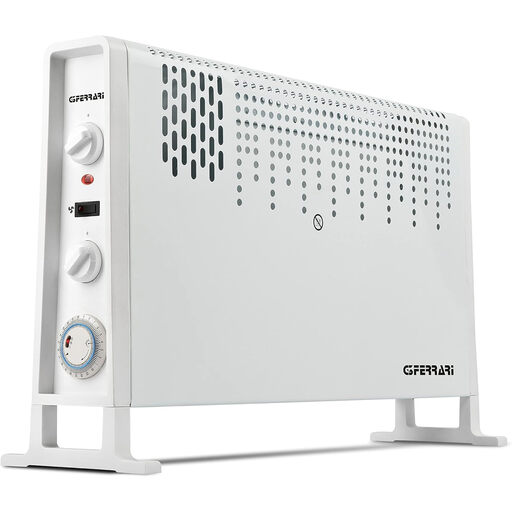
Why it suits this profile: According to the product listing, this compact fan heater has an adjustable thermostat and overheating protection. This makes it straightforward to use every day in a smaller room.
The thermostat gives you more control than a simple on/off switch. Before buying, check the exact power rating on the packaging or product page.
Adjustable thermostat, compact design and overheating protection according to the product information.
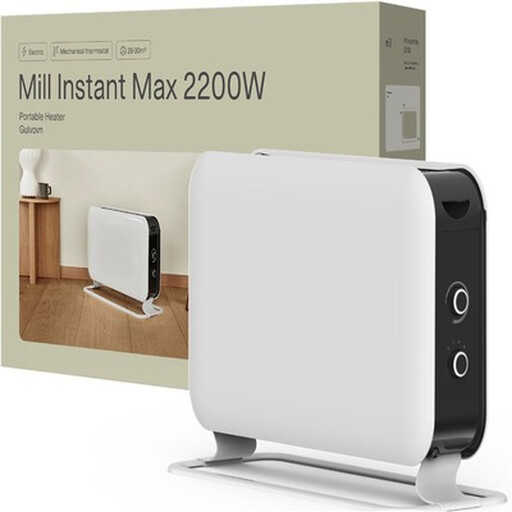
Why it suits this profile: According to the product specifications, this convector heater is suitable for rooms of up to 30 m² and operates without stated fan noise. That makes it suitable for prolonged heating in a living room or office.
This is not a small heater for occasional use: it has a clearly stated power rating and room-size indication. It must still be positioned as a free-standing unit.
2,200 watts, three power settings, mechanical thermostat and tip-over switch according to the product information.
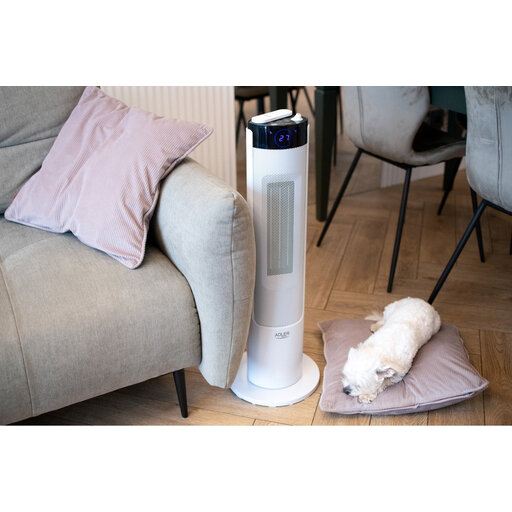
Why it suits this profile: According to the product description, this tower heater combines 1,400 and 2,200 watts, a thermostat, timer and 80° horizontal oscillation. Its column design is practical when floor space is limited.
The functions are clearly specified: a timer from 1 to 12 hours, a temperature setting from 10 to 35 °C, and automatic shut-off if the heater tips over.
Ceramic element, LCD display, remote control, timer, and tip-over and overheating protection according to the product listing.
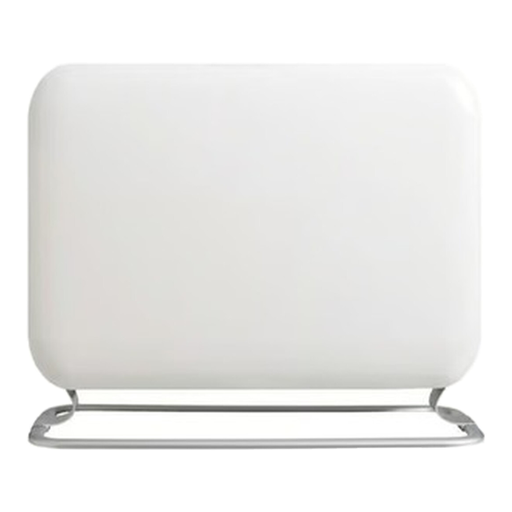
Why it suits this profile: According to the product specifications, this convector heater is intended for rooms of up to 18 m² and can be controlled via an app. That suits home workers who want to use fixed schedules or control the heater remotely.
The lower power rating is suited to a smaller room. Check the Wi-Fi and app requirements beforehand, though; without a connection, you may not be able to use all the features.
1,200 watts, suitable for up to 18 m², Wi-Fi control and overheating protection according to the product information.
We have put together a complete, up-to-date list of products that fully meet these strict selection criteria and the applicable European safety regulations.
Calculate the cost using: power in kilowatts × usage time in hours × your electricity tariff. A 2,000-watt heater uses 2 kilowatts per hour when operating at full power. A thermostat can reduce actual consumption when the heating element does not need to run continuously, but the result depends on the room and the settings.
For a bedroom, size, noise level, thermostat and timer are important. A quiet convector heater is suitable for prolonged use. A ceramic tower heater may be worth considering if you are looking for rapid heat distribution and a compact design. Also, always check the tip-over and overheating protection.
Its lifespan depends on how often it is used, dust, storage and maintenance. There is no fixed service life that applies to every model. Follow the instructions, keep the air inlet clean and do not use the appliance if any parts are damaged. Also check the warranty and returns information before placing your order.
