
Vandaag of morgen in huis

Kwaliteit gegarandeerd

Welkomstaanbiedingen ontgrendelen: GRATIS bezorging | Tot 80% korting | Gratis 30 dagen JoyPlus-proefperiode
Download de app
An electric heater seems simple enough: plug it in and switch on the heat. Yet many people in the Netherlands buy a model that disappoints after just a few weeks. The problem usually isn’t how it looks, but a poor match between its power, the room and its features.
If you want to heat a bedroom, living room, home office or bathroom, it’s worth avoiding these three common pitfalls first.
More power doesn’t automatically mean a heater will work better in every room. A 2000-watt model can produce heat quickly, but it also uses more electricity when running at full power. For a desk, small bedroom or personal workspace, 600 to 1500 watts may be enough. For a larger or less well-insulated room, 1800 to 2000 watts may be more practical.
So always check the stated heating coverage in square metres. Treat this as a guide: ceiling height, draughts, insulation and the outdoor temperature all affect the results.
An electric heater converts electricity directly into heat. Its energy use is mainly determined by its power and how long it runs. A 1500-watt appliance running at full power for one hour uses 1.5 kWh in theory. Calculate the actual cost using:
energy use in kWh × your electricity tariff per kWh
A thermostat, ECO mode or timer can stop the appliance from heating for longer than necessary. According to information from some brands, including DREO and PELONIS, their control technology can reduce energy use. Treat any percentages as brand claims: actual consumption depends on the settings and the room.
A heater with overheat protection and tip-over protection offers an extra layer of safety, but it doesn’t make unsafe use safe. Never cover a heater, keep curtains, bedding and paper at least one metre away, and don’t use the appliance near water unless the model is specifically designed for that purpose.
A CE mark indicates that the manufacturer declares the product meets relevant European requirements. It doesn’t guarantee that an appliance is suitable for every room or situation.
For quick heat in a small room, an electric fan heater or ceramic heater is often a practical choice. These models blow warm air into the room. A convector heater generally warms the room more gradually and distributes heat without a constant flow of air.
As a guide:
Use the manufacturer’s stated coverage as a starting point, not a firm promise.
Noise matters when choosing a heater for a bedroom or home office. A fan can spread heat more quickly, but it’s noisier than a quiet convector. DREO’s product information gives noise levels of 25 to 42 dB, while Philips lists 24 dB(A) for the CX2120/01. These are stated product specifications, but the noise you hear may vary depending on the setting.
Product descriptions often associate a PTC ceramic element with rapid heating and a lower surface temperature. Also check whether the model has a thermostat, automatic shut-off and overheat protection.
A heater with a thermostat switches the heat on or off around a set temperature. A heater with a timer is useful when you want to set how long the appliance runs in advance. A heater with a remote control means you don’t have to keep getting up to operate it, for example when you’re in bed.
Also consider these practical points:
A standard portable heater isn’t automatically suitable for a bathroom. For example, the Camry CR 7747 has an IPX2 rating and is designed for wall mounting in the bathroom. Other models in this guide state that they must not be used in damp rooms.

Why it suits this type of user: Its low power and compact size make it a good fit for a desk, small workspace or personal seating area. The stated dimensions are 18,8 × 14,2 × 18,8 cm and it weighs 0,93 kg.
You don’t pay for a large heating coverage area you may not need. Tip-over and overheat protection are clearly listed.
600 watts, PTC ceramic, 45° oscillation, thermostat and automatic shut-off.

Why it suits this type of user: This compact model is designed for people who value quiet operation, simple controls and multiple layers of protection for everyday use.
The product information clearly lists both 600 and 1500 watts, so you don’t always have to heat at full power.
24 dB(A) according to the product specifications, temperature settings from 20 to 30 °C, tip-over protection and overheat protection.
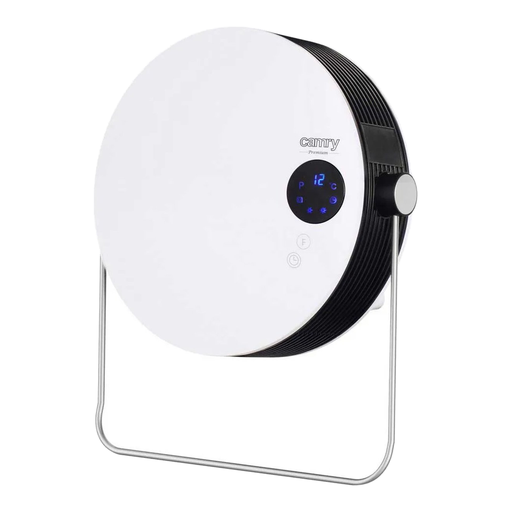
Why it suits this type of user: This wall-mounted model is designed specifically for bathroom use and combines heating with a built-in towel rail.
Rather than putting a standard portable heater in a damp room, choose a model whose product information lists an IPX2 rating and suitability for bathroom use.
1400/2000 watts, adjustable thermostat from 10 to 49 °C, weekly timer and open-window detection, according to the product description.

Why it suits this type of user: With a timer, remote control, thermostat and stated noise level, this model is a practical choice for a bedroom or home office.
There’s no need to leave the appliance running at full power unnecessarily: it has 900, 1300 and 1500-watt settings, plus a thermostat range of 5 to 35 °C.
Stated noise level of 25–42 dB, 12-hour timer, remote control, and tip-over and overheat protection.
We’ve put together a complete, up-to-date list of products that meet these strict selection criteria and comply with the applicable European safety regulations.
For a small to medium-sized bedroom, 1200 to 1500 watts is often a good choice. Also consider insulation, draughts and the stated heating coverage. A thermostat stops the heater from continuing to run once it reaches the set temperature.
That depends on its power, how long you use it and your electricity tariff. A 2000-watt model uses 2 kWh in theory when running at full power for one hour. Use a lower setting, thermostat or timer when you don’t need full power.
First, check the manual and only use a model that’s positioned securely and has the relevant safety features. A timer and automatic shut-off can help limit the risk of prolonged use, but never cover the heater and keep bedding away from it. If in doubt, switch it off and unplug it to be safe.
