
Vandaag of morgen in huis

Kwaliteit gegarandeerd

Welkomstaanbiedingen ontgrendelen: GRATIS bezorging | Tot 80% korting | Gratis 30 dagen JoyPlus-proefperiode
Download de app
An electric heater is useful when you want to heat a single room quickly, such as a bedroom, home office or student room. However, not every model is suitable for every situation. A higher wattage does not automatically mean that a heater will perform better, and a term such as “energy efficient” means little without information about how the appliance is used.
As Joybuy Product Recommendation Officer, I filter product information based on practical considerations. Below, you’ll find what to look for when choosing supplementary electric heating, which specifications matter and which type is right for your room.
A 2000-watt heater can provide powerful heating, but it can also use up to 2 kWh per hour while running. Actual consumption depends on the selected setting, the thermostat and how well the room is insulated. For a small workspace, 600 or 1000 watts may be sufficient, while a larger living room may require more power or a different heating solution.
Also look out for conflicting product information. For example, a product may list 1500 watts in the title while mentioning different settings in the description. Always check the technical specifications and manual on the product page.
Brands sometimes state a recommended room size, but the result also depends on factors such as ceiling height, insulation, draughts and the outside temperature. A 20 m² room with single glazing puts greater demands on a heater than a well-insulated room of the same size.
Use the stated coverage area as a guide, not a promise. For targeted electric room heating, it is sensible to place the heater near your workspace or seating area without blocking any air vents.
A remote control, timer or oscillation function makes a heater easier to operate. However, these features do not prevent an appliance from becoming hot or being positioned incorrectly. Check separately whether a model has overheating protection, tip-over protection and a stable base.
A CE mark indicates that the manufacturer declares compliance with relevant European requirements. It is not a substitute for safe use or reading the manual.
A fan heater actively blows warm air into the room. This makes the heat feel immediate, but the fan noise may be distracting in a bedroom or when you need to concentrate at work. This type is particularly practical for short-term supplementary heating.
A ceramic heater generally uses a PTC heating element. Some product descriptions state that PTC technology provides a lower surface temperature or produces less burnt dust. According to Mill’s product information, this applies to the CUS1800MEC; treat it as a product specification rather than a general guarantee for every ceramic model.
A convector heater warms air, which then rises and circulates around the room. This often provides more even heating, although it may feel different from direct warm air. According to the product description, the Mill SG2000LED has a power output of 2000 watts, three settings, an electronic thermostat and an additional fan for distributing heat.
A small portable heater of, for example, 600 watts is designed for a limited area, such as a desk. It is not intended to bring an entire living room up to temperature. Pay particular attention to the surface it stands on: only use a heater in a stable, freestanding position and in accordance with the specified clearances.
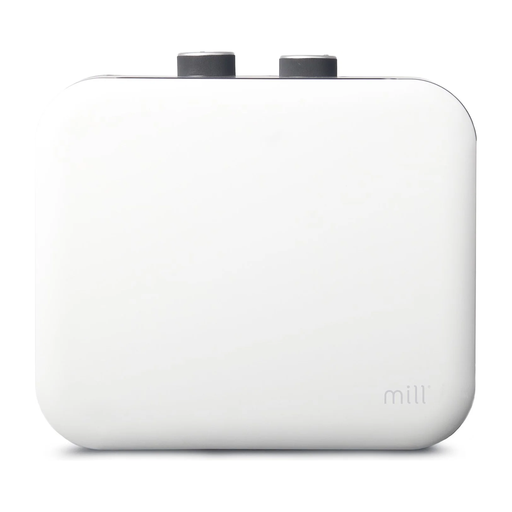
Why it suits this profile: According to the product information, this compact model is intended for rooms of up to 30 m² and is easy to move between, for example, the bedroom and office.
The two settings of 1200 and 1800 watts allow you to adjust the power to suit the situation instead of always running the heater at its highest setting.
PTC heating, mechanical thermostat, tip-over protection and overheating protection.

Why it suits this profile: It suits anyone who values a compact design, a low stated noise level and multiple operating settings for the bedroom or office.
The product information states 24 dB(A), tip-over protection and overheating protection. This makes comfort and safety independently verifiable.
600 and 1500 watts, adjustable temperature from 20 to 30 °C, carry handle and automatic shut-off.

Why it suits this profile: According to the product description, this model is designed for rooms of 15 to 25 m² and offers extensive controls for regular use.
Rather than highlighting only a high wattage, the product information also gives the thermostat range, noise level, timer and safety features.
2000 watts, 70° oscillation, temperature setting from 5–35 °C, 12-hour timer and a stated noise level of 25–42 dB.

Why it suits this profile: The combination of a compact design, remote control, timer and stated noise level of 25–42 dB is well suited to a workspace or bedroom.
According to DREO’s own information, the claim of up to 40% lower energy consumption comes from the brand. Treat this as a brand claim and focus on comparing the settings and actual usage.
1500 watts, adjustable thermostat from 5–35 °C, 12-hour timer and multiple safety layers according to the product description.
We’ve put together a complete, up-to-date list of products that fully meet these strict selection criteria and the applicable European safety regulations.
Place an electric heater on a flat, stable surface and keep the air inlet and outlet clear. Never cover the appliance with clothing, towels or bedding. Keep flammable materials at a safe distance and do not use a heater in a bathroom unless the model is explicitly designed for that purpose.
Switch off the appliance and unplug it before cleaning, moving or storing it. Allow hot components to cool down completely first. A timer is a useful aid, but do not leave a heater running unattended for extended periods.
A 2000-watt appliance uses a maximum of approximately 2 kWh per hour at full power. Multiply this by your electricity tariff. A thermostat or lower setting can reduce average consumption, but the exact cost depends on insulation, the temperature setting and how long the heater is used.
Not necessarily. A ceramic fan heater usually uses a fan and may therefore produce noise. A convector heater without an active fan can operate more quietly. Check the stated noise level; if none is provided, you cannot assess how quiet it is objectively.
Its lifespan depends on how frequently it is used, dust, storage and maintenance. Choose a model with clear instructions, accessible warranty information and protection against overheating and tipping over. Stop using the heater immediately if the cable is damaged or you notice a burning smell or abnormal noise.
