
Vandaag of morgen in huis

Kwaliteit gegarandeerd

Welkomstaanbiedingen ontgrendelen: GRATIS bezorging | Tot 80% korting | Gratis 30 dagen JoyPlus-proefperiode
Download de app
An electric heater can be useful when you only want to warm up a bedroom, home office or study. That way, you don’t have to heat the whole house. However, not every ceramic heater is suitable for every room. A higher wattage, for example, doesn’t automatically mean a model is more efficient or quieter.
Many disappointing purchases come down to three common pitfalls:
Power is measured in watts. Many compact models have settings from 600 to 1,500 watts, while larger ceramic fan heaters go up to 2,000 or 2,200 watts.
A higher wattage can heat a room more quickly, but it also increases maximum energy consumption. So, check:
A portable heater rated at 600 to 1,000 watts may be enough for a small desk or personal workspace. For a living room or larger study, models rated at 1,500 to 2,000 watts are a more sensible choice, provided the manufacturer specifies that heating range.
A PTC heater uses a ceramic heating element. Most models have a fan to distribute warm air. So, check not only the material but also the airflow and stated noise level.
According to product specifications, a quiet electric heater for the bedroom, for example, may operate at around 24 to 42 dB. Other models are rated at around 45 to 50 dB. Bear in mind that noise levels can vary between settings. A ‘quiet mode’ may produce less heat than the highest setting.
Oscillation helps spread the warmth more widely around the room. A 45°, 70°, 80° or 90° range can be useful when several people are in the same room. Oscillation is less important if you want focused warmth under a desk.
A heater with a thermostat switches the heating element off or turns it down when the set temperature is reached. That’s more convenient than running the heater constantly at full power. Some models offer a range of 5 to 35 °C, while others have fixed settings.
A heater with a timer can switch off automatically after 1 to 12 or 24 hours. Check whether the timer can set a start time, a switch-off time or just a countdown.
Important safety features include:
A CE mark indicates that, according to the manufacturer, the product meets the relevant European requirements. It is not an independent quality rating. Plug an electric heater directly into a suitable socket and always follow the instructions.
The recommendations below are based on verifiable product specifications and different usage scenarios. Brand warnings and energy-saving claims are presented as information from the product descriptions, not as guaranteed results.

Why it suits this profile: A compact option for a bedroom, student room or home office where straightforward controls and a light weight matter.
The product specifications list two power settings, 600 and 1,500 W, so you don’t have to heat the room at full power all the time. The stated noise level is 24 dB(A).
Weighs 1.51 kg and has a built-in handle, tip-over protection and overheat protection. The product description states that it can heat areas of up to 15 m².

Why it suits this profile: Designed for anyone looking for plenty of settings, a wider heating range and quiet operation in the living room, office or bedroom.
The thermostat can be set from 5 to 35 °C, and the model has 70° oscillation. This lets you adjust the heat more precisely than with a simple on/off switch.
According to the product description, the model operates at 25–42 dB and is suitable for 15–25 m². It has a 12-hour timer, remote control and multiple safety features.
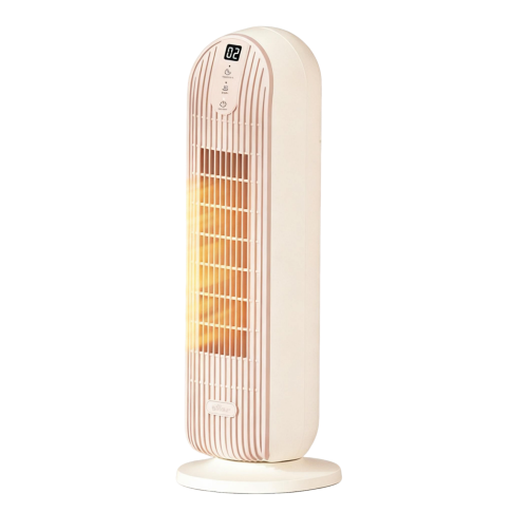
Why it suits this profile: A good choice if you want to heat a larger room or shared office, and wide air distribution is important to you.
The 1,200 and 2,000 W settings mean you’re not limited to choosing between off and full power. The 90° oscillation helps distribute the heat more widely.
A timer of up to 12 hours, concealed handle and digital display. The product description also states that it runs quietly and has multiple safety features.
We’ve put together a complete, up-to-date list of products that meet these strict selection criteria and the applicable European safety requirements.
Calculate energy consumption using:
power in kW × running time in hours × your electricity tariff
A 1,500-watt heater uses a maximum of 1.5 kWh per hour when its heating element runs continuously at full power. A thermostat, lower setting or ECO mode can reduce average consumption, but the result depends on the room and the settings. So, don’t just check the ‘energy-saving’ claim: also look at the maximum power and the available settings.
It can be, provided the model is designed for indoor use and has tip-over and overheat protection. Ideally, choose a model with a timer and a low noise level. Keep the heater well away from bedding and curtains, and never cover it while it’s running.
Its lifespan depends on how often it’s used, dust, ventilation and maintenance. Let the appliance cool down before cleaning it, keep the air inlet clear and don’t use it if the cable or casing is damaged. Without a manufacturer’s guarantee, it’s not possible to reliably specify how long it will last.
A thermostat can help prevent unnecessary continuous heating by switching the element off or turning it down when the set temperature is reached. However, that doesn’t automatically make the appliance economical in every situation. Overall energy consumption is mainly determined by the power, running time, insulation and temperature setting.
