
Vandaag of morgen in huis

Kwaliteit gegarandeerd

Welkomstaanbiedingen ontgrendelen: GRATIS bezorging | Tot 80% korting | Gratis 30 dagen JoyPlus-proefperiode
Download de app
An electric heater can quickly provide extra warmth in a bedroom, home office, living room or office. However, the differences between models can be significant. A compact ceramic fan heater heats up quickly, while a convector heater or oil-filled radiator often operates more evenly and quietly.
Marketing claims do not always make the choice easier. Terms such as “instant heating”, “energy efficient” and “suitable for large rooms” only become meaningful when you also consider the power rating, stated room size and safety features.
A heater that, according to its product description, blows warm air within a few seconds can make the room feel comfortable quickly. That does not automatically mean the appliance uses little electricity. A 2000-watt model running at full power uses 2 kWh per hour. A lower power setting or thermostat can help limit consumption, but the result depends on insulation, outdoor temperature, the temperature setting and how long you use it.
So look out for:
According to DREO’s own information, an energy-saving mode can reduce consumption by up to 40%. This is a brand claim; actual savings depend on the room and how the heater is used.
A product may be described as suitable for, for example, 10, 15 or 25 m². Ceiling height, draughts, insulation and the desired temperature all have a significant impact on the result. A small bedroom heater will perform differently in a well-insulated room than in a draughty loft space.
Use the stated room size as a guide, not a guarantee. For a small personal area, 600 to 1500 watts is often more practical. A larger living room may require 1800 to 2000 watts, but also check whether the heat will circulate effectively around the room.
A heater with tip-over protection switches off, according to the product description, when the appliance falls over. A heater with overheat protection can cut the power if the temperature becomes too high. These features reduce a risk, but they do not make unsafe use safe.
Always position an electric heater:
Do not use a standard indoor model in a bathroom. A model with an IP rating is not automatically suitable for every wet environment. Check the manual and positioning instructions.
The power rating determines how much electrical energy the heater can convert into heat at maximum capacity. Important ratings in this category include 600W, 1000W, 1500W, 1800W and 2000W. A higher wattage mainly means a higher maximum heat output, not necessarily lower energy consumption.
For a home office, student room or bedroom, an adjustable thermostat and several heat settings are more useful than simply having a high maximum power rating. A portable heater with a carry handle is also useful when you need to move one appliance between rooms.
A ceramic heater often uses a PTC element and a fan to distribute warm air. This generally provides noticeable heat quickly. However, fans make noise and can move dust around.
A convector heater warms the air through natural convection. Models with a built-in fan distribute heat more quickly, while a fanless model may operate more quietly. An oil-filled radiator generally heats up more gradually and continues to give off heat for some time after being switched off. This makes it suitable for longer periods of use, although this type of appliance is often heavier and less convenient to move.
For quiet models, check the stated decibel rating. The Philips CX2120/01, for example, lists 24 dB(A), while the DREO Atom 416 states a range of 25 to 42 dB. However, check whether the figure applies to the selected setting.
A heater with a timer prevents the appliance from running for longer than necessary. A heater with a remote control is convenient beside the bed or from the sofa. A display, child lock, oscillation and temperature control can make the heater easier to use, but add little value if you only use it briefly under a desk.
Also check the difference between a mechanical and electronic thermostat. A mechanical dial is simple and often easy to understand. An electronic thermostat usually offers more precise adjustment and additional programmes.

Why it suits this profile: Compact, lightweight and easy to use in a bedroom, student room or home office.
The description lists 600W and 1500W settings, so you do not have to heat exclusively at the maximum power.
1500W maximum power, three temperature settings, 24 dB(A) according to the product information, plus tip-over and overheat protection.

Why it suits this profile: For anyone who values precise temperature control, oscillation and remote operation.
The product information states a range of 15–25 m² and a thermostat range of 5–35°C. This makes it easier to assess whether it is suitable for your room.
2000W, 70° oscillation, 12-hour timer, remote control, child lock and stated noise levels of 25–42 dB.
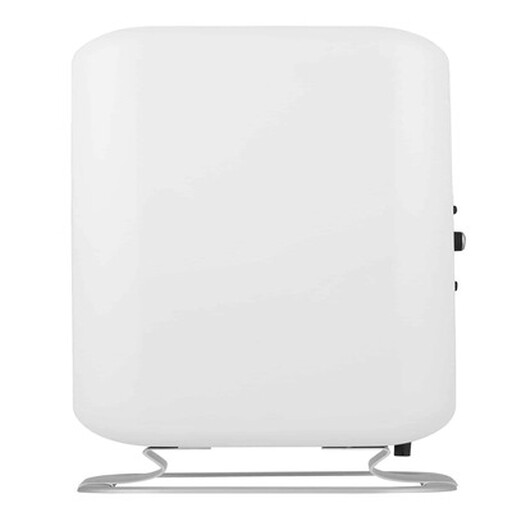
Why it suits this profile: Suitable for anyone looking for quiet, even heat over longer periods in a medium-sized room.
This is not a rapid fan heater. Choosing an oil-filled radiator prevents you from mistaking low noise levels for instant heating.
1000W, three settings from 400W to 1000W, day/night programme, electronic thermostat, plus tip-over and overheat protection.

Why it suits this profile: A compact choice for a workspace or bedroom where noise and ease of use matter.
Alongside a brand claim about energy savings, the product information also lists specific settings, a thermostat range and a timer.
1500W, 12-hour timer, thermostat from 5–35°C, remote control and a stated noise range of 25–42 dB.
We have put together a complete, up-to-date list of products that fully meet these strict selection criteria and the applicable European safety regulations.
That depends on the room, its insulation and the desired temperature. Do not look only at the floor area; also consider ceiling height and draughts. An adjustable 1500W heater may be more practical than a model that only operates at 2000W.
Consumption is calculated as: power in kW × usage time in hours = consumption in kWh. A 2000W heater running at full power for one hour uses 2 kWh. A thermostat, lower setting and timer can limit the number of hours it runs. The exact cost depends on your energy tariff.
Check the manual first. Ideally, choose a model with a timer, thermostat, tip-over protection and overheat protection. Keep it away from bedding and curtains, never cover the appliance and do not leave the heater running unattended if the usage instructions advise against it.
