
Vandaag of morgen in huis

Kwaliteit gegarandeerd

Welkomstaanbiedingen ontgrendelen: GRATIS bezorging | Tot 80% korting | Gratis 30 dagen JoyPlus-proefperiode
Download de app
An electric heater can quickly make a cold bedroom, home office or living room more comfortable. However, not every model is suitable for every space. A higher wattage does not automatically mean more comfortable or cheaper heating. Terms such as “energy-efficient”, “quiet” and “fast heating” also need a closer look at the specifications.
As a Joybuy Product Recommendation Officer, I filter the most important information from product descriptions, so you can compare marketing claims with verifiable features.
A 2000W heater can deliver more heat than a 1000W model, but at maximum power it also uses roughly twice as much electricity per hour. For a small workspace, a 1500W heater may be sufficient. A more powerful appliance can also heat a room faster, but that does not automatically make it cheaper to run.
Therefore, pay attention to:
An energy-efficient heater does not automatically use little electricity when it runs continuously at full power. Electric heating essentially converts electricity directly into heat. The main difference lies in the controls: a thermostat, ECO mode, timer or day-and-night programme can prevent the appliance from running for longer than necessary.
According to DREO’s own product information, the Atom 416 can save up to 40% energy through intelligent power regulation. This is a claim made by the brand and is not a general guarantee for every usage situation. Your results will depend on the room temperature, insulation, set temperature and duration of use.
A fan heater distributes warm air quickly, but you will usually hear the fan. A ceramic heater with a PTC element can be compact and heat up quickly, but it still needs to move air. A convector heater is often quieter because warm air rises naturally, although the heating may feel different.
So check whether the noise level is actually given in decibels. “Quiet heater” without a measurement is difficult to compare. Some models only state “quiet” or “silent operation” in the description.
Use the stated room-size recommendation as a guide, not a guarantee. A poorly insulated room, high ceilings or draughts require more capacity. For a small bedroom or home office, 1000W to 1500W is often a practical power range. For larger rooms, 1800W to 2000W may be more suitable.
A simple calculation can help you estimate electricity costs:
consumption in kWh = power in kW × usage time in hours
A 1500W heater uses a maximum of 1.5 kWh in one hour of continuous operation. The actual running time may be lower when the thermostat switches off the heating element.
A heater with a thermostat regularly switches the heat on and off to maintain the selected temperature. This is more practical than an appliance that is simply permanently on or off. A heater with a timer is useful when you want to set an automatic switch-off time in advance. Some models offer a 12-hour timer, while others can be programmed for up to 24 hours.
A heater with a remote control or app control is particularly useful when the appliance is next to your bed, desk or sofa. However, check whether the key functions are also available without the remote control.
At a minimum, look for:
A CE marking indicates that the manufacturer declares the product complies with the relevant EU regulations. It is not an independent ranking of heating performance. Always follow the instructions. Never cover an electric heater; do not use one in a damp room unless the model is specifically designed for this; preferably connect a powerful model directly to a wall socket.

Why it suits this profile: This compact model is portable and offers two power settings of 600W and 1500W. This allows you to choose a lower setting for a small room or workspace.
The product information specifies concrete settings and an adjustable temperature, rather than making only a general claim about low energy consumption.
1500W maximum power, 600W low setting, weight of 1.51 kg, tip-over and overheating protection.

Why it suits this profile: This model is aimed at users who value quiet operation, temperature control and multiple safety features in a bedroom or office.
According to the product information, the stated noise level is between 25 and 42 dB. The timer, thermostat and tip-over protection are also clearly specified.
PTC technology, adjustable from 5–35°C, 12-hour timer, remote control, overheating and tip-over protection.
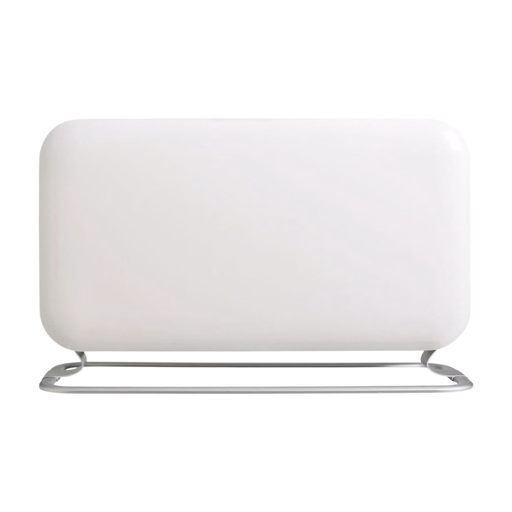
Why it suits this profile: This convector heater is designed for larger work or living spaces. According to the product description, it is intended for rooms of up to 20 m² and operates quietly.
The power rating, room-size guidance and three settings are clearly stated. The fan can distribute heat further on colder days.
2000W power, electronic thermostat, LED display, three settings, metal panels and a 160 cm cable.
We have put together a complete, up-to-date list of products that fully meet these strict selection criteria and the applicable European safety regulations.
Place a portable heater on a level, hard surface and leave plenty of clear space around it. A bedroom is not a suitable place for an appliance placed on bedding, carpet or a soft chair. Keep textiles, paper and curtains at least approximately one metre from the air outlet, unless the instructions specify a different distance.
Do not use a multi-socket adaptor or extension lead with a powerful model if the manufacturer advises against it. Switch off the heater and unplug it before moving or cleaning it. Allow an oil-filled radiator to cool down completely; it is heavier and generally heats up more gradually than a fan heater.
That depends on energy prices, insulation and the area being heated. For one workspace or a short period, supplementary heating can be practical because you do not need to heat the entire home. Calculate the maximum consumption using: power in kW × hours of use. Then compare this with your current electricity tariff.
A compact ceramic heater with a thermostat, timer, overheating protection and tip-over protection is a sensible choice. Also pay attention to the stated noise level. Use the timer if you do not want the appliance to keep running indefinitely, and follow the instructions on keeping a safe distance from bedding and curtains.
Its lifespan depends on frequency of use, dust, storage and maintenance. Clean the ventilation openings carefully according to the instructions, do not block the airflow and stop using an appliance with a damaged cable or casing. Also check the statutory guarantee and any additional manufacturer’s warranty in the product information.
