
Vandaag of morgen in huis

Kwaliteit gegarandeerd

Welkomstaanbiedingen ontgrendelen: GRATIS bezorging | Tot 80% korting | Gratis 30 dagen JoyPlus-proefperiode
Download de app
An electric heater seems simple: plug it in, set the temperature and you’re ready to go. Yet many Dutch consumers buy a model that does not suit the room or their everyday needs. A heater may be powerful enough for a living room, but too noisy for a bedroom. A compact fan heater can distribute heat quickly, but that does not automatically make it suitable for a damp bathroom.
This buying guide compares electric heating based on verifiable specifications. That way, you can avoid paying mainly for features you do not use.
An electric heater 2000 watts sounds powerful, but wattage does not tell the whole story. The shape of the room, insulation, ceiling height and desired temperature also play a part. Manufacturers sometimes state a recommended floor area, but this remains a guideline for specific conditions.
Therefore, always compare:
A 2200-watt heater is not automatically more economical than a 1200-watt model. The higher power can heat the room more quickly, but during prolonged use, electricity consumption will also be higher if the heating element remains continuously active.
A convector heater without a fan generally operates more quietly than a fan heater. With a fan-assisted model, heat can spread through the room more quickly, but the noise level may be noticeable while sleeping, working or watching television.
Pay attention to how the noise level is stated. If no measurement is provided in the product information, you cannot draw a precise conclusion. The Adler AD 7730, for example, states a noise level of less than 50 dB. Some Mill models mention “silent operation”, even though no dB value is given.
A timer, remote control, LCD display, oscillation or Wi-Fi control can be useful. But check whether you really need these features. A smart heater with Wi-Fi is particularly useful if you want to adjust heating schedules remotely. For occasional use in a home office, a mechanical thermostat may be sufficient.
An integrated humidifier also does not make a heater suitable for every damp room. Always check the safety instructions and IP rating. Only use an appliance in a bathroom when the manufacturer explicitly permits it.
Power is measured in watts. Many models in this selection have a power rating of 1800, 2000 or 2200 watts. Smaller models, such as a compact desktop heater, are intended for a limited zone or small room.
Do not just look for “rapid heating”; also check the stated coverage:
These figures do not guarantee the same heating time in every Dutch home. A poorly insulated room requires more power than a well-insulated room of the same size.
A convector heater warms air that passes through the appliance and then circulates around the room. This type is suitable for even, long-lasting heating. A fan heater uses a fan to distribute warm air more quickly. This is practical when you want rapid heat around a desk or seating area.
A ceramic heater uses a ceramic, often PTC-based heating element. The product specification for the Mill CUS1800MEC states that it has a PTC element, two settings of 1200 and 1800 watts, and protection against tipping over and overheating.
An oil-filled radiator generally heats up more gradually and continues to give off heat for some time after being switched off. The Mill AB-H1000DN has three settings of 400, 600 and 1000 watts, as well as an electronic thermostat. Its lower power rating makes this model more suitable for a medium-sized bedroom or office than for a large, cold living room.
A heater with a thermostat switches off the heating element once the set temperature has been reached and can switch it on again later. This is more practical than running the heater continuously at maximum power.
Also check for:
A longer warranty may be appealing, but it does not affect your statutory consumer rights. In the European Union, the minimum statutory guarantee of conformity applies; any additional manufacturer’s warranty varies by product.
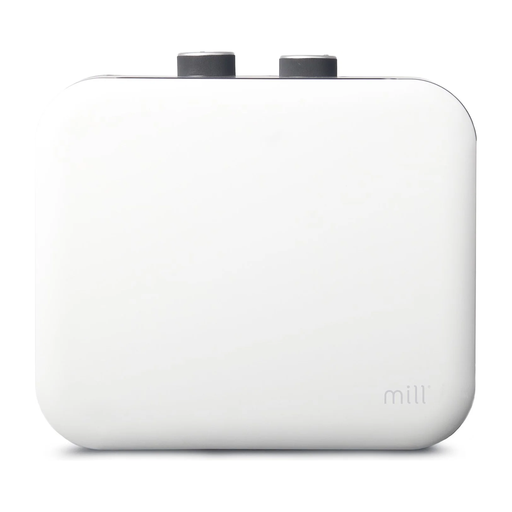
Why it suits this profile: This compact model is easy to move around and has a mechanical thermostat. That means you do not pay for Wi-Fi or advanced programming features when you mainly want straightforward controls.
The product specification lists two settings of 1200 and 1800 watts, so you do not always have to use the maximum power.
PTC heating, tip-over and overheating protection, and a stated coverage of up to 30 m².
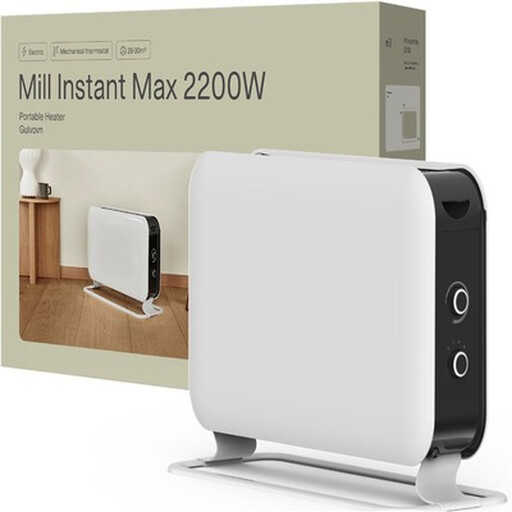
Why it suits this profile: If you are looking for a simple freestanding heater for a larger room, this convector model offers mechanical controls and a stated coverage of up to 30 m².
The specifications list three wattage settings and a thermostat. You are therefore not limited to simply switching the heater on or off at full power.
2200 watts, steel front panels, stated quiet operation and tip-over protection.

Why it suits this profile: According to the product information, this wall-mounted model is designed for bathrooms and has an integrated towel rail, weekly timer and adjustable temperature.
The stated IPX2 rating, overheating protection and open-window detection provide more information than a simple marketing claim about bathroom use. Check the installation instructions beforehand.
Two settings of 1400 and 2000 watts, temperature adjustment from 10 to 49 °C, and a programmable weekly timer.
We have put together a complete, up-to-date list of products that fully meet these strict selection criteria and the applicable European safety regulations.
Consumption depends on the power rating and the actual length of use. A 2000-watt heater theoretically uses 2 kWh per hour when the heating element operates continuously at maximum power for one hour. The thermostat can reduce the time the heater is actively heating, but the savings depend on the insulation, set temperature and outdoor temperature.
Use this simple calculation:
power in watts ÷ 1000 × hours of use × your electricity tariff = estimated cost
Check your current tariff with your energy supplier. An “energy-efficient electric heater” does not automatically use less electricity to produce the same amount of heat; electric resistance heating essentially converts electricity directly into heat. However, a lower power setting, thermostat and timer can help you heat for less time or at a lower output.
For a bedroom, a quiet convector heater or oil-filled radiator is often a practical choice. Pay attention to the stated noise level, thermostat and timer. A fan heater can distribute heat more quickly, but not everyone enjoys the sound of a fan during the night.
Only if the model is intended for this purpose by the manufacturer and the installation manual permits it. Check the IP rating, clearance requirements and installation instructions. A standard heater designed for a living room or bedroom should not simply be used in a damp room. Never place an appliance close to water or cover it.
Lifespan varies according to the type, build quality, intensity of use and maintenance. Keep ventilation openings free from dust, check the cable and plug regularly, and store a portable model in a dry place. Stop using the appliance immediately if you notice any damage, an unusual smell or abnormal heat. Always follow the manual and disconnect the heater from the power supply before cleaning it.
