
Livraison le jour même et le lendemain

Qualité garantie

Débloquez vos offres de bienvenue: Livraison GRATUITE | Jusqu'à -80 % | 30 jours d'essai gratuits à JoyPlus
Téléchargez l'application
An electric heater can quickly make a cold bedroom, workspace or living room more comfortable. However, a high wattage does not tell you everything. A 2,000-watt appliance may provide powerful heat, but it can also use more electricity than necessary if it is placed in a small room without an effective thermostat.
The most common poor purchases are caused by three misleading expectations:
Power is expressed in watts. Many models have a power rating of 1,500 to 2,000 watts. That is suitable for various indoor spaces, but the actual heat requirement also depends on insulation, ceiling height, draughts and the desired temperature.
Pay attention to the difference between:
A product listing may state a recommended coverage area, but use this as a guideline. A compact heater for a 10 m² bedroom is not automatically suitable as the main heating source for a draughty living room.
A heater with a thermostat switches the heating element on and off around the set temperature. This is more practical than a model that only operates continuously at low or high power.
A heater with a timer is useful when you want the heating to switch off automatically after a certain period. Check whether the timer is one-off or programmable. Some models offer a timer of up to 12 hours, while others have a 24-hour programme or several time periods throughout the day.
An ECO mode can adjust the power, but check the exact description. Claims such as “up to 40% energy savings” come from the brand’s product communication and depend on usage, the room and the settings. According to DREO’s own information, certain intelligent power management features can save up to 40%; this is not a guaranteed saving for every household.
For a heater for a bedroom, study or home office, the noise level is particularly important. A fan will generally make more noise than a quiet convector heater or oil-filled radiator. Products with a stated level of around 24 to 34 dB may be suitable for quiet spaces on paper, but the experience can vary depending on the setting.
Also check:
Place every electric heater on a flat, stable and dry surface. Maintain at least the clearance specified in the manual and never block the air inlet or outlet.

Why it suits this profile: A compact heater for students, home workers and small bedrooms, with a relatively manageable power rating of 600 or 1,500 watts.
The two power settings help prevent you from constantly heating a small room at maximum power. The product description also states that it has tip-over and overheat protection.
Maximum power of 1500 W, stated noise level of 24 dB(A), temperature setting from 20–30 °C and a weight of 1.51 kg.

Why it suits this profile: Designed for users who value precise temperature control, a remote control and a low stated noise level.
According to the product information, the thermostat can be adjusted from 5 to 35 °C in 1 °C increments. This allows more precise control than using only a low or high setting.
2000 W, 70° oscillation, timer of up to 12 hours, remote control and a stated noise level of 25–42 dB.
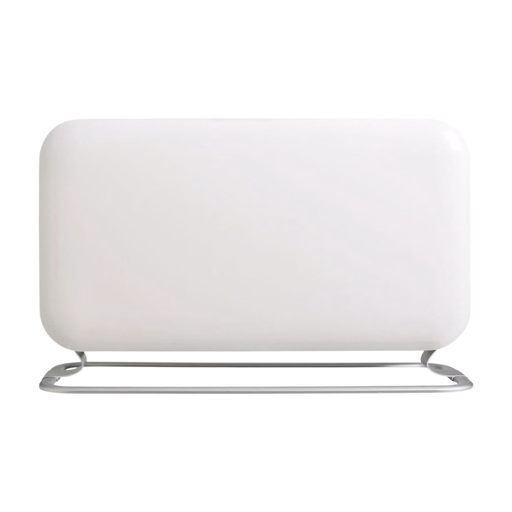
Why it suits this profile: A practical choice for a living room, office or other space where quiet operation and a larger size matter more than maximum portability.
This is not a small appliance that you need to move around constantly. The convector has an electronically adjustable thermostat and an LED display for direct control.
2000 W power, three settings, stated quiet operation, a 160 cm cable and dimensions of 62 × 21 × 38.5 cm.

Why it suits this profile: Suitable for immediate warmth at a desk or in a small personal space, without having to install a large floor heater.
The low stated power is suitable for targeted heating. The compact housing means you do not have to buy a large heater for desk use alone.
600 W, 45° oscillation, a weight of 0.93 kg, thermostat and automatic shut-off in the event of tipping over or overheating.
We have put together a complete, up-to-date list of products that fully meet these strict selection criteria and the applicable European safety regulations.
Calculate electricity costs using:
power in kilowatts × usage time in hours × your electricity tariff
A 2,000-watt heater uses 2 kWh per hour when operating at maximum power. A 600-watt model uses 0.6 kWh over the same period. A thermostat or ECO mode can limit the amount of time the heater is actively heating, but the maximum power still determines consumption when the element switches on fully.
Use a portable heater mainly for targeted electric heating. For example, heat your workspace rather than your entire home when you are only using one room.
Yes, provided the model is designed for indoor use and is placed on a stable, unobstructed surface. Choose a heater with a thermostat, timer, tip-over protection and overheat protection. Keep it away from bedding and curtains, and do not leave the appliance covered.
Its lifespan depends on how often it is used, dust, storage and maintenance. Allow a heater to cool down before moving it, clean the air vents according to the manual and do not use it if the cable, plug or housing is damaged. The statutory consumer guarantee is generally at least two years, unless additional terms apply.
A ceramic element converts electricity into heat efficiently, but the wattage still determines maximum consumption. A ceramic heater is therefore not automatically energy-efficient. In practice, a lower power rating, a good thermostat, a timer and a suitable room size have a greater impact on energy costs.
