
Vandaag of morgen in huis

Kwaliteit gegarandeerd

Welkomstaanbiedingen ontgrendelen: GRATIS bezorging | Tot 80% korting | Gratis 30 dagen JoyPlus-proefperiode
Download de app
An electric heater can quickly make a cold home office, bedroom or bathroom more comfortable. However, the difference between a useful supplementary heater and a poor purchase often comes down to more than just the wattage. A heater that is too small will run for longer, while an overly powerful model may use more electricity than necessary.
So don’t focus solely on claims such as “heats up quickly”, “energy efficient” or “quiet”. Above all, check the technical specifications, safety features and suitability for your space.
A 2000-watt model can provide powerful heating, but at full power it also uses 2 kWh per hour. The actual cost depends on your electricity tariff, how long you use it and how often the thermostat switches off the heating element.
An energy-efficient heater therefore does not simply rely on low power consumption. A thermostat, several heat settings and a timer can help limit operating time. Bear in mind that a claim such as “up to 40% energy saving” is a statement made by the brand. According to DREO’s own information, certain models achieve this through smart power management and temperature control. In practice, the result depends on insulation, room size and settings.
A quiet electric heater with a fan will always make some noise. Look for a stated value in dB and check whether it is a range. For example, DREO models list 25–42 dB, while the Atom 416 is also described as a 34 dB model. Perceived noise can vary depending on the heat setting and distance.
For sleeping or concentrated work, a model with a quiet motor, dimmable display and timer is more practical than a device labelled simply “quiet”.
Do not use an ordinary ceramic fan heater in the bathroom unless the product information explicitly permits it. Check the IP rating, installation method and safety instructions. The Camry CR 7747 lists IPX2 and is designed for wall mounting in the bathroom. This still does not mean that the appliance may come into contact with water.
Never place a heater next to a bath, shower or washbasin, and follow the specified safety zones and installation instructions.
For small spaces or targeted supplementary electric heating, 600 watts may be sufficient. The Xiaomi Desktop Heater has a compact design and is intended for use on a desk or in a small room. For a bedroom or home office of approximately 10 to 20 m², 1500-watt models are often more practical. Larger rooms require more attention to insulation, ceiling height and air circulation.
Use the stated coverage area as a guide, not a guarantee. A poorly insulated 20 m² living room may need more power than a well-insulated room of the same size.
A PTC heater or ceramic heater warms the air using a ceramic element and often a fan. This type produces heat quickly and is usually portable. Oscillation helps distribute the warm air more widely.
An infrared heater mainly warms surfaces and people within its direct range. The 800-watt Alpina infrared heater is intended for indoor and outdoor use, has IP44 and specifies a heating range of approximately 2 to 5 m², depending on the specification. This type is better suited to a patio or a specific seating area than to heating an entire living room evenly.
An oil-filled radiator generally heats up more gradually and continues to give off heat for some time after being switched off. The Mill AB-H1000DN has three settings of 400, 600 and 1000 watts and, according to the product specification, is suitable for rooms of up to 16 m². The trade-off is that an oil-filled radiator is heavier and less quick to move around.
A heater with a thermostat switches off the heating element when the set temperature is reached. A heater with a timer is useful when you do not want to leave the appliance running all evening. Check whether the timer can be set once, daily or weekly.
Important safety features include:
A CE mark is not an independent quality seal. It indicates that the responsible party declares that the product meets the applicable EU requirements. Also read the manual and check that the plug, voltage and connection instructions are suitable for use in the Netherlands.
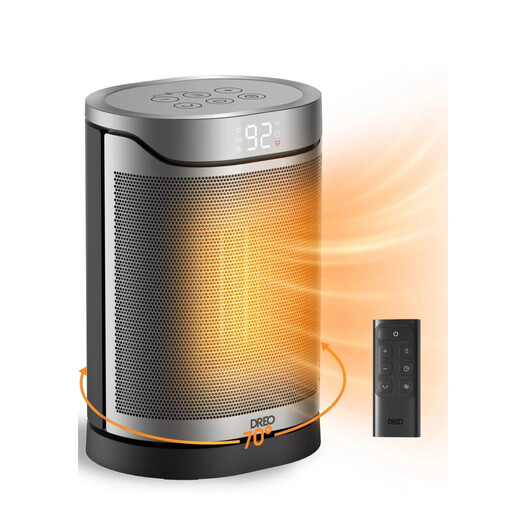
Why it suits this profile: A compact portable heater for a bedroom, office or home office of up to approximately 20 m², with remote control and timer.
The three settings of 900, 1300 and 1500 watts mean you do not always have to heat at maximum power. The product specification also lists tip-over and overheating protection.
PTC ceramic element, thermostat from 5–35 °C, 12-hour timer and stated noise level of 25–42 dB.

Why it suits this profile: For anyone who wants to heat a larger space of approximately 15–25 m² quickly and values comprehensive controls.
The specifications list an adjustable thermostat, 70° oscillation and a 12-hour timer. This allows you to control heat distribution and operating time more precisely.
2000 watts, temperature control from 5–35 °C, remote control and, according to the product information, eight safety layers.

Why it suits this profile: For households looking for a fixed heating solution with a towel rail and programmable weekly timer.
The IPX2 rating and wall-mounting design are explicitly stated. However, always check the manual and placement requirements before using the appliance in a damp area.
Two settings of 1400 and 2000 watts, thermostat from 10–49 °C, open-window detection and a weekly timer with multiple periods.
We have put together a complete, up-to-date list of products that fully meet these strict selection criteria and the applicable European safety regulations.
A 2000-watt heater uses a maximum of 2 kWh per hour when the heating element operates continuously at full power. At 1000 watts, this is a maximum of 1 kWh per hour. Multiply this by your electricity tariff and the length of use. A thermostat can reduce consumption by preventing the heater from running continuously.
Not necessarily. Both convert electricity into heat. The practical difference mainly lies in speed, heat distribution and control. A ceramic fan heater warms up quickly, while an oil-filled radiator operates more gradually and makes no fan noise. Choose based on the room, the desired heating time and the features available.
Only use a model whose manual permits overnight use and which has suitable safety features, such as overheating and tip-over protection. Keep the appliance away from bedding, curtains and furniture, never cover it, and preferably use a timer and thermostat. If in doubt, switching it off and unplugging it is the safest option.
