
Vandaag of morgen in huis

Kwaliteit gegarandeerd

Welkomstaanbiedingen ontgrendelen: GRATIS bezorging | Tot 80% korting | Gratis 30 dagen JoyPlus-proefperiode
Download de app
An electric heater may seem simple to choose: select the desired power rating, plug the appliance into the socket and wait for the heat. In practice, models vary considerably in heating method, noise level, controls and safety features. Choosing the wrong one can result in insufficient heat, unnecessary electricity consumption or an appliance that makes too much noise at night.
Pay particular attention to these three common pitfalls:
The technology determines how the heat is distributed.
A ceramic heater generally uses a PTC element and a fan to actively circulate warm air around the room. This type is practical when you want quick heat at your desk, in a bedroom or in a small living room. A fan heater is often compact and portable, but the fan can be audible.
That is why you should check the stated noise level. For example, DREO models list a range of 25 to 42 dB, while the PELONIS 2000 W PTC ceramic fan heater lists 50 dB. According to DREO and PELONIS’s own product information, these are stated values measured under their own testing conditions.
A convector heater warms the air that rises as it passes over the heating element. This generally provides more even air circulation and often less mechanical noise than a fan heater. According to its product description, a model such as the Mill SG2000LED has a power rating of 2000 watts, an electronic thermostat, three settings and an additional fan for heat distribution.
A convector heater is suitable as a fixed source of supplementary heating in a living room or home office. However, take its dimensions into account and do not place the appliance directly against furniture or beneath curtains.
Power is measured in watts. A 600-watt model is mainly intended for a desk or a very small room. For a bedroom or home office, models rated between 1200 and 1800 watts are often more practical; for larger or poorly insulated rooms, 2000 watts may provide more reserve capacity.
The stated room size is a guideline, not a guarantee. Ideally, compare:
For example, a heater running at full power consumes 2 kWh per hour at 2000 watts. The actual cost depends on your energy tariff and how often the thermostat switches the element off. An energy-efficient electric heater is therefore not necessarily the heater with the lowest wattage; adjustability and usage time also matter.
A heater with a thermostat can maintain the set temperature more accurately than a simple on-off model. A timer is useful when you want the heater to switch off automatically after a certain period. Models with a remote-controlled heater are convenient from the sofa or bed, but check whether the remote control is included as standard.
These features are also relevant for everyday use:
Ideally, choose a model with overheating protection and, for portable models, tip-over protection. Also check whether the appliance has a suitable IP rating when it is marketed for use in a damp room. An IP rating does not automatically make a heater suitable for every bathroom: always follow the instructions and specified clearance distances.
Never use an electric heater:
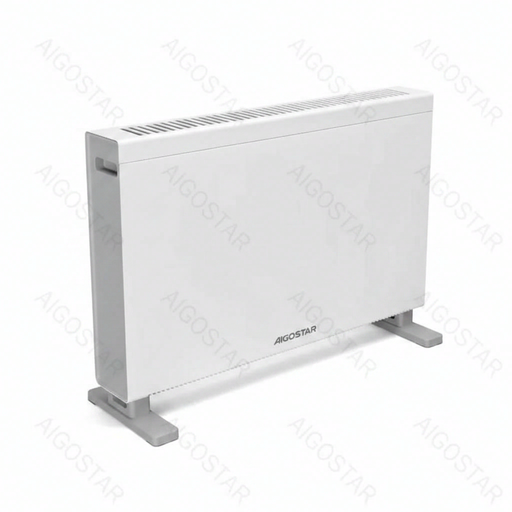
Why it suits this profile: The combination of 1250 and 2000 watts, a remote control and a 24-hour timer provides basic comfort without complicated installation.
The two power settings make it possible to avoid heating continuously at maximum power. According to the product information, it also has overheating and tip-over protection.
2000-watt maximum power, LED controls, timer and carry handle.

Why it suits this profile: This model is aimed at users who value temperature control, quiet operation and remote control in a bedroom, home office or living room.
The product specifications state a thermostat range of 5 to 35 °C, a 12-hour timer, and tip-over and overheating protection. Check the current instructions for installation and use.
Stated noise level of 25–42 dB, 70° oscillation and temperature adjustment by degree.

Why it suits this profile: This wall-mounted model is designed for bathroom use and has a towel rail, programmable weekly timer and two heat settings.
The stated IPX2 rating and fixed wall mounting provide clearer positioning guidance than a standard portable heater. Use it only in accordance with the instructions.
1400/2000 watts, a weekly programme with up to six periods per day and open-window detection, according to the product description.
We have put together a complete, up-to-date list of products that fully meet these strict selection criteria and the applicable European safety regulations.
That depends on how you use it and your electricity tariff. A 2000-watt appliance theoretically uses 2 kWh per hour when running continuously at full power. With a thermostat, lower setting or timer, the time spent running at full power can be reduced. So do not compare only the maximum wattage; also consider the available controls.
For a bedroom, a quiet heater, thermostat and timer are practical features. A ceramic model with a stated noise level may be suitable when rapid heating is important. A convector heater without a continuously running fan is a better choice if you want minimal mechanical noise. Keep the heater away from bedding and do not operate it while covered.
Only if the manufacturer expressly permits it and the IP rating and clearance distance are suitable for the room. A standard portable heater is not automatically suitable for damp conditions. Keep the appliance away from direct splashes, use dry hands and follow the safety instructions in the manual.
