
Vandaag of morgen in huis

Kwaliteit gegarandeerd

Welkomstaanbiedingen ontgrendelen: GRATIS bezorging | Tot 80% korting | Gratis 30 dagen JoyPlus-proefperiode
Download de app
An electric heater is useful when you want to provide extra temporary warmth in a bedroom, living room, office or study. However, not every compact heater is suitable for every room. A low purchase price can, for example, come with excessive noise, limited safety features or higher-than-expected energy consumption.
As a Joybuy Product Recommendation Officer, I filter product information based on verifiable features. This helps you see which specifications really matter and which marketing claims should be treated with a degree of caution.
A 2000-watt heater delivers more heat output than a 1000- or 1500-watt model, but that does not automatically mean it is suitable everywhere. Insulation, ceiling height, room size and the desired temperature all play a part. A manufacturer may specify a particular heating range, but this still depends on the room.
So, check the stated coverage in square metres as well as whether the power can be turned down. An appliance with several settings may be more practical than a model that only operates at maximum power.
An electric heater converts electricity into heat, but consumption mainly depends on the power rating and how long it is used. A 2000-watt heater running at full power for one hour theoretically uses 2 kWh. A thermostat or ECO mode can stop heating once the set temperature has been reached, but it cannot save energy indefinitely.
Claims such as “up to 40% energy saving” are product claims. According to DREO’s own research, smart power control could save up to 40% in certain usage conditions. Treat this as an indication from the product information, not as a guaranteed result in every home in the Netherlands.
An electric heater with tip-over protection and overheat protection provides extra protection, but it does not replace safe usage. An electric heater must not be covered and should be placed on a flat, stable surface. Keep curtains, bedding, paper and furniture at a safe distance, usually at least one metre according to the supplied safety instructions.
Do not use the appliance in a bathroom or other damp area unless it has been specifically designed for that purpose. For specific bathroom heating solutions, you can also browse the bathroom heating range.
For a small workspace or study, 600 to 1500 watts may be sufficient, depending on insulation and the outside temperature. For a larger living room, 1800 to 2000 watts is generally more suitable. A ceramic heater or ceramic fan heater usually distributes heat via a fan, while a convection heater allows the air to circulate more gradually.
Always check:
An electric heater with a thermostat switches the heating element on and off around a set temperature. This is more convenient than continually turning the heater on and off manually. An electric heater with a timer can switch off automatically after a set period. Some models offer a remote control, digital display, ECO mode or app control.
Bear in mind that a timer is not the same as a presence sensor. Do not leave a heater running unattended for long periods and always follow the instructions.
For a bedroom or office, a quiet heater is more important than simply having a high heat output. Product listings may quote figures such as 24 dB(A), 25–42 dB or 50 dB. These values are not always measured under exactly the same conditions. Use them for comparison within the range, rather than as an absolute guarantee of silent operation.
A built-in handle and low weight make a portable heater easy to move between rooms. Also check the cable length and plug the appliance directly into a suitable socket if the manufacturer advises against using extension leads.

Why it suits this profile: At 1.51 kg, this compact model is easy to move between a bedroom, desk or small living room. The two power settings of 600 and 1500 watts allow you to adjust consumption to suit the situation.
The product specification lists five safety features, including tip-over and overheat protection. The power is not limited to a single high setting.
1500 watts maximum power, a stated noise level of 24 dB(A), thermostat settings and an integrated handle.

Why it suits this profile: The combination of PTC ceramic technology, an adjustable thermostat from 5–35 °C, remote control and 70° oscillation is ideal for anyone who wants plenty of control options in a medium-sized room.
The product lists tip-over, overheat and child-lock protection. The stated coverage is 15–25 m²; check whether this suits your insulation and room layout.
2000 watts, display, remote control, 12-hour timer and, according to the product information, a noise level of 25–42 dB.
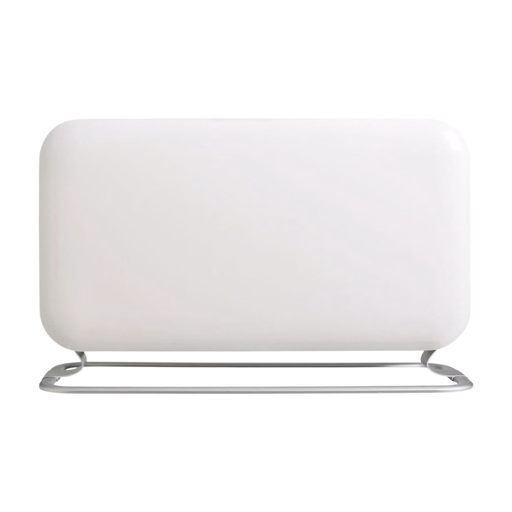
Why it suits this profile: This convection heater is designed for rooms of up to 20 m² and features a steel panel, electronic thermostat and an additional fan for heat distribution.
The thermostat and three settings allow more precise use than simple on/off operation. The heater must still be freestanding to ensure safe airflow.
2000 watts, LED display, electronic thermostat and, according to the product description, quiet operation.

Why it suits this profile: Weighing 1.44 kg, this compact model is designed for smaller rooms of 10–20 m². The product information lists a thermostat from 5–35 °C, remote control and a 12-hour timer.
The maximum power is 1500 watts rather than the standard 2000 watts. This means you can choose lower consumption for a smaller workspace or bedroom, provided the heat demand allows it.
According to DREO’s own research, the noise level is 25–42 dB and ECO control can save up to 40%; results vary depending on usage.
We have put together a complete, up-to-date list of products that fully meet these strict selection criteria and the applicable European safety regulations.
For every electric heater, follow the instructions and check before use that the cable, plug and casing are undamaged. Also bear the following points in mind:
This depends on the power rating and your electricity tariff. A 2000-watt model uses 2 kWh per hour in theory when operating at maximum power. A 1500-watt model uses 1.5 kWh per hour. In practice, a thermostat can temporarily switch off the heating element, which may reduce average consumption.
Not necessarily. Both types can have different power ratings and use electricity while the heating element is active. A ceramic fan heater distributes heat quickly through airflow. A convection heater generally operates more quietly and may be suitable for even supplementary heating. Focus mainly on the power rating, thermostat, timer and usage duration.
This is only advisable if the instructions permit it and the appliance has been positioned correctly. Use a timer if one is available, never cover the heater and keep bedding and curtains away from it. Automatic tip-over and overheat protection are useful, but safe supervision and correct positioning remain essential.
