
Livraison le jour même et le lendemain

Qualité garantie

Débloquez vos offres de bienvenue: Livraison GRATUITE | Jusqu'à -80 % | 30 jours d'essai gratuits à JoyPlus
Téléchargez l'application
An electric heater can be a handy solution if you need to temporarily heat a single room, such as a bedroom, home office or chilly living room. However, not every model is right for every situation. A low price tag, for instance, might mean fewer settings, a short cable or no clear information about the noise level.
Our Joybuy Product Recommendation Officer filters the most important product information, so you can compare marketing claims with verifiable specifications. Pay close attention to these common pitfalls.
A power rating of 2,000 W sounds powerful, but it doesn't just tell you how quickly a heater will warm up a room. It also determines the maximum amount of electricity the appliance uses. A heater with a thermostat, ECO mode or multiple settings can reduce its power output more often once the desired temperature is reached.
Use this simple calculation:
power in kW × hours of use × your electricity rate = estimated running costs
An electric heater rated at 2,000 W running for one hour at full power will use a maximum of 2 kWh. In practice, consumption can be lower when the thermostat switches the heating element off. To check this, look at the settings, not just the term “energy-efficient”.
“Quiet” is not a fixed technical standard, so look for a specified noise level in decibels (dB). A ceramic fan heater generally makes more noise than a panel heater, but it can distribute heat more quickly.
For a bedroom or home office, models with a specified range, such as 25–42 dB or 38–50 dB, are easier to evaluate than products without a measurement. Bear in mind that the actual experience can vary depending on the fan speed and the room itself.
A portable heater is often placed near curtains, furniture or bedding. Therefore, check that it has tip-over protection and overheat protection. Place the appliance on a hard, flat surface, keep ventilation openings clear and never cover the heater.
A CE mark indicates that the manufacturer declares compliance with applicable EU regulations. It is not a guarantee that you can use the appliance safely under all circumstances. Always follow the manual and use a suitable, earthed socket when required.
For a small workspace, 1,500 W may be sufficient, while a larger or poorly insulated room might need more power. In addition to the wattage, look at the specified room area. The DREO Solaris SH628, for example, states a range of 15–25 m² and a power rating of 2,000 W. Such an indication will always depend on ceiling height, insulation, outside temperature and draughts.
A PTC heater uses a ceramic heating element. PTC stands for Positive Temperature Coefficient, which means the electrical resistance changes as the element gets hotter. This type of element is often combined with a fan for rapid heat distribution. Make sure the product has multiple settings so you don't always have to run it at maximum power.
An adjustable thermostat allows you to set a target temperature. On some models, the range is from 5 to 35 °C, in 1 °C increments. A heater with a timer can switch off automatically after a set period, which is practical if you don't want to leave the heater running all evening.
An ECO mode can adjust the power output automatically. You should read claims like “saves up to 40% energy” as a maximum figure from the product information, not as a guaranteed saving in every home. According to DREO's product description, the model uses adaptive power control; your own energy consumption will depend on the room, temperature setting and duration of use.
Oscillation helps to spread warm air over a wider angle. A heater with a remote control is useful if you want to change the temperature, timer or mode from your bed or desk. Also, pay attention to the size. A tower model around 51 cm high takes up little floor space, but it must still be kept clear of obstacles.
For renters, a portable heater is often an attractive option because no installation is required. Only move the appliance using its handle, and let it cool down before you store it away.
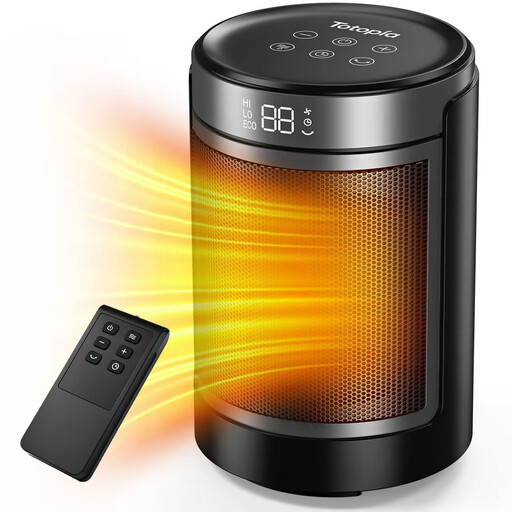
Why it fits this profile: Four modes, an ECO mode, oscillation and a timer give beginners clear choices for a bedroom, study area or small office.
The product specifically lists 750 W, 1,500 W and ECO modes, plus a 1–12 hour timer. This means you don't have to rely solely on a general term like “energy-efficient”.
PTC element, LED display, remote control, oscillation, and tip-over and overheat protection, according to the product description.

Why it fits this profile: Ideal for those who want to provide targeted extra heat for a larger room and value precise temperature control and a specified noise range.
The product information mentions 15–25 m², 25–42 dB, a 5–35 °C thermostat and a 12-hour timer. This makes it easier to compare room size, noise and controls before you buy.
2,000 W, 70° oscillation, remote control and multiple safety features, including tip-over and overheat protection, according to the product description.

Why it fits this profile: A practical choice for those who want to adjust settings remotely and distribute heat more widely while working from home or sleeping.
The specified noise level varies from 38 to 50 dB depending on the mode. Four heat settings, ECO mode, oscillation and a 24-hour timer are also specified.
1,800 W ceramic heating, remote control, a 5–35 °C thermostat, and tip-over and overheat protection, according to the product information.
We have compiled a complete, up-to-date list of products that fully meet these strict selection criteria and comply with current European safety regulations.
A separate plug-in timer might seem useful, but always check the timer's maximum power rating. A 2,000 W appliance can use a significant portion of the permitted load. Furthermore, a timer is no substitute for the built-in safety features of an electric heater.
That depends on the power rating, how long you use it, and your electricity rate. A 1,500 W model running at full power for one hour will use a maximum of 1.5 kWh. With a thermostat, a lower setting and a timer, the actual consumption can be less. Therefore, you should compare not only the maximum wattage but also the control options.
Only use a model if its manual states that it is suitable for overnight or prolonged use. A timer, thermostat, tip-over protection and overheat protection are useful features, but don't take unnecessary risks: keep the area around the appliance clear and always follow the manufacturer's safety instructions.
The lifespan varies depending on the model, intensity of use and maintenance. Dust in the ventilation openings can restrict airflow. Let the heater cool down, unplug it from the socket and clean it according to the manual. Do not use a damaged appliance, and do not attempt to repair it yourself.
