
Vandaag of morgen in huis

Kwaliteit gegarandeerd

Welkomstaanbiedingen ontgrendelen: GRATIS bezorging | Tot 80% korting | Gratis 30 dagen JoyPlus-proefperiode
Download de app
An electric heater can quickly make a cold bedroom, home office or study more comfortable. However, models vary considerably in power, noise level, controls and safety features. A high wattage alone doesn’t tell you whether an electric heater is right for your room.
The most common buying mistakes are:
For an indoor space of around 10 to 20 m², compact models rated at approximately 1500 to 2000 watts are common. The capacity you need also depends on insulation, ceiling height, outdoor temperature and how quickly you want the room to warm up.
A PTC heater or ceramic heater uses a ceramic heating element. This type of fan heater blows warm air into the room and is best suited to occasional supplementary heating. 1500 watts may be enough for a small bedroom or home office; in a poorly insulated room, 2000 watts can provide heat more quickly.
Look out for conflicting product information. Some models list different low heat settings in different parts of the product description. Check the current power rating and settings for your chosen version on the product page.
A heater with a thermostat is more practical than a unit with just an on/off switch. For example, you can set a target temperature, then the heater adjusts its heat output accordingly. A heater with a timer is useful if you want it to switch off automatically after a set time.
You can easily calculate electricity use:
power in kilowatts × usage time in hours = consumption in kWh
A 1500-watt heater theoretically uses 1.5 kWh per hour at full power. In practice, consumption may be lower if the thermostat or ECO mode temporarily switches off the heating element. The actual cost depends on your energy tariff.
An “energy-efficient heater” doesn’t automatically use little electricity. Look for lower heat settings, a thermostat, ECO mode and a timer. Dreo says the Atom 416 can use up to 40% less energy through intelligent power control. This is a brand claim, not a guarantee for every room or usage scenario.
Noise level matters if you’re choosing a heater for a bedroom or office. A fan will always make some noise. Check the stated dB rating and see whether there are multiple fan settings. According to the product information, the DREO Atom 416 operates at between 25 and 42 dB, depending on the setting. Dreo also states that it runs quietly at 34 dB. These figures come from the manufacturer’s product specifications.
Important safety features include:
Safety features are no substitute for supervision. Switch the heater off and unplug it when moving or cleaning it, or when it won’t be used for an extended period.
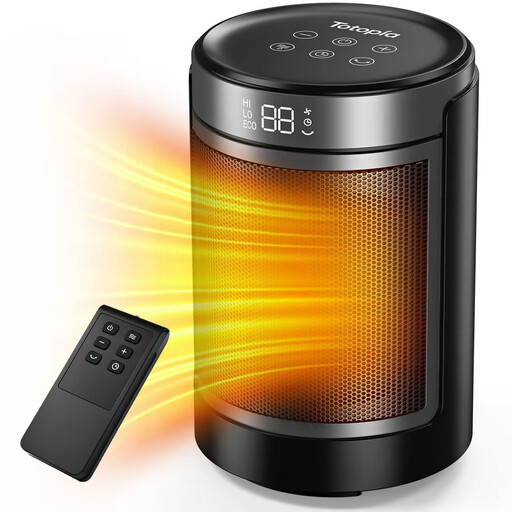
Why it suits this type of user: Four settings, including fan-only, 750 watts, 1500 watts and ECO, give beginners several options for a bedroom, office or study.
The low setting and ECO mode mean you don’t have to keep heating at maximum power. The timer can be set from 1 to 12 hours.
1500W heating, ceramic element, oscillation, LED display, remote control and tip-over protection.

Why it suits this type of user: This model is designed for quiet operation, precise temperature control and extra layers of protection for everyday use in a peaceful space.
The stated 5–35°C thermostat and three power settings help limit excessive heating. Dreo lists eight safety features, including tip-over and overheat protection.
1500W PTC heating, 12-hour timer, remote control and, according to Dreo, a noise level from 34 dB.

Why it suits this type of user: The 24-hour timer, four modes, oscillation and adjustable thermostat are well suited to longer working days at home or regular use in a living room.
According to the product specifications, the thermostat can be set from 5 to 35°C. The timer helps prevent the heater from running all day unintentionally.
1800W power, ECO mode, remote control, oscillation and stated noise settings of up to 38 dB.
We’ve put together a complete, up-to-date list of products that meet these strict selection criteria and the applicable European safety regulations.
Yes, a compact electric heater can be suitable for occasional supplementary heating. Ideally, choose a model with a thermostat, timer, overheat protection and tip-over protection. Place it on a hard, flat surface and keep bedding, curtains and furniture clear of the airflow. Don’t leave a heater running unattended.
That depends on the power rating and your electricity tariff. A 1500-watt model uses around 1.5 kWh per hour at full power. At an electricity rate of €0,30 per kWh, that works out at around €0,45 per hour. A thermostat, lower setting or ECO mode can reduce actual consumption, as the element won’t run continuously at full power.
Its lifespan depends on how it’s used, dust build-up, ventilation and proper storage. Only clean the heater when it’s switched off and has cooled down, don’t block the air intake, and don’t use it if the cable or housing is damaged. Check the warranty terms too; some of the models mentioned come with a limited one-year warranty.
