
Vandaag of morgen in huis

Kwaliteit gegarandeerd

Welkomstaanbiedingen ontgrendelen: GRATIS bezorging | Tot 80% korting | Gratis 30 dagen JoyPlus-proefperiode
Download de app
An electric heater can be a useful solution for a cold bedroom, home office or living room where the main heating system does not provide enough warmth everywhere. However, it is unwise to rely solely on terms such as “rapid heat”, “energy efficient” or “whisper quiet”. The right choice depends on the power output, how the heat is distributed and the safety features.
A 2000-watt heater can bring a room up to temperature more quickly than a 600- or 1000-watt model, but it also uses more electricity at full power. A 1500-watt appliance theoretically uses 1.5 kWh per hour when running continuously on its highest setting. The actual cost depends on your electricity tariff and how often the thermostat switches the heating element off.
An ECO mode can adjust the power output or pause operation once the set temperature has been reached. According to product information published by various brands, this can help limit consumption, but any claimed percentage is not a guaranteed saving for every household.
A fan heater moves warm air quickly, but the fan makes noise. For a bedroom or workspace, the stated dB level is therefore more important than the general description “quiet electric heater”. Also check whether the noise level applies on all settings or only on the lowest setting.
A convector heater without a fan generally operates more quietly, but it heats the room differently. An oil-filled radiator distributes heat more gradually and is less suitable when you want to feel a warm airflow within a few minutes.
A portable heater should be easy to move, but it must not be placed on a soft surface, bedding or a wobbly table. Look for a stable base, a sufficiently long cable and a handle positioned away from hot parts. Tip-over protection and overheat protection are important extras, but they do not replace safe positioning.
For a small personal area, such as under a desk, a low power output may be sufficient. For a medium-sized bedroom or office, models of around 1500 to 2000 watts are common. The required capacity also depends on insulation, ceiling height, outdoor temperature and draughts.
Use a heater primarily as supplementary electric heating. A portable model is not automatically designed to heat a poorly insulated home in its entirety.
An electric heater with a thermostat can maintain the set temperature more effectively than a model with only an on/off switch. A timer of 1 to 12 hours is practical for temporary use; some models offer a 24-hour programme. A remote control or app is particularly useful when the heater is next to a bed or on the other side of the room.
Also check whether the thermostat displays the temperature in degrees Celsius and whether the heater restarts automatically after a power cut. This is not stated for every product.
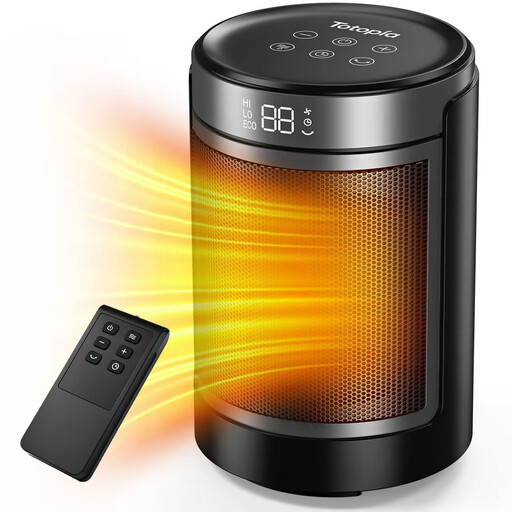
Why it suits this profile: This compact model offers fan-only, 750W, 1500W and ECO modes. This means you can start on a lower setting for a desk, bedroom or study.
The four settings mean you do not always have to run the heater at maximum power. The timer can be set from 1 to 12 hours; according to the product description, tip-over and overheat protection are also included.
PTC ceramic element, LED display, remote control, oscillation and a maximum power output of 1500W.

Why it suits this profile: With its higher power output, thermostat and remote control, this model is a good choice for anyone who values comfort, precise control and low noise levels in a medium-sized room.
The manufacturer states a noise level of 25–42 dB and a thermostat range of 5–35 °C. The claimed energy saving of up to 40% is a claim made by DREO and is not a guaranteed result in every home.
2000W PTC heating, 70° oscillation, 12-hour timer, remote control and multiple safety features according to the product information.

Why it suits this profile: This oil-filled radiator is designed to provide even heating in medium-sized rooms of up to 16 m², making it suitable for longer-term use in an office or bedroom, for example.
The three settings of 400W, 600W and 1000W provide more control than having only a maximum setting. The day-and-night thermostat can adjust the set operation while you are away.
Electronic thermostat, three power settings, and tip-over and overheat protection according to the product specifications.
We have put together a complete, up-to-date list of products that fully meet these strict selection criteria and the applicable European safety regulations.
Place an electric heater on a flat, hard and stable surface. Keep at least the distance specified in the manual; for many models, around one metre from curtains, bedding, paper and furniture is a practical safety guideline. Never cover the appliance or block the air inlet or outlet.
Preferably use a wall socket directly and avoid using a multi-socket extension lead with several appliances that together require a lot of power. Do not use a heater in a bathroom or near a washbasin unless the specific model is suitable for this. Unplug the appliance before cleaning, moving or storing it.
That depends on the power output and your electricity price. A 2000-watt model uses 2 kWh per hour when operating continuously at full power. A 600-watt model theoretically uses 0.6 kWh per hour. With a thermostat or ECO mode, average consumption may be lower because the heating element does not remain active continuously.
A ceramic heater can be suitable for temporary use in a bedroom, particularly when the model has a timer, thermostat and low stated noise level. Keep the appliance clear of bedding and curtains, and use the timer if you do not want it to run for long periods. Always follow the manufacturer’s safety instructions.
Lifespan varies depending on the model, frequency of use and maintenance. Keep ventilation openings free of dust, prevent the appliance from being dropped and only store it once it has cooled down completely. Before buying, check the warranty and the information about the manufacturer or responsible economic operator within the EU.
