
Vandaag of morgen in huis

Kwaliteit gegarandeerd

Welkomstaanbiedingen ontgrendelen: GRATIS bezorging | Tot 80% korting | Gratis 30 dagen JoyPlus-proefperiode
Download de app
An electric heater can be a practical solution for a cold bedroom, home office or living room. You can heat one room at a time without turning up the central heating. However, there can be a big difference between models. A low price says little about noise levels, controls, safety or electricity consumption during everyday use.
Pay particular attention to these three common pitfalls:
For an indoor space of around 10 to 25 m², the most important factors are the wattage, how the heat is distributed and the controls.
A ceramic heater generally uses a PTC heating element. This element produces heat without an open flame and is often combined with a fan. The advantage is that warm air is circulated into the room quickly. A portable electric heater with a ceramic element is therefore suitable for a home office or study where you want extra heat quickly.
A convection heater warms the air more gradually. This type is often quieter, but it is less suitable if you want to feel warm air immediately at your desk. For a permanent position in the living room, a convector heater with a thermostat and digital display can be a practical choice.
An electric fireplace is particularly appealing if appearance and a flame effect matter to you. The heating function is generally intended as supplementary heating. Always check that the stated coverage matches your room and look at the dimensions: a fireplace-style model takes up considerably more floor space than a compact fan heater.
The wattage is given in watts. A 2000-watt heater theoretically uses 2 kWh per hour when running continuously at full power. You can calculate the cost as follows:
power in kW × usage time × your electricity tariff
A thermostat can switch the heater off once the set temperature has been reached. This means the appliance does not run continuously at full power. A model with settings such as 900, 1300 and 1500 watts gives you more control than an appliance that can only be switched on or off.
Bear in mind that brand claims about savings are not guaranteed results. According to information provided by DREO, smart controls can reduce energy consumption by up to 40%. Treat this as a manufacturer’s product specification, not as a fixed saving for every Dutch home.
For a bedroom, office or study, a quiet heater is often more important than an especially high maximum temperature. Fan heaters make some noise because of their motor. Products with a stated noise level of 25 to 42 dB are quieter on paper than models around 50 dB, but the perceived experience also depends on the distance and the surface the heater is placed on.
An oscillation function distributes warm air across a wider angle. A range of 70 degrees can be useful in a living room or shared workspace. For a heater placed under a desk, a more focused airflow may be more comfortable.
A heater with a thermostat does not simply operate at maximum power. You set a temperature, after which the appliance adjusts its operation accordingly. A heater with a timer is useful when you want to set the operating time in advance. Some models offer a 12-hour timer, while others run for up to 24 hours.
Also check for:
Place the heater on a stable, dry and level surface. Follow the product instructions and keep the minimum required distance from curtains, furniture, bedding and other flammable materials. Never cover an electric heater or use it near a bath, shower or swimming pool unless the manual expressly permits this.
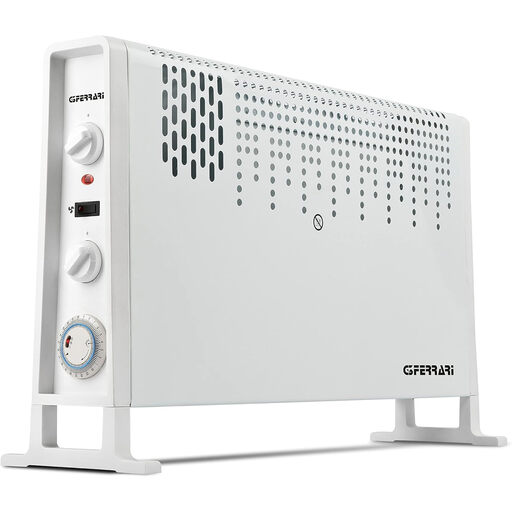
Why it suits this profile: This model is designed for straightforward operation and everyday use without a long list of smart features.
The product information positions this heater as a practical household model. Before buying, check the exact wattage and certification details on the packaging or in the manual.
Adjustable thermostat, compact design and overheat protection according to the product description.
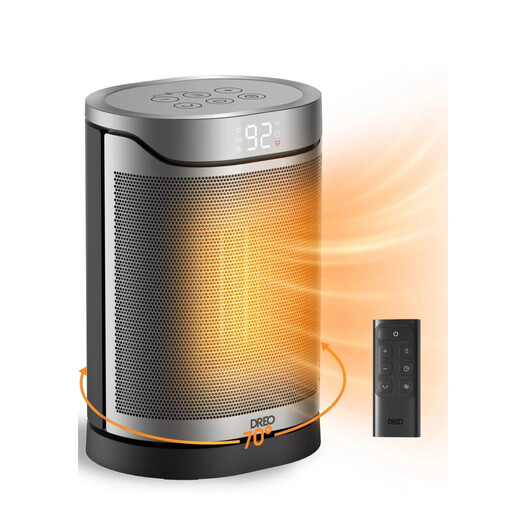
Why it suits this profile: Suitable for anyone looking for a quiet heater with precise temperature control and a remote control for a bedroom, office or living room.
The stated noise level is between 25 and 42 dB. The manufacturer also lists three power settings, so you do not always have to heat at 1500 watts.
1500-watt PTC ceramic heating, a temperature setting of 5–35 °C, a 12-hour timer, plus tip-over and overheat protection according to the product specifications.

Why it suits this profile: A sensible choice for anyone looking for a fixed heater for the living room or office, with convection heating, electronic controls and quiet operation.
The manufacturer states that it operates quietly and offers three settings. The heater is designed to be freestanding; maintain the prescribed distance from flammable materials.
2000 watts, electronic thermostat, LED display and integrated fan for improved heat distribution.
We have put together a complete, up-to-date list of products that fully meet these strict selection criteria and the applicable European safety regulations.
For a well-insulated room of around 10 to 20 m², models rated at 1500 to 2000 watts are commonly available. The capacity required depends on the ceiling height, insulation, outdoor temperature and desired room temperature. Use the stated floor area as a guide, not a guarantee.
That depends on the electricity and gas tariffs, the insulation and the room you are heating. For temporary use in one room, a portable electric heater can be practical. For heating an entire home over a longer period, it is wise to calculate the expected consumption in advance. A thermostat, lower power setting and timer can help prevent unnecessary heating for too long.
Always read the manual. Only use a model with suitable safety features and place the appliance away from bedding, curtains and furniture. A timer can limit the operating time, but it does not replace safe positioning. Switch the heater off and unplug it when you are not using it, unless the manufacturer specifically describes a different safe function.
