
Vandaag of morgen in huis

Kwaliteit gegarandeerd

Welkomstaanbiedingen ontgrendelen: GRATIS bezorging | Tot 80% korting | Gratis 30 dagen JoyPlus-proefperiode
Download de app
An electric heater seems simple: plug it in, choose a setting and you’re done. But models can vary considerably. A cheap fan heater, for example, can quickly blow out warm air, but it may also be inconveniently noisy. A ceramic heater may offer useful features, but an ECO mode doesn’t automatically mean low energy use in every room.
For a bedroom, office, student room, garage or workshop, the power output, controls and safety features are particularly important. Read on to find out what you should actually check before buying a portable heater.
A 2000W heater has a higher maximum output than a 1500W heater, but that doesn’t mean you’ll always need 2000 watts. In a small, reasonably well-insulated room, 1500 watts may be enough. A cold garage or workshop may need more power.
Maximum output also tells you nothing about the quality of the thermostat, how well the heat is distributed or how noisy the heater is. So look at how you’ll use the heater as a whole, rather than just the number on the packaging.
An electric heater converts electricity into heat. When running at maximum output, a 2000-watt model uses up to around 2 kWh in one hour. A 1500-watt model uses up to around 1.5 kWh in the same conditions.
A thermostat, timer and ECO setting can help you spend less time heating at full power. However, actual energy use depends on the temperature you set, the insulation, the outside temperature and the size of the room. An energy-efficient heater is therefore most useful when you make good use of its controls.
An electric heater is often placed on the floor and may be moved around. Check whether the model has overheat protection and tip-over protection. These features don’t replace safe use: place the heater on a stable, dry surface, keep the air vents clear and don’t put curtains, clothing or paper directly next to it.
Only use a heater indoors if the product information says it is suitable for indoor use. Never cover the appliance, use it with wet hands or place it near water.
As a practical guide, you can look at:
For a garage, workshop or construction site, pay particular attention to draughts, dust, damp and the manufacturer’s requirements. A standard portable heater isn’t automatically suitable as a construction heater or for long-term use in a harsh environment.
A heater with a thermostat doesn’t run continuously at the same setting. You set your preferred temperature, then the appliance adjusts how it operates using its built-in controls. Check whether you can set a specific temperature or choose from just a few settings.
A heater with a timer is useful if you want it to switch off after a set period. A 24-hour timer offers more options than a simple on-off timer. Don’t use the timer as a reason to leave a heater unattended or running while you sleep; always follow the manual and safety instructions.
A fan heater actively circulates warm air. This can help distribute heat quickly, but the fan makes a noise. For a bedroom or office, a stated noise level, such as 34 dB according to the product information, is more useful than a general claim like “whisper-quiet”.
Also check the weight, dimensions and whether there’s a handle. A portable heater that you can move safely is practical if you want to heat your office during the day and your bedroom in the evening. A remote control or touch controls can make the heater easier to use, but won’t affect its maximum energy use.

Why it suits this type of user: This compact 1500W model is designed for smaller living spaces, offices and bedrooms. The remote control, thermostat and timer make it easy to manage.
The stated power output is clear, and the product information lists a thermostat, 12-hour timer and several layers of protection. DREO states that the noise level is 34 dB on the quiet setting; check the manual for the conditions under which this applies.
1500W PTC heating, temperature settings from 5–35 °C, dimensions of 15.8 × 15.4 × 25 cm and a stated weight of 1.44 kg.

Why it suits this type of user: This model offers more power and extensive controls for living rooms, basements, garages and offices where faster heating is preferred.
The product information lists an adjustable thermostat, 24-hour timer, overheat protection and tip-over protection. PELONIS says the ECO mode adjusts how the heater operates according to the ambient temperature; actual energy use will still depend on the room and settings.
2000W maximum output, five heat settings, temperature display, ceramic PTC technology and a concealed carry handle.
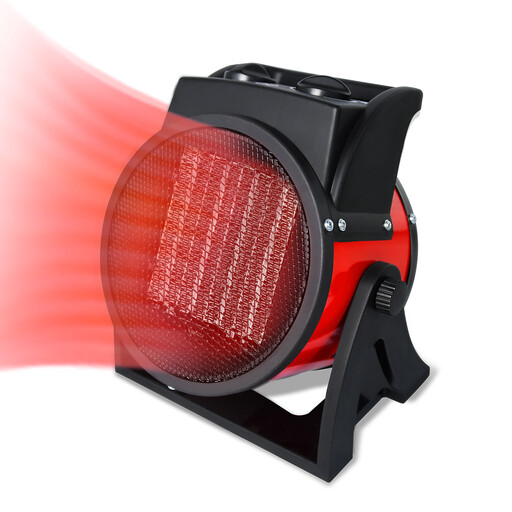
Why it suits this type of user: The product name and listing are aimed at use as a workshop, garage or construction heater. This makes it an option for anyone specifically looking for a more powerful model for a practical work environment.
The listing mentions a thermostat, PTC heating and three heat settings. Before using it in a garage or on a construction site, always check the full safety instructions and make sure the location is suitable.
2 kW output, ceramic PTC heating element, thermostat and three heat settings according to the available product information.
We’ve put together a complete, up-to-date list of products that meet these strict selection criteria and the applicable European safety requirements.
It depends on the floor area, insulation, ceiling height and temperature you want. A 1500W heater may suit a smaller room, while 2000 watts offers more capacity for a larger or draughty space. Don’t use maximum output as your only buying criterion.
Not necessarily. Both types can use a relatively large amount of electricity when running at maximum output. A ceramic fan heater may come with a thermostat, ECO mode or several settings. Any savings stated by the manufacturer aren’t a guarantee of the same results in every home.
This isn’t recommended unless the manual expressly allows it and you follow the safety requirements. A timer can limit how long the heater runs, but always keep it away from flammable materials, don’t cover the appliance and make sure it’s stable.
