
Vandaag of morgen in huis

Kwaliteit gegarandeerd

Welkomstaanbiedingen ontgrendelen: GRATIS bezorging | Tot 80% korting | Gratis 30 dagen JoyPlus-proefperiode
Download de app
An electric heater can quickly add extra warmth to a bedroom, home office, living room, garage or workshop. But it’s not wise to choose one based solely on its wattage or claims such as ‘fast heating’. A 2,000-watt model won’t automatically suit every room, and a feature-packed ceramic fan heater can be impractical if the controls or safety information are lacking.
As a Joybuy Product Recommendation Officer, I’ve picked out the key product specifications for you. This will help you spot marketing claims, avoid a poor purchase and choose a portable heater that suits your space and how you plan to use it.
An electric heater rated at 2,000 watts uses around 2 kWh per hour at full power. At an electricity rate of, for example, €0,30 per kWh, that works out at approximately €0,60 per hour. Your actual costs will depend on the selected power setting, the thermostat, how well the room is insulated and how long you use the heater.
So a higher wattage mainly means the appliance can use more electricity. A lower setting may be enough for a small bedroom or workspace. For an unheated garage or building site, power, airflow and suitable safety features are more important.
Noise levels aren’t always measured under the same conditions, so check whether the brand gives a specific decibel rating. For example, the PELONIS 2000 W PTC Ceramic Fan Heater is listed at 50 dB. That’s a product specification, not a guarantee that every user will find the heater quiet in every room.
An ECO mode won’t automatically lower your energy bill either. According to PELONIS’s product description, this mode adjusts the power to the ambient temperature. Consumption still depends on the temperature setting, insulation and how long the heater is switched on.
Tip-over protection and overheating protection are important features, but they don’t replace safe use. Place an electric heater on a stable, dry, hard surface. Keep textiles, curtains, furniture and other flammable materials at least 1 metre from the hot air outlet. Never cover the appliance, and don’t use a portable heater in a bathroom or other damp room.
Also check the manual, plug type, voltage and whether the product includes relevant information for the European market. A CE mark indicates conformity; also check the manufacturer and responsible person details, as well as the safety instructions.
Models rated at 1,500 to 2,000 watts are commonly available for living and working spaces. Don’t just look at the stated coverage in square metres. Also consider:
A ceramic heater with a PTC element regulates heat output using a ceramic heating element. This differs from a construction heater or fan heater, which is designed mainly to move air powerfully in larger or less comfortable spaces.
A heater with a thermostat can automatically adjust its heat output around your chosen temperature. A display makes settings easier to see, while a heater with a timer helps prevent the appliance from running longer than necessary. Check whether the timer only switches the heater off automatically or can be programmed with multiple settings.
A heater with a remote control is handy for a bedroom or living room. Oscillation can be useful in an office if several people want to feel the warmth. For a desk, a compact model without a wide airflow can sometimes be more comfortable.
Look for at least:
Features such as a child lock or quiet mode can be useful, but always read the full user manual. Don’t leave a heating appliance running unattended in a room where children or pets can easily reach it.
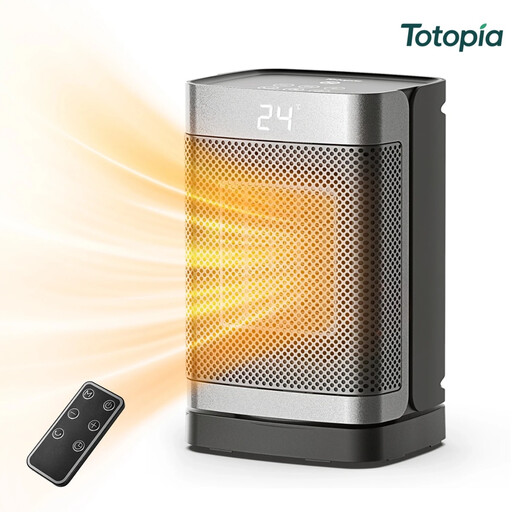
Why it suits this type of buyer: This compact model is designed for bedrooms, offices and study rooms. Two heat settings, a timer and a remote control keep operation straightforward.
The stated power and settings are clearly listed. Automatic shut-off after a maximum of 12 hours helps prevent unnecessarily long use.
PTC heating, 1000W and 1800W settings according to the specification, remote control, 12-hour timer, and tip-over and overheating protection.

Why it suits this type of buyer: Its wide temperature range, ECO function, oscillation and remote control make it well suited to regular use in a bedroom, living room or office.
Rather than simply claiming to be ‘energy-efficient’, the product information gives a temperature range of 5°C to 35°C and an ECO mode.
1800W power, 24-hour timer, four settings, oscillation, remote control, and tip-over and overheating protection.
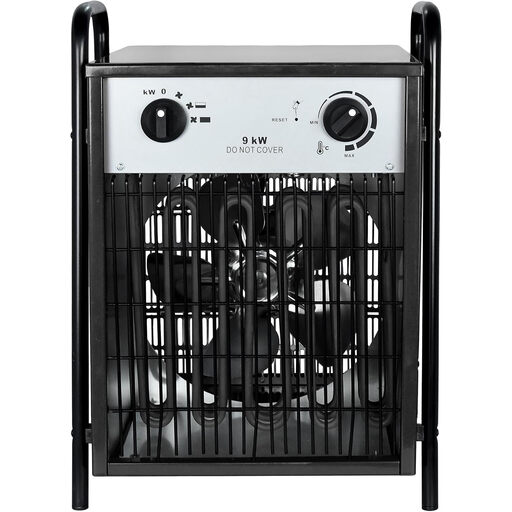
Why it suits this type of user: The product name positions this model as a fan heater for workshops, garages, warehouses and building sites. This makes it a targeted choice for professional or more intensive use.
The high stated power makes it clear straight away that this isn’t an ordinary heater for a small bedroom. Check the circuit, connection and manual before buying.
9KW rating, four heat settings according to the product name, and overheating protection. Check the full product specifications to make sure it suits your connection.
We’ve put together a complete, up-to-date list of products that meet these strict selection criteria and the applicable European safety requirements.
The calculation is: power in kW × electricity rate × usage time. A 2,000-watt model uses around 2 kWh per hour at full power. At €0,30 per kWh, that’s approximately €0,60 per hour. A lower setting or thermostat can reduce average consumption, but the exact cost depends on the circumstances.
A ceramic heater converts electrical energy into heat, just like other electric heaters. PTC technology can offer stable control and different heat settings, but it doesn’t automatically make the appliance more energy-efficient. Focus on the power rating, thermostat, timer and length of use.
That’s only safe if the manual allows it and the appliance is stable and kept clear of flammable materials. A timer and overheating protection are useful, but never leave a heater covered or running unattended. For a bedroom, key things to look for include a low setting, clear temperature control and automatic shut-off.
