
Vandaag of morgen in huis

Kwaliteit gegarandeerd

Welkomstaanbiedingen ontgrendelen: GRATIS bezorging | Tot 80% korting | Gratis 30 dagen JoyPlus-proefperiode
Download de app
An electric heater can quickly make a home office, bedroom or student room more comfortable. However, not every fan heater is suitable for every room. A high wattage, for example, says little about noise levels, controls or actual electricity consumption during everyday use.
As a Joybuy Product Recommendation Officer, I assess product information based on practical, verifiable points. This helps you avoid paying solely for a striking marketing claim.
A 2000 W heater can deliver heat quickly, but at full power it uses around 2 kWh per hour. Costs depend on your energy tariff and how long you use it. An ECO mode or thermostat can limit consumption by ensuring the heating element does not operate continuously at maximum power. This does not automatically make a heater energy-efficient: its position, insulation, room size and usage time remain decisive factors.
A quiet electric heater is particularly useful in a bedroom, study or office. Check whether the noise level is stated in dB and under which conditions it was measured. The Philips CX2120/01, for example, lists 24 dB(A), while the DREO Solaris 628 gives a range of 25–42 dB. These figures are not directly comparable, but they provide more useful guidance than simply using the word “quiet”.
Look for specific features such as tip-over protection, overheat protection, automatic shut-off and a heat-resistant housing. A CE marking is relevant for the European market, but it is not a quality ranking. Read the user manual too: a safety feature does not replace a stable surface and sufficient clearance.
Some product listings may also contain discrepancies. The Totopia is described as a 1500W model, while part of the description states 2000W. Before buying, therefore, check the technical specification sheet and the wattage shown on the product itself.
For personal supplementary heating or a small room, a model rated between 600W and 1500W may be more practical. Models rated between 1800W and 2000W are available for medium-sized rooms. Do not look only at maximum power; consider the number of heat settings too. A heater with 750W and 1500W settings, such as the Totopia, gives you more choice than a model that operates at just one level.
The stated coverage area is a guideline. A 15 m² room with good insulation places less demand on a heater than a draughty room with high ceilings.
A ceramic PTC heater uses a ceramic heating element. PTC stands for Positive Temperature Coefficient: the electrical resistance changes as the element gets hotter. Manufacturers often associate this with fast, stable heating. According to DREO’s own information, Hyperamic technology provides rapid heat and an even airflow; this is a brand claim, not a universal guarantee for every room.
An electric fan heater distributes heat using a fan. An oscillating heater also moves horizontally, for example through 70° or 90°, allowing the warm air to reach a wider area. This is useful when several people are in the room. For one fixed workstation, oscillation may be less essential.
A heater with a thermostat can follow the set temperature more accurately than a simple on/off model. Check the temperature range and adjustment options. The DREO Solaris 628 lists a range of 5–35 °C; the OmniHeat lists the same range. A heater with a timer is practical when you want the heating to switch off after a set period. On the selected models, timers range from 12 to 24 hours.
A heater with a remote control is convenient when you are in bed or sitting at a desk. Check, however, whether the key functions are also available on the appliance itself, so you are not reliant on the remote control alone.
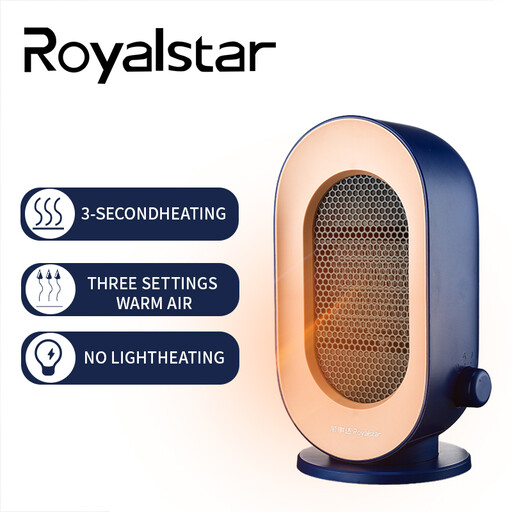
Why it suits this profile: The low power output is suitable for a desk, small study or personal workspace where you need targeted extra warmth.
The three heat settings make usage easier to control than with a heater without adjustable settings. The product information also lists tip-over and overheat protection.
600W maximum power, compact design, three heat settings and tip-over protection.

Why it suits this profile: Suitable for anyone who values temperature control, quiet operation and comprehensive safety features in a medium-sized room.
The stated noise range of 25–42 dB and adjustable thermostat provide more concrete information than simply describing a product as “quiet” or “efficient”.
2000W power, 5–35 °C thermostat, 70° oscillation, 12-hour timer and multiple safety features according to the product description.

Why it suits this profile: Useful for people who regularly move between the living room, office, bedroom or student room and want automatic control.
The ECO mode, adjustable thermostat and 24-hour timer help prevent unnecessary continuous heating at maximum power. It is still important to monitor actual usage.
2000W PTC heating, ECO mode, five settings, thermostat, 24-hour timer and carry handle.

Why it suits this profile: A lightweight portable heater for rooms of up to approximately 15 m², prioritising low noise and simple operation.
The product information states 24 dB(A), 600W and 1500W settings, as well as automatic shut-off in the event of a tip-over or overheating.
1500W maximum power, weight of 1.51 kg, built-in carry handle and five listed safety features.
We have put together a complete, up-to-date list of products that fully meet these strict selection criteria and the applicable European safety regulations.
A 1500W model theoretically uses 1.5 kWh per hour at full power. A 2000W model uses around 2 kWh per hour. Multiply this by your electricity tariff and the number of hours you use it. A thermostat or ECO mode can reduce average consumption once the desired temperature has been reached.
According to product information, PTC technology can provide stable heat and efficient control. However, overall consumption is primarily determined by the power rating, set temperature, insulation and length of use. Compare the settings and thermostat rather than relying solely on the word “ceramic”.
Place the heater upright on a flat, hard surface with clear space around the air vents. Keep textiles and furniture at a safe distance, do not use a soft surface such as bedding, and unplug the appliance before moving it.
