
Vandaag of morgen in huis

Kwaliteit gegarandeerd

Welkomstaanbiedingen ontgrendelen: GRATIS bezorging | Tot 80% korting | Gratis 30 dagen JoyPlus-proefperiode
Download de app
An electric heater can quickly make a cold bedroom, home office or garage more comfortable. However, there are big differences between models. A compact ceramic heater for your desk serves a different purpose from a powerful workshop heater. If you only look at the wattage or a low price, you could end up with unnecessarily high electricity costs, not enough heat or a heater that isn’t suitable for your room.
In this guide, the Joybuy Product Recommendation Officer explains what to look for and which models suit different needs.
A 2000W heater can produce more heat than a 600W model, but it also uses more electricity when running at full power. For a desk or small bedroom, 600W to 1500W may be enough. A large, draughty room may need more heating capacity or a different heating solution.
Also check the available capacity of your home’s electrical circuit. A 2000W electric heater uses around 2 kWh if it runs continuously at full power for one hour. The actual cost depends on your energy tariff and how often the thermostat switches on the heating element.
A ceramic fan heater with a PTC element can automatically regulate its heat output and warm up quickly. This doesn’t necessarily mean it uses less energy than every other electric heater. Energy use is mainly determined by the power rating, how long you use it, the temperature setting and how well insulated the room is.
A thermostat, ECO mode and timer can help prevent unnecessary heating. Check that the product description clearly explains how these features work.
A heater with tip-over protection will usually switch off if it is knocked over. A heater with overheat protection may switch off if the temperature gets too high. These features are useful, but they don’t make unsafe use safe.
Always place an electric fan heater on a hard, level surface. Keep it away from curtains, bedding, paper and furniture. Never cover the air intake or outlet, and don’t use a heater in a damp room unless it is specifically designed for that purpose.
Power is measured in watts. A compact room heater rated at 600W is mainly suited to personal warmth, for example at a desk. Models rated from 1500W to 2000W are often better suited to a bedroom, office or small living room. A workshop or construction-site heater rated at 3 kW, 5 kW or 9 kW is designed for a different purpose and requires extra care with the connection, ventilation and instructions.
A stated coverage area, such as 10 or 15 m², is a guide rather than a guarantee. Insulation, ceiling height, draughts and the outdoor temperature can all have a significant effect on performance.
A ceramic heater uses a PTC heating element. PTC stands for Positive Temperature Coefficient: the electrical resistance changes as the element gets warmer. Product information often links this to fast, stable heat output. This is presented by the relevant brands as an advantage of their technology; always check the specific settings, power rating and safety information for the model itself.
A ceramic fan heater blows warmed air into the room. Oscillation, for example 45°, 70° or 90°, can spread the airflow over a wider area. This won’t automatically heat the whole room evenly, but it can be useful when several people are sitting in different places.
A heater with a timer is useful if you want to set a time for it to switch off. Some models offer 12 hours, while others offer 24 hours. A remote control, digital display or app control can be handy in the bedroom or living room, but it also adds extra electronics and settings.
Also check whether the thermostat lets you set a target temperature or simply switches between low and high settings. This determines how precisely you can control the heating.
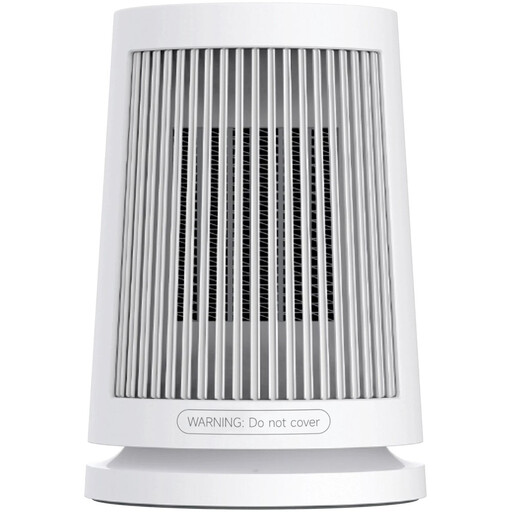
Why it suits this profile: This compact model, measuring 142 × 132 × 188 mm and weighing 0.93 kg, is designed for a desk, small bedroom or personal workspace.
Its lower power rating means you don’t need to choose a powerful 2000W model straight away for a small area. The product information also lists tip-over and overheat protection.
600W PTC heating, 45° oscillation and a compact, portable design.

Why it suits this profile: According to the product information, this compact model is designed for indoor spaces of up to around 15 m². It has several settings for bedrooms, offices or studies.
The specifications list 600W and 1500W settings, so you don’t always have to heat at full power. Tip-over and overheat protection are also listed.
Three temperature settings, a carry handle, a maximum power of 1500W and a stated noise level of 24 dB(A).
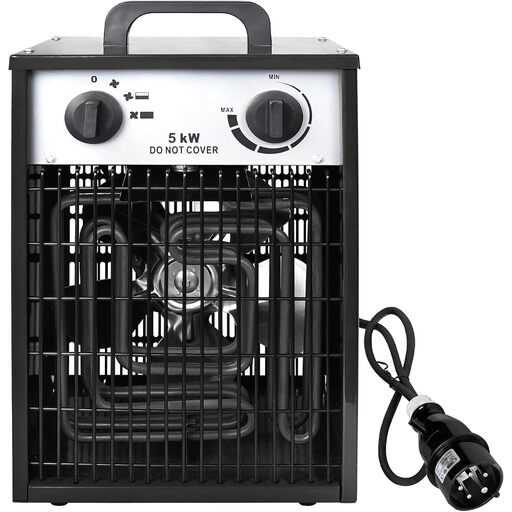
Why it suits this profile: Its high heating capacity is intended for workshops, garages, warehouses and construction sites, not small bedrooms or desks.
Its intended use and power rating are clearly different from those of a portable heater for the home. Before buying, check that your electrical connection is suitable.
5KW power, four heat settings and a design for larger workspaces.
We’ve put together a complete, up-to-date list of products that meet these strict selection criteria and the applicable European safety requirements.
A CE mark indicates that the manufacturer declares the product meets relevant European requirements. Also look for clear warnings, manufacturer or importer details, a model number and warranty terms. The statutory guarantee in the EU is separate from any commercial warranty offered by the brand.
This mainly depends on its power rating and how long you use it. A 2000W heater uses around 2 kWh if it runs continuously at full power for one hour. A thermostat, lower setting and timer can reduce the number of hours it runs. Work out your costs using the rate in your own energy tariff.
A 600W to 1500W model may be suitable for a small bedroom or personal workspace. Larger or poorly insulated rooms may need more power. Use the stated coverage area as a guide only, and take draughts and insulation into account.
Always check the instructions. A timer and tip-over or overheat protection are useful features, but they don’t replace supervision or correct placement. Keep the heater clear, don’t cover it and unplug it when you’re not using it.
