
Vandaag of morgen in huis

Kwaliteit gegarandeerd

Welkomstaanbiedingen ontgrendelen: GRATIS bezorging | Tot 80% korting | Gratis 30 dagen JoyPlus-proefperiode
Download de app
An electric heater seems simple: plug it in and turn on the heat. Yet many households buy a model that is unsuitable for the room, too noisy or awkward to use every day. Students, people working from home and office users in particular often look for a compact supplementary heater that provides quick warmth without unnecessary features.
When comparing models, do not focus solely on an impressive wattage or a promise such as “warm in seconds”. The right choice depends on the room, your preferred controls and the available safety features.
A 2000W heater can provide powerful heating, but that does not automatically mean every model is suitable for a large living room. Insulation, ceiling height, draughts and the desired temperature also play a part. Always check the stated coverage in square metres and treat it as a guide, not a guarantee.
For a desk, bedroom or study, 600W to 1500W is often more practical. For a larger or colder room, 1800W or 2000W may provide more capacity.
An electric heater converts electricity into heat, but consumption mainly depends on the power rating and how long it is used. A model with an ECO mode, thermostat or timer can make operation more convenient, but it does not automatically save energy in every situation.
Example calculation: a 2000W heater running at full power for one hour theoretically uses 2 kWh. A 1000W setting uses approximately 1 kWh over the same period. Calculate the actual cost using:
consumption in kWh × your electricity tariff
A thermostat can prevent the appliance from heating unnecessarily. However, check whether the model actually adjusts its power output or merely displays a temperature setting.
A heater with tip-over protection switches off, according to the product description, when the appliance falls over. Overheating protection is also useful. Neither feature makes covering the heater, placing it near curtains or using it on bedding safe.
Use a heater on a flat, stable and dry surface. Following the supplied warnings, keep it approximately one metre away from curtains, paper, furniture and other flammable materials. Ideally, connect a powerful model directly to a suitable wall socket and check the manual before using an extension lead.
A ceramic heater usually uses a PTC element. A ceramic fan heater blows heated air into the room, providing quick, localised warmth. This type is useful when you want to feel heat immediately beside a desk or sofa. Oscillation, such as 70° or 90°, helps distribute the airflow across a wider area.
A convector heater warms the air without necessarily requiring a fan. This can be useful in a bedroom or home office where quiet operation matters. Some convector models include a built-in fan to provide additional air circulation.
As well as the maximum power, look at the lower settings. A unit offering, for example, 600W, 1200W and 2000W gives you more flexibility than one that only operates at full power. For prolonged supplementary heating, a lower power setting is often more practical than repeatedly switching the heater on and off.
Also check:
A quiet heater is particularly useful in bedrooms, home-working spaces and studies. A stated noise level in dB is useful for comparison, but the experience may vary depending on the fan setting and the surface the heater is placed on.
A heater with a timer prevents the appliance from running for longer than necessary. A remote control is useful when the heater is beside the sofa or under a desk. For everyday use, a display, child lock, oscillation and an easily accessible on/off button may be more important than an extensive app.

Why it suits this profile: Compact, portable and suitable for rooms of up to 15 m² according to the product description. This makes it a good fit for a student room, home office or small bedroom.
According to Philips, the adjustable settings include 600W and 1500W. You therefore do not always have to heat at maximum power.
According to the product information: 24 dB(A), ceramic heating, handle, tip-over protection and overheating protection.

Why it suits this profile: Suitable for anyone who values temperature control, a remote control and quiet operation in a living room or home office.
The product description states a thermostat range of 5–35°C, a timer of up to 12 hours and 70° oscillation. Check which features are included in the supplied version when purchasing.
According to DREO’s own product information: noise level of 25–42 dB, 2000W power and multiple layers of safety protection.
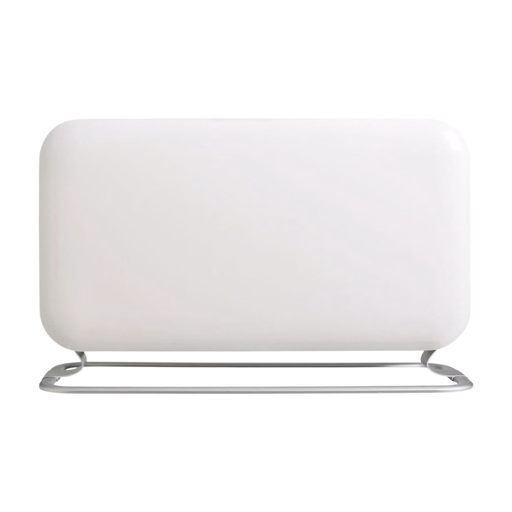
Why it suits this profile: A convector heater for anyone who values even warmth and quiet operation in a larger living room or office.
This is not a small fan heater that mainly provides immediate warmth from its airflow: the product description mentions convection heating, an electronic thermostat and three settings.
According to the product specifications: 2000W power, LED display, electronic thermostat and a stated coverage of up to 20 m².
We have compiled a complete, up-to-date list of products that fully meet these strict selection criteria and the applicable European safety regulations.
That depends on the power rating, how long you use it and your electricity tariff. A 2000W model running at full power for one hour theoretically uses 2 kWh. A thermostat, lower setting and timer can limit the number of hours it runs, but they do not automatically make the appliance energy efficient.
Use the manufacturer’s stated room coverage as a starting point. For a small office or bedroom, 600W to 1500W may be sufficient. For a larger or draughty room, 1800W to 2000W may be more suitable. Also measure the available space and check the clearance around the appliance.
Only if the manual permits this and the heater has been positioned correctly. A timer, thermostat, tip-over protection and overheating protection are useful features, but do not run the appliance covered or close to bedding. Switching it off and unplugging it when you are not using the heater remains the simplest precaution.
