
Livraison le jour même et le lendemain

Qualité garantie

Débloquez vos offres de bienvenue: Livraison GRATUITE | Jusqu'à -80 % | 30 jours d'essai gratuits à JoyPlus
Téléchargez l'application
An electric heater can quickly make a cold bedroom, home office or student room more comfortable. However, the differences between models go far beyond the wattage shown on the packaging. A compact heater with lots of features is not automatically suitable for your room, while a powerful model may use unnecessarily large amounts of electricity if used incorrectly.
As a Joybuy Product Recommendation Officer, I therefore focus mainly on verifiable specifications: power, controls, safety features, dimensions and intended use.
Hot air produced quickly does not mean that a heater can efficiently warm an entire home. An electric fan heater mainly heats the air that is blown directly out of it. That can be practical for a desk, bedroom or small seating area, but coverage may be limited in a large living room.
Pay attention to:
An ECO mode can adjust the power based on the set temperature or ambient temperature. This may help reduce the amount of time the heater operates at full power, but consumption mainly depends on how long it is used, the level of insulation and the desired temperature.
A simple calculation is:
power in kW × number of hours used × your electricity tariff = estimated running cost
A 2000W heater therefore uses 2 kWh per hour when operating at full power. A thermostat or ECO mode can limit how long it runs, but electric heating is not free.
Check that the product description clearly mentions overheat protection and tip-over protection. Also read the operating instructions carefully. A heater must not be covered and should stand on a flat, stable, hard surface. Keep curtains, bedding, paper and furniture at a safe distance.
Where possible, plug a portable electric heater directly into a suitable wall socket. Avoid using extension leads and multi-plug adaptors if the manual advises against them.
A 1500W heater is often practical for a personal workspace, bedroom or smaller study. A 2000W heater can deliver heat more quickly in a larger room, but it also uses more electricity when operating at full power.
Look beyond the wattage and consider the size. A compact heater with a handle is easy to move, while a convection heater takes up more floor space but is often quieter.
A ceramic heater or ceramic fan heater uses a PTC heating element. Product information often describes this as providing fast and stable heating. According to the product specifications of the relevant brands, PTC technology may also help achieve a lower surface temperature than some other heating elements. Treat this as product information, not a universal guarantee for every model.
A heater with a thermostat gives you more control than a model with only an on/off switch. A heater with a timer can switch off automatically after a set period. This is useful when you want temporary warmth while working or reading.
With oscillation, the heater turns from side to side. A wide angle, such as 70° or 90°, can distribute warm air over a larger area. A heater with a remote control is especially convenient beside the bed or from the sofa.
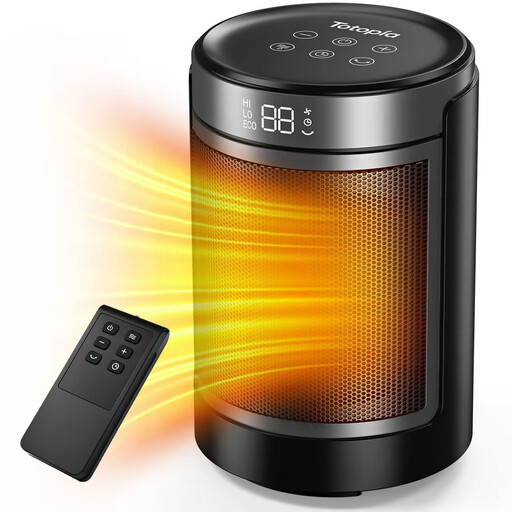
Why it suits this profile: The four settings — fan, 750W, 1500W and ECO — give beginners the flexibility to adjust the heat for a desk, bedroom or small seating area.
The 1–12-hour timer, tip-over protection and overheat protection make the features more tangible than simply claiming that the heater warms up quickly.
PTC ceramic element, LED display, remote control and wide oscillation.

Why it suits this profile: According to the product specification, this compact model is designed for rooms of up to 15 m² and offers 600W and 1500W settings.
The stated room size, multiple temperature settings and automatic switch-off provide clear information to help you make your purchase.
The product specification states 24 dB(A), a handle, five safety features and a temperature setting of 20–30 °C.

Why it suits this profile: For those planning longer periods of use, the stated ECO mode, thermostat, five settings and 24-hour timer are particularly useful.
The description mentions not only high power, but also control via the thermostat and ECO mode. According to PELONIS's own product specification, the ECO mode adjusts operation to the ambient temperature.
PTC ceramic heating, carry handle, tip-over protection and overheat protection.
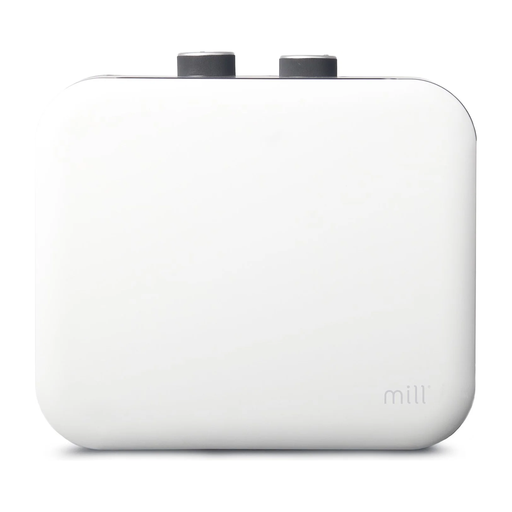
Why it suits this profile: This model is a good fit for home workers or households looking for a compact PTC heater with a mechanical thermostat for regular use.
The specifications list two power settings of 1200W and 1800W, a thermostat, tip-over protection and overheat protection.
Dimensions of approximately 13.4 × 25.2 × 22.8 cm, a weight of approximately 2.2 kg and a stated coverage of up to 30 m².
We've put together a complete, up-to-date list of products that fully meet these strict selection criteria and the applicable European safety regulations.
It can be, particularly if you choose a compact model with a thermostat, timer, tip-over protection and overheat protection. Check the noise level beforehand and position the heater away from bedding and curtains. Do not leave it running unattended if the manual advises against this.
This depends on the power and your electricity tariff. A 1500W heater uses approximately 1.5 kWh per hour at full power. A 2000W heater uses approximately 2 kWh per hour. Using a lower setting or thermostat may reduce actual consumption, depending on how often the element switches on.
The service life varies by model, frequency of use and maintenance. Keep the ventilation openings free from dust as instructed in the manual, move the appliance carefully and store it in a dry place. A clear manufacturer's warranty and an available manual are useful points to check before buying.
