
Vandaag of morgen in huis

Kwaliteit gegarandeerd

Welkomstaanbiedingen ontgrendelen: GRATIS bezorging | Tot 80% korting | Gratis 30 dagen JoyPlus-proefperiode
Download de app
A chilly study, a draughty living area, or a bedroom that never seems to warm up. An electric heater might seem like a quick fix, but the market is flooded with models that promise more than they can deliver. Many people fall into marketing traps, ending up with a noisy power-guzzler or a device that malfunctions after just one winter.
Before you make a choice, it's crucial to recognise the most common pitfalls:
To avoid a bad purchase, focus on the specifications that truly matter. These are the non-negotiable features for effective and safe supplemental electric heating.
Most modern heaters use ceramic heater technology, also known as PTC (Positive Temperature Coefficient). Unlike a traditional fan heater with a glowing heating coil, a PTC element has a self-regulating property.
A ceramic heater is therefore often a smarter choice for long-term and unattended use, for example, as a heater for a bedroom.
This is where you'll find the real savings. An energy-efficient heater is one that only runs when it's needed.
A heater with a remote control adds an extra layer of convenience, allowing you to adjust settings from your chair or bed.
Safety comes first. Always check if a model is equipped with:
For comfort, a quiet heater is essential. A noise level below 40 dB is generally considered quiet, comparable to a peaceful library. Models specifically designed for bedrooms can even operate at around 34-35 dB on their lowest setting.
Based on these criteria, we have selected a few models that suit different user profiles.
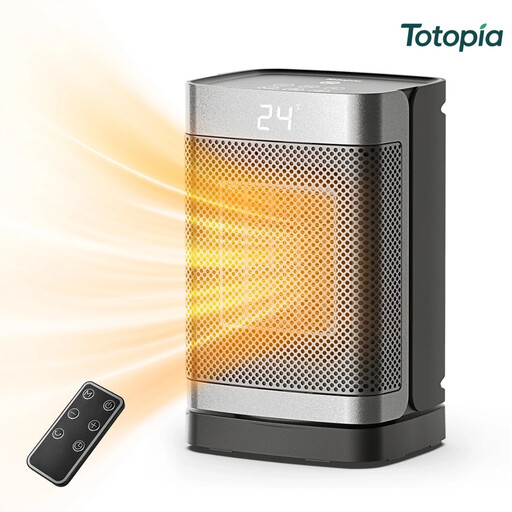
Why This Fits Their Persona: This compact model is ideal for smaller spaces like a dorm room or a desk area. It delivers heat quickly and has all the modern conveniences without taking up much space.
It bypasses the "energy-efficient" myth by offering an adjustable thermostat and a 12-hour timer. This way, you only heat when necessary and don't waste electricity.
Compact size with full functionality, including a remote control, oscillation, and the required tip-over and overheat protection.
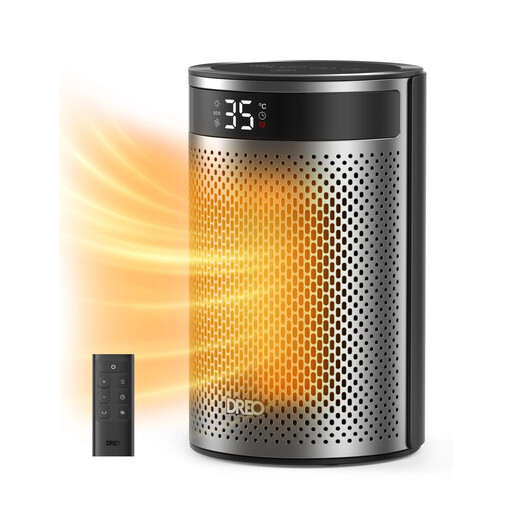
Why This Fits Their Persona: Specifically designed for those who value silence. Ideal for the bedroom or a quiet workspace where concentration or an undisturbed night's sleep is a priority.
This heater tackles the "noisy powerhouse" pitfall. According to the manufacturer Dreo, its HyperSilent technology ensures a noise level starting at 34 dB, confirming its focus on quiet operation.
The combination of quiet operation, a precise thermostat (5-35°C), and comprehensive safety features makes this a highly suitable heater for the bedroom.
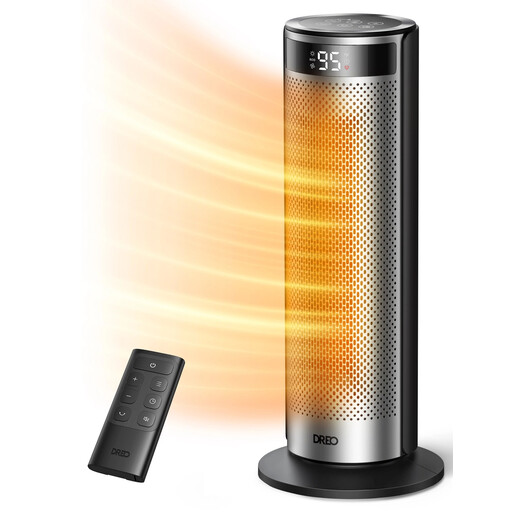
Why This Fits Their Persona: With 2000W of power and a tower design, this model is suitable for effectively heating medium to large spaces like a living room or an open-plan office. The oscillation feature ensures wide heat distribution.
Its high power is kept in check by a precise thermostat and an ECO mode. According to Dreo, this can regulate energy consumption, giving you power without unnecessary costs.
Combines high power (2000W) for rapid heating with relatively quiet operation (from 25 dB) and extensive safety features, including a child lock.
We have compiled an up-to-date list of products that meet these strict selection criteria and safety standards.
The cost depends on the heater's power rating and your current electricity price. The calculation is simple: (power in kilowatts) x (price per kilowatt-hour).
A 1500-watt heater is 1.5 kilowatts (kW). At an electricity price of, for example, $0.30 per kilowatt-hour (kWh), using this heater at full power costs: 1.5 kW * $0.30/kWh = $0.45 per hour. However, a model with a good thermostat and ECO mode will not run continuously at full power, which reduces the final cost.
Not in terms of pure efficiency, but in effective use. Both ceramic and traditional heaters convert almost all electricity into heat. The advantage of a PTC ceramic heater is that it distributes heat more evenly and self-regulates. Combined with a thermostat, this leads to a more stable room temperature and less wasted energy, often making it a more economical choice in practice.
As a rule of thumb for supplemental heating in a reasonably insulated room, you can count on about 75 to 100 watts per square meter (m?).
Keep in mind that this is an estimate. The quality of insulation, ceiling height, and the number of windows also affect the required capacity.
