
Slicing ham thinly
You mainly use the machine to prepare cooked ham for a meal with others, and want to check which blade is included and how to adjust the slice thickness before you buy.


For thin slices of cooked ham, a model supplied with a suitable smooth deli blade is a sensible first choice. Also check the thickness setting and whether your piece of ham will fit through the machine. If you’re sharing a meal, a food holder, a stable base and parts you can clean according to the instructions are important too. A stated slicing range alone doesn’t guarantee a particular result with every piece of ham.
You mainly use the machine to prepare cooked ham for a meal with others, and want to check which blade is included and how to adjust the slice thickness before you buy.
After slicing, you want to be able to clean the parts that have come into contact with the ham, and you’re looking for a food holder and a stable base.
You have limited worktop or storage space, so you compare the dimensions and any folding feature, not just the blade.
The percentages show each consumer’s main purchasing priority among those considering an electric slicer for cooked ham.
| What to consider | What to look for | Who is this important for? |
|---|---|---|
| Thin, practical slices | Check the exact model, the blade supplied and the adjustment range. | If I’m slicing ham for a shared meal, I want to check the blade and the thickness I need in advance. Around 33% of consumers who prioritise thin slices of ham put this first. |
| Safe use and cleaning | Check the food holder, how the machine sits on the worktop and the cleaning instructions for that specific model. | If you want to clean the machine thoroughly after slicing, check the food holder and which parts can be cleaned according to the instructions. Around 27% of consumers give safe use and cleaning their highest priority. |
| Worktop and storage space | Measure your worktop and storage space, then compare them with the dimensions of the exact model. | If I have limited space, I want to know whether the machine will fit while I’m using it and where I can store it afterwards. Space is the top priority for around 20% of consumers. |
| Slicing other foods too | Compare the blades supplied, the permitted size of the food to be sliced and the stated operating time. | If I want to use the machine for bread or cheese as well as ham, versatility matters alongside its ability to slice ham. Around 20% of consumers put versatility first. |
The Graef MYtiny TWIN MT1200EU is described as coming with an extra-smooth ham blade. The manufacturer specifies a lightly serrated blade for the DOMO DO521S. So check the exact model, rather than relying on the product range name alone.
Check the full model code, what’s included in the box and whether any separately sold blades are compatible.
Whether a piece of ham will fit through the machine also depends on the space available for the food and the design of the food holder.
Compare the size of your ham with the manufacturer’s stated capacity for food, and check the design of the food holder.
A manufacturer’s guarantee doesn’t replace your statutory rights. The Dutch Government explains that statutory rights apply alongside any manufacturer’s guarantee.
Check what any additional cover includes, and contact the retailer if there’s a fault.
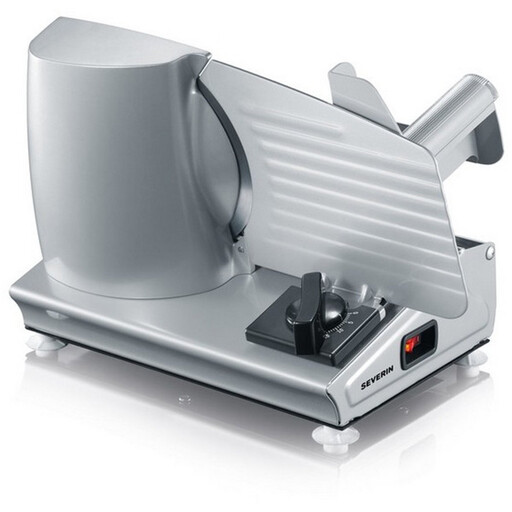
The AS 3915 is worth considering if you’re looking for a supplied deli blade and adjustable slice thickness for ham.
According to Graef, the foldable MYtiny TWIN MT1200EU combines a smooth ham blade with a more compact stated footprint.
The DO521S is worth comparing if you want to slice bread or cheese as well as ham.
The E 16, article 515045, is worth comparing if you’re looking for a metal design with a serrated blade and different switch settings.
These product picks are aimed at slicing cooked ham, from models with a smooth meat blade to a foldable slicer with a serrated blade for a range of slicing tasks.
 No image available
A smooth meat blade makes this model a good option if you want to slice ham and tackle a range of other slicing tasks with one machine.
The product description lists a slicing thickness of up to 23 mm, a serrated bread blade, variable speed control, a removable carriage and a collection tray.
 No image available
The smooth blade and adjustable slice thickness suit anyone who wants to cut cooked ham into slices of different thicknesses.
The product description lists a 0–15 mm range, two blades, a tilting carriage and a removable blade. Finger protection and rubber feet are also mentioned.
 No image available
This model is an option if you want to slice ham and fold the machine away after use.
The product description lists a serrated blade, a 0–15 mm adjustment range, a removable carriage and a food holder. The serrated blade is not the same as a smooth deli blade.
Check whether the exact model comes with a smooth deli blade. Severin specifies one for the AS 3915, while Graef lists an extra-smooth ham blade for the MYtiny TWIN MT1200EU. A description of another model in the same range doesn’t confirm that your chosen model comes with that blade too.
Follow the instructions for your model when taking it apart and cleaning it. Wash your hands before preparing food and use clean utensils. The Netherlands Nutrition Centre recommends cleaning chopping boards and kitchen utensils thoroughly to help prevent cross-contamination.
The Netherlands Nutrition Centre recommends storing ham in a sealed container in the coldest part of the fridge, at 4 °C. It advises keeping opened ham in the fridge for 3–5 days, or 2 days if you’re pregnant. The general advice for people at higher risk is not to keep opened cold meats for more than 2–3 days. For an unopened pack, follow the label and don’t use the product after its use-by date.
In the Netherlands, you’re entitled to a product that works properly, and the retailer is your point of contact if there’s a fault. According to the Dutch Government, there is no fixed period for statutory guarantees in the Netherlands. In many cases, you have 14 days to change your mind when buying online from a business; the rules and exceptions that apply depend on the circumstances.
According to the Dutch Government, you can take an old household appliance to the shop or online retailer where you buy a new, similar appliance, to a collection point or to your local council recycling centre.