
Vandaag of morgen in huis

Kwaliteit gegarandeerd

Welkomstaanbiedingen ontgrendelen: GRATIS bezorging | Tot 80% korting | Gratis 30 dagen JoyPlus-proefperiode
Download de app
An electric griddle seems simple: plug it in, add your ingredients and get grilling. But if your expectations don’t match the appliance, you could end up with one that’s too small, difficult to clean or not hot enough. Three common pitfalls are worth watching out for:
Check these points in advance to avoid buying a tabletop grill designed for two for a whole family, or finding that a griddle for larger groups is awkward to store after use.
A compact surface can be practical for a griddle for two. The Fritel Grill Teppanyaki GT 1075 has a 28 × 20 cm cooking plate and, according to its specifications, is recommended for one to two people. The larger Fritel GT 1375 has a 48 × 20 cm cooking surface and is listed as suitable for two to three people.
A longer plate is more convenient for groups. The Nedis Teppanyaki Table Grill offers a cooking area of 90 × 23 cm. The Tefal Giant Plancha CB631D has a surface that, according to its specifications, can serve up to twelve people. With a grill of this size, make sure you have enough table space and keep it a safe distance from flammable materials.
Power is measured in watts. A grill rated at 1,000 to 1,500 watts is often suitable for compact models. Larger plates may need 1,800 to 2,400 watts to heat the cooking surface. Always compare wattage with the size of the cooking area: more power on a smaller plate doesn’t automatically mean more even cooking.
An adjustable thermostat is useful when you’re cooking different ingredients. Meat may need a higher setting, while fish, vegetables and eggs can benefit from a lower temperature. The Fritel models have five heat settings. According to their product information, the Severin RG 9670 and Philips HD6210/90 also have temperature controls.
A smooth plate works as a teppanyaki grill or plancha grill, making it suitable for foods such as eggs, vegetables, fish and marinated ingredients. A ridged section leaves grill marks and can be useful for meat. The Fritel GT 1075 and GT 1375 combine a smooth teppanyaki zone with a ridged grilling section.
A non-stick griddle generally makes it easier to remove food, but it’s best to use wooden, silicone or heat-resistant plastic utensils. Metal utensils can damage the coating. Also check whether the plate is removable and dishwasher-safe. Some appliances only allow you to wipe the plate clean by hand once it has cooled.
If you’re specifically looking for a PFAS-free griddle, check that this is explicitly stated in the product information. The Fritel GT 1075 and GT 1375 are listed as PFAS-free in their specifications. Don’t assume this applies to other models too: always check the information for the product you’re considering.
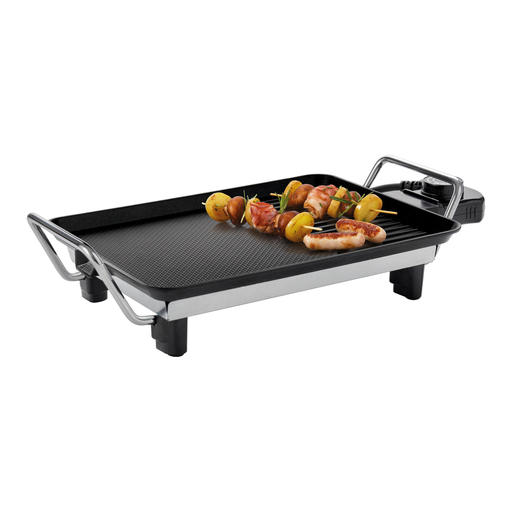
Why it suits this profile: According to its specifications, this compact model is designed for one to two people, making it a good fit for couples or small households.
The stated plate size helps you avoid buying a large appliance for occasional use. The five heat settings give you more control over the temperature than a basic on/off model.
1,000 watts, smooth and ridged cooking zones, a removable thermostat and a PFAS-free coating according to the product information.
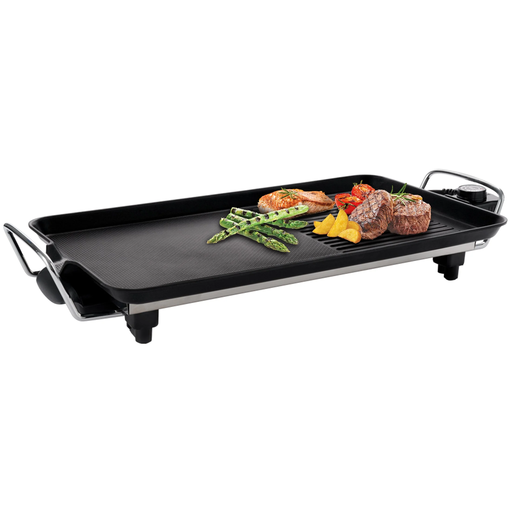
Why it suits this profile: With a 48 × 20 cm aluminium plate and 1,360 watts of power, this model is a good fit for couples and small families who regularly grill together at the table.
The specifications state both the usable cooking area and the five heat settings. The integrated pouring spout helps drain away fat.
Two cooking zones, cool-touch handles, a removable thermostat and a PFAS-free non-stick coating according to the product information.
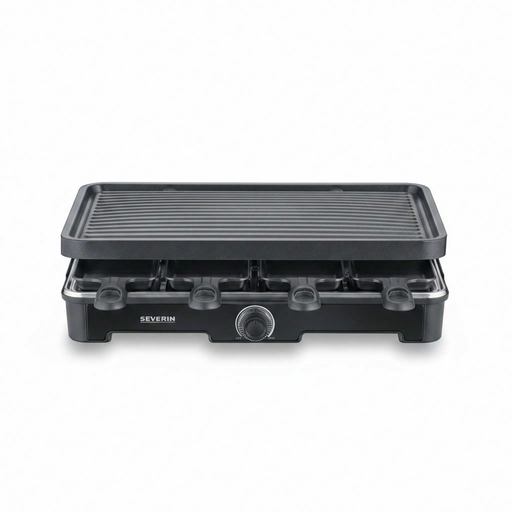
Why it suits this profile: This model is designed for sociable meals with a group and, according to the product information, comes with eight pans and spatulas.
The stated capacity of eight people makes it clear in advance how many it can serve. The adjustable thermostat means you’re not limited to a single fixed cooking temperature.
1,400 watts, a 41.5 × 26 cm grilling surface, eight pans and a non-stick coating according to the product information.
You can estimate electricity use with this formula: power in kilowatts × usage time in hours × your electricity rate. A 1,400-watt grill running at full power for one hour theoretically uses 1.4 kWh. In practice, the thermostat switches the grill on and off as needed, so actual consumption may vary.
Always place the grill on a flat, heat-resistant surface. Use an earthed socket and, if using it outdoors, check that the socket is suitable for outdoor use and protected from moisture. Don’t leave the appliance unattended while it’s switched on. The housing and plate remain hot after you switch it off. Unplug the grill before removing the plate or drip tray.
We’ve put together a full, up-to-date list of products that meet these strict selection criteria and the applicable European safety requirements.
You can use models that are listed as suitable for indoor and outdoor use. Outdoors, use the grill only on a dry, stable surface and with a suitable, protected socket. Don’t leave the appliance out in the rain, and keep the plug and thermostat dry.
Its lifespan depends on how often you use it, how you clean it and how you care for the coating. Don’t use metal utensils, avoid overheating the plate when it’s empty and follow the cleaning instructions. A removable plate or drip tray can make everyday cleaning easier.
That depends on the power rating, how long you use it and your electricity rate. An electric grill doesn’t need charcoal or gas and is quick to get started. To compare options for your needs, focus on the wattage, heating time and how often you’ll use the appliance.
