
Vandaag of morgen in huis

Kwaliteit gegarandeerd

Welkomstaanbiedingen ontgrendelen: GRATIS bezorging | Tot 80% korting | Gratis 30 dagen JoyPlus-proefperiode
Download de app
An electric food slicer can be useful for home cooks and households who want to slice bread, cold meats, cheese, vegetables and fruit evenly. However, not every multi-purpose slicer is suitable for everyday use. A model that looks powerful on paper may offer too little space in practice, be difficult to clean or feel unsafe when a piece of food gets smaller.
So don’t focus only on wattage or a low price. The slicing thickness, blade, construction and safety features are what determine whether a kitchen slicer is right for you.
A higher wattage doesn’t automatically mean the machine will slice more smoothly. The drive, blade and stability all play a part, too. For example, a gear-driven motor may be useful when slicing cold meats repeatedly, while a compact appliance may be intended mainly for short slicing sessions.
Check the operating limits as well. According to the product information, the Fritel SL 3710 can run for a maximum of 10 minutes at a time, after which it needs 30 minutes to cool down. This makes it suitable for preparing portions at home, but less suited to prolonged slicing without a break.
A serrated blade is generally practical for crusty bread and firmer foods. A smooth blade may be more suitable for thin slices of meat or soft cheese. That’s why some models come with two blades.
Think about whether you need a slicer with a serrated blade, a smooth blade or both. An electric bread slicer and a meat slicer can be the same machine, but the blade type will affect what it’s best suited to.
A slicer has a sharp, rotating blade. The food holder that comes with it isn’t just an extra: it keeps your hand away from the blade as the remaining piece of food gets smaller. Also check whether the carriage and blade can be removed. Leftover grease, crumbs and food residue make cleaning more difficult and can cause unpleasant smells.
Always place the machine on a stable, dry surface. Set the slicing thickness to zero before plugging it in, use the food holder and unplug the machine before removing the blade.
An adjustable slicing thickness of 0 to 15 mm is enough for many households, whether you’re slicing bread, cheese or cold meats. If you also want to slice thicker pieces of ham, vegetables or larger loaves, a range of up to 20 mm or more could be useful.
Check how the setting works. A continuously adjustable dial gives you more control than a limited number of fixed settings. The ideal thickness depends on the food: thin slices for carpaccio-style dishes, medium slices for sandwich fillings and thicker cuts for bread or firm vegetables.
A 17 cm blade is compact and may be suitable for standard loaves and smaller pieces of food. A 19 cm blade gives you more room to slice larger items. However, blade diameter isn’t the whole story: check the length of the carriage and the maximum distance from the stop plate, too.
A removable stainless steel blade makes cleaning easier. According to the product description, the Severin AS 3915 comes with both a smooth blade and a serrated blade. This gives you more choice between slicing bread and making finer cuts of meat or cheese.
A metal housing and rubber or non-slip feet can help the machine stay more stable on your work surface. An angled carriage, such as the 15° position on several Fritel models, can make it easier to feed food into the blade.
Check the controls, too. A momentary setting is intended for short bursts of slicing, while a continuous setting can be useful when preparing several slices of bread in a row. A child-safe or safety switch is a helpful extra, but it never replaces supervision and careful use.

Why it suits this profile: This foldable model is designed for households that want to slice bread, cheese, cold meats, vegetables and fruit, then store the machine away compactly.
The product information lists a child-safe on/off switch, a food holder and a removable carriage. These features help with everyday use and cleaning.
Slicing thickness of 0–15 mm, serrated stainless steel blade, foldable design and gear-driven motor.

Why it suits this profile: The product description focuses on intensive home use, with a metal construction, electronic speed control and two blades.
Having the choice of a serrated or smooth blade means you don’t have to use the same blade for every type of food.
Slicing thickness up to 23 mm, variable electronic speed control, removable carriage and collection tray.

Why it suits this profile: This model has a 19 cm blade and a 0–20 mm range, making it a good option if you regularly slice different types of food.
The 15° tilt and serrated food holder are clearly described features that help guide food steadily towards the blade. Do bear the stated cooling period in mind.
150 watts, gear drive, 190 mm blade diameter, collection tray and non-slip feet.
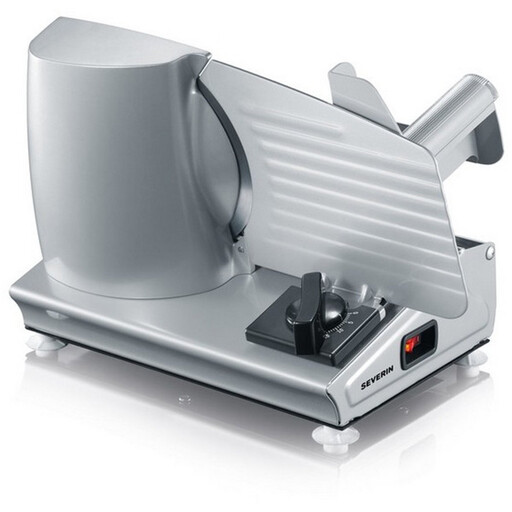
Why it suits this profile: If you often switch between slicing bread, cheese, meat and vegetables, two blades give you more flexibility in the kitchen.
The product information lists a smooth blade and a serrated blade, finger guard and rubber feet. These features suit different slicing tasks and help keep the machine stable.
180 watts, slicing thickness of 0–15 mm, stainless steel sliding plate and removable carriage.
We’ve put together a full, up-to-date list of products that meet these strict selection criteria and the applicable European safety regulations.
Products that comply with the law are covered by the statutory guarantee in the European Union. The seller handles the process if a product develops a fault. So, as well as checking the product specifications, take a look at the warranty and returns information.
It can, if these uses are listed in the product description and the blade is suitable. A serrated blade is practical for bread; a smooth blade can offer more control when slicing certain cold meats and cheeses. If you’re unsure, follow the manufacturer’s advice on which blade and settings to use.
A range of 0–15 mm works well for most household uses. Choose a model that goes up to 20 mm or 23 mm if you want to cut thicker slices of bread, vegetables or meat. The right choice depends on what you slice most often.
Energy use depends on the power rating and how long the machine is running. A 150 to 180 watt machine mainly uses electricity while its motor is running. Short slicing sessions will therefore use a different amount of energy from prolonged, continuous use. Always follow the maximum operating time stated in the manual.
