
Vandaag of morgen in huis

Kwaliteit gegarandeerd

Welkomstaanbiedingen ontgrendelen: GRATIS bezorging | Tot 80% korting | Gratis 30 dagen JoyPlus-proefperiode
Download de app
Slicing homemade bread, cheese, cold meats and vegetables is not equally easy with every electric food slicer. One model may look compact but still be difficult to clean. Another appliance may offer several functions but not be suitable for neat slices. If you focus only on wattage or a low price, you can quickly run into limitations.
Pay particular attention to these three common pitfalls:
For bread, cheese and cold meats, adjustable slice thickness is an important specification. Check the range in millimetres. Models with a range of 0–15 mm are suitable for thin to medium-thick slices. A range of up to 20 or 23 mm gives you more scope for thicker bread or larger pieces of meat.
The diameter of the stainless-steel cutting blade also matters. A 17 cm blade is often suitable for compact kitchen appliances. A larger 19 cm blade can provide more room for bigger products, but it also requires sufficient worktop space and extra care when cleaning.
A kitchen slicer should remain stable while you are slicing. Look at the non-slip feet, the weight and the shape of the carriage. An angled carriage can make it more comfortable to guide food towards the blade, but it generally takes up more space.
For smaller kitchens, a foldable food slicer is practical. Measure the available cupboard or shelf space beforehand. Also check that the machine locks securely when folded and that the blade is covered during storage.
An electric bread slicer should have a food pusher or end-piece holder. This keeps your hands away from the rotating blade. A removable carriage, collection tray and cutting blade make it easier to remove crumbs and food residue.
Always use the machine on a flat, dry surface. Unplug it before removing the blade. A model with a pulse or momentary setting gives you more control during short slicing tasks. Also follow the instructions regarding maximum operating time and cooling periods.
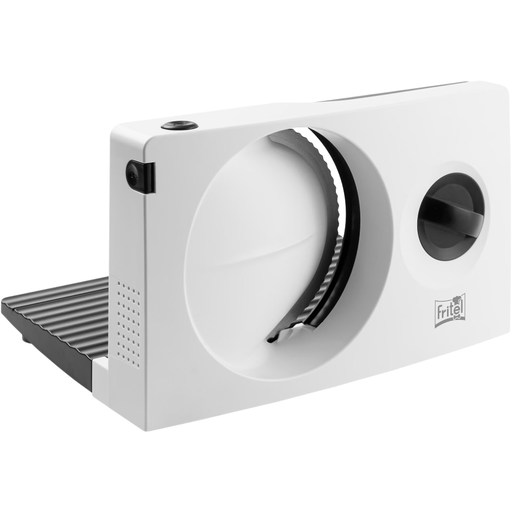
Why it suits this profile: This compact model is designed for bread and offers straightforward controls for regular home use.
The product details specify an adjustable slice thickness of 0–15 mm, a serrated stainless-steel blade and a foldable design. This makes it clear what the appliance is intended for.
100 W motor, collection tray, removable blade and child-safe on/off switch according to the product description.

Why it suits this profile: Designed for households that regularly slice bread, cold meats and cheese and value extensive adjustment options.
The description mentions both a serrated and a smooth blade, a slice thickness of up to 23 mm and electronic speed control. This gives you more specific information about its functions than simply calling it multifunctional.
Metal construction, removable carriage, 24 cm cutting path and collection tray according to the product information.
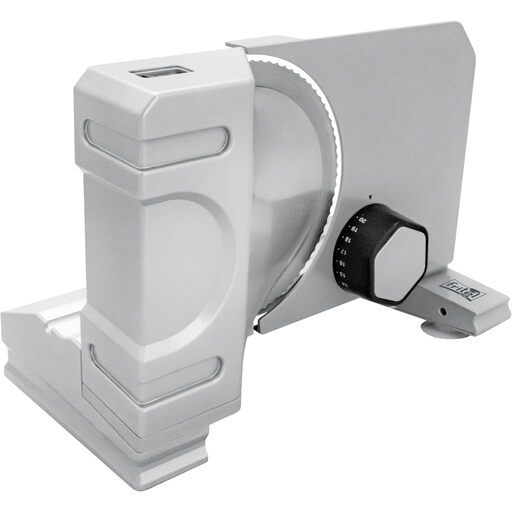
Why it suits this profile: A suitable option if you want to slice cheese, cold meats, vegetables and fruit as well as bread.
The specifications give a slice thickness of 0–20 mm, a 19 cm blade and a carriage angled at 15°. They also specify a maximum continuous operating time of 10 minutes.
150 W motor, three settings, non-slip feet, removable carriage and end-piece holder according to the product details.
A meat slicer and bread slicer are designed for making slices. If you want to chop onions, herbs, nuts or meat, a food chopper is a better choice. According to the product information, the Rommelsbacher Multifunctional Chopper MZ 500 has a power rating of 500 W, a 1.5-litre glass bowl and a stainless-steel blade with four wings. So, the appliance does not make evenly sized bread slices, but it is a versatile kitchen aid for chopping and mixing.
For grating vegetables, making chips or preparing simple dishes, a manual vegetable slicer may sometimes be sufficient. Check whether a hand guard is included and whether the blades are easy to clean. An electric slicer is particularly worthwhile when you often need slices of the same thickness.
We have put together a complete, up-to-date list of products that fully meet these strict selection criteria and the applicable European safety regulations.
Yes, provided the model has a stable carriage, food pusher and suitable slice-thickness setting. With intensive use, check the maximum continuous operating time and give the motor time to cool down.
Switch off the appliance, unplug it and remove only the parts that the instructions say may be detached. Wipe the motor housing with a slightly damp cloth. A removable blade and collection tray make maintenance easier. Dry all parts before putting them back.
Power consumption depends on the wattage and operating time. A 100 W appliance theoretically uses 0.1 kWh after one hour of continuous operation; in practice, a slicer is usually used for much less time. So, as well as wattage, consider the controls, cleaning requirements and the amount of food you want to slice at a time.
