
Salami slicing enthusiast
You want thin slices for sandwiches, so you’re looking at the blade supplied, adjustable slice thickness and a food holder.


If you mainly want thin slices of salami, check that the version you choose comes with a suitable smooth blade. A serrated blade is handy for bread, or you could choose a model supplied with both blade options. Manufacturer information about slice thickness and blades is not an independent test of how well a slicer performs with salami. If you plan to slice ahead, also consider cleaning, the instruction manual and the Netherlands Nutrition Centre’s storage advice for opened cold meats.
You want thin slices for sandwiches, so you’re looking at the blade supplied, adjustable slice thickness and a food holder.
You slice several portions in one go and plan how to clean the machine, as well as when to use or freeze the salami. The Netherlands Nutrition Centre provides storage advice for opened salami.
You want to slice bread or cheese as well as salami, and weigh up how often you’ll use it against the worktop space it takes up and whether you’ll need to change blades.
Choose this if: you want to slice both cold meats and bread, and both blades are included with the exact version you’re buying.
The trade-off: you may need to change blades and clean both, so check what’s included in the box.
Choose this if: you also want to slice bread and the standard blade suits the way you’ll use the slicer.
The trade-off: don’t assume a smooth blade is included or that the slicer has been proven to produce wafer-thin salami slices; check the blade options for the exact model.
First, decide which blade you need for salami and bread. Then check the cleaning instructions, controls and how much you want to slice in one session.
| What to consider | What should you check? | Who is this most important to? |
|---|---|---|
| Thin slices | Check the adjustable slice thickness, the blade supplied and whether any separately sold blade is suitable for the complete model number. | If I’m slicing salami for delicate sandwiches, I want to adjust the thickness and know whether a smooth blade is included. Around 33% of consumers prioritise thin slices. |
| Storing portions | Follow the label and relevant storage advice; the Netherlands Nutrition Centre recommends keeping opened cold meats covered and at 4 °C. | If I’m slicing several portions in advance, I want to use or freeze them in good time. Around 27% of consumers prioritise safe portion storage. |
| Controls and cleaning | Check the safety switch, finger guard and food holder, and read which parts can be removed and washed. | If I’m slicing portions one after another, I want to operate the machine safely and clean it thoroughly. Around 20% of consumers prioritise controls and cleaning. |
| Versatility and space | Compare the overall dimensions, the space needed on your worktop, the standard blade and the size of the food you want to slice. | If I want to use the slicer for bread or cheese as well, I’ll consider both what it can do and where I’ll keep it. Around 20% of consumers prioritise versatility and space. |
A range such as 0–15 mm describes the setting, not an independently measured result for slicing salami. The blade supplied also varies by model.
Check which blades come with the exact version. If you’re considering a separate blade, ask whether the manufacturer confirms it’s suitable for your full model number.
Ritter states that the E 16 has an operating cycle of 5 minutes. This information applies to this specific model and not automatically to other slicers.
Read the operating limits for the model you’re considering and plan longer slicing sessions accordingly.
Sliced salami won’t keep for longer just because you’ve portioned it in advance. The Netherlands Nutrition Centre gives limited storage advice for opened salami and recommends shorter periods for people in vulnerable groups.
Prepare portions that you can use within the relevant storage period. Keep them covered and chilled, or freeze them in good time.
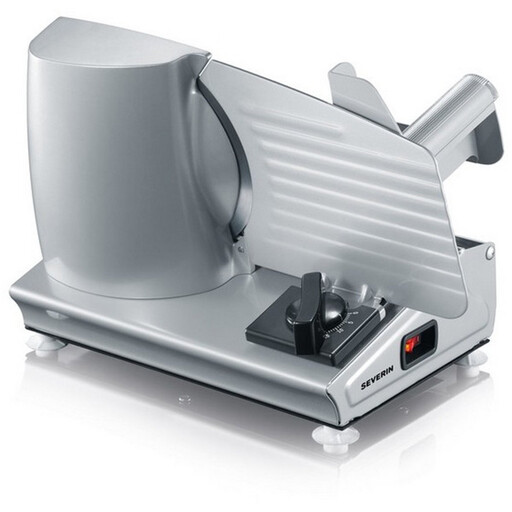
The AS 3915 is an adjustable food slicer; the manufacturer’s specification sheet lists an additional ham blade.
The E 16 is a household model supplied with a serrated blade as standard.
The SKS110 is a compact food slicer for bread, cold meats and more.
The MS171/N is a food slicer for bread and cold meats, supplied with a standard blade.
The EM-2099 is a food slicer for anyone who values removable parts and easy cleaning.
These Joybuy products are electric food slicers for cold meats. Some models come with both a smooth and a serrated blade, while others have a serrated blade. If you want to slice salami thinly, check which blades are included with each version.
 No image available
The smooth blade option mentioned makes this version worth considering if you want to slice cold meats finely.
Adjustable slice thickness: 0–15 mm. The description lists a smooth blade for meat, a serrated blade for bread and finger protection.
Check the instruction manual for blade changes and cleaning.
 No image available
This version could suit you if you want to slice cold meats and value a removable carriage for cleaning.
The description lists a serrated blade, slice thickness of up to 20 mm and a removable carriage.
If thin slices of salami are your main priority, check that the blade type suits your needs.
 No image available
The foldable design is worth considering if you want to put the slicer away after use.
The description lists a serrated blade, settings from 0–15 mm, a blade diameter of 17 cm and a power rating of 100 W.
Check that the serrated blade is suitable for the salami slices you want.
Check which blades are included with the exact version. Severin lists an additional ham blade for the AS 3915; the other models mentioned have a serrated blade as standard. Only consider buying a separate smooth blade if the manufacturer confirms it’s suitable for your model.
Unplug the machine before removing any parts or cleaning it. Ritter specifies this for the E 16. Only wet parts or put them in the dishwasher if your model’s manual says you can; Tristar states that the removable parts of the EM-2099 are dishwasher-safe.
For opened salami, the Netherlands Nutrition Centre generally recommends 5–7 days in the fridge, and 2 days for pregnant people. For older people, pregnant people, very young children and anyone with a weakened immune system, the advice for opened cold meats is to keep them for no more than 2–3 days. Keep salami covered at 4 °C, and follow the label and use-by date for an unopened pack.
When you buy as a consumer, you’re covered by a statutory guarantee: you’re entitled to a product that works as it should, and the retailer is your point of contact if there’s a problem. A manufacturer’s warranty or additional cover you buy is separate; read the terms before taking out extra cover.
The Netherlands Food and Consumer Product Safety Authority states that CE marking is mandatory for electrical products. For electrical equipment, it describes an applicable range that includes 50–1000 V AC. Check which rules apply to the specific model and whether it carries the required mark. The mark alone doesn’t tell you how thinly the machine can slice salami.