
Vandaag of morgen in huis

Kwaliteit gegarandeerd

Welkomstaanbiedingen ontgrendelen: GRATIS bezorging | Tot 80% korting | Gratis 30 dagen JoyPlus-proefperiode
Download de app
An electric food slicer can be handy for slicing fresh bread, cheese, cold meats, vegetables and fruit. It’s quicker and more consistent than using an ordinary kitchen knife. However, not every model is right for every household. A compact bread slicer, for example, may take up little space but be less suited to frequent use. A heavier-duty food slicer offers more options, but you’ll also need to find it a permanent spot on your worktop.
Look out for these three common pitfalls:
An adjustable thickness is useful for slicing bread, cheese and cold meats. Thin slices work well for sandwiches; thicker slices are better for crusty bread or certain vegetables. A model offering 0-15 mm gives you plenty of flexibility for everyday use. If you also want to slice thicker pieces, look for a cutting thickness of 0-20 mm.
Also consider the blade:
A bread slicer with only a serrated blade is generally designed mainly for bread. A slicer for bread and meat gives you more flexibility, but always check the manual and which foods the appliance is suitable for.
The wattage gives you an indication of the electrical power, but it doesn’t tell you everything about the slicing experience. Check the drive system and housing, too. For example, the models in this selection have a power rating of 100, 150, 160 or 180 watts, depending on the type.
A compact model is often enough for occasional use. If you’re slicing larger quantities, useful specifications to look for include a metal housing, a stable carriage and a gear drive. An angled carriage set at 15 degrees can make it easier to position food, but usually takes up more space.
Before buying, check:
An electric food slicer has a sharp, moving blade. Always use the food holder or pusher, especially when the piece of food gets smaller. A safety switch, finger guard and non-slip feet are useful features, but they don’t replace careful use.
Unplug the appliance before cleaning it or changing the blade. Some models have a removable carriage, collection tray or blade, which makes cleaning easier. Never immerse the motor housing in water. Keep the appliance and power cord out of children’s reach, and store a foldable model safely after use.
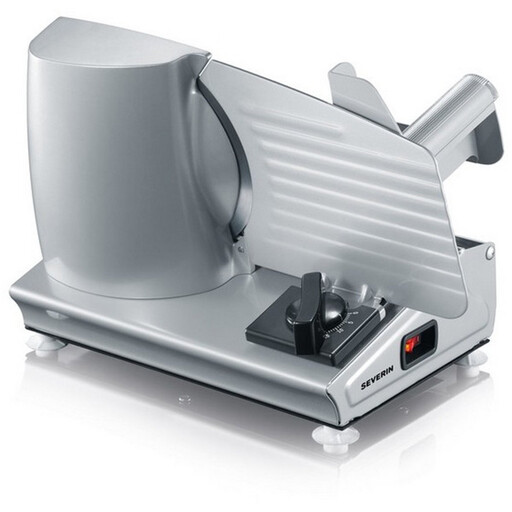
Why it suits this profile: According to the product information, this model offers an adjustable cutting thickness from 0 to 15 mm and comes with two blades for slicing bread, cheese, cold meats and vegetables.
The two blades supplied mean you don’t immediately need separate appliances for bread and finer slices of cold meat. The metal slide plate and finger guard are tangible features of its construction.
180 watts, adjustable from 0-15 mm, two blades and a 131 cm power cord.

Why it suits this profile: According to the product description, this model is designed for versatile use, with a cutting thickness ranging from wafer-thin slices up to 20 mm and a removable carriage.
The removable carriage helps you avoid the common cleaning pitfall. The product information also lists a metal construction, a safety glass base plate and an 18 cm-long cutting track.
Cutting thickness up to 20 mm, removable carriage and safety glass base plate.

Why it suits this profile: According to the product specifications, this food slicer has a 19 cm blade, a cutting thickness of 0-20 mm and a sliding plate angled at 15 degrees.
The larger blade and metal parts are tangible features for anyone who regularly slices larger quantities. The food holder supplied helps you avoid pushing food towards the blade by hand.
19 cm blade, adjustable from 0-20 mm, gear drive and non-slip feet.
We’ve put together a complete, up-to-date list of products that meet these strict selection criteria and the applicable European safety regulations.
It depends on the blade and the product specifications. Serrated blades are often offered for bread, while product information may describe a smooth blade as suitable for finer slices of cold meat. Always check the manual before slicing meat, cheese or vegetables.
Switch off the appliance, unplug it and wait until the blade has come to a complete stop. Only remove parts that the manual says are removable. A detachable carriage, collection tray or blade can make cleaning easier. Wipe the motor housing with a slightly damp cloth and don’t immerse it in water.
Its lifespan depends on how often you use it, how you clean it and how it’s stored. A model used every day to slice large quantities will be under more strain than a compact machine used for the occasional loaf. Check the recommended operating time, cooling periods and warranty terms. In the EU, consumers are covered by a legal guarantee based on the product’s conformity; additional terms may vary by retailer or brand.
