
Vandaag of morgen in huis

Kwaliteit gegarandeerd

Welkomstaanbiedingen ontgrendelen: GRATIS bezorging | Tot 80% korting | Gratis 30 dagen JoyPlus-proefperiode
Download de app
An electric food slicer can be useful if you regularly want to slice bread, cheese, cold meats, charcuterie or vegetables evenly. Many models look similar, but differences in the blade, stability and controls can make a noticeable difference in everyday use.
Look out for these three common pitfalls:
Stability is sometimes overlooked, too. A lightweight kitchen slicer with little grip can shift while you’re slicing. So check the non-slip feet, weight, and the design of the carriage and food holder.
For everyday use, an adjustable slicing thickness is more important than a high wattage. With a range of 0-20 mm, you can make thin slices of cold meat and cut thicker slices of bread or cheese. A model with a range of 0-15 mm may be enough if you mainly slice bread, cheese and standard cold meats.
A wider adjustment range gives you more flexibility, but also check whether the dial is easy to read. Return the setting to 0 after use if the instructions recommend this. This keeps the blade edge covered while the slicer is stored.
The blade diameter affects the maximum size of each slice. A 17 cm blade is suitable for many everyday tasks. A 19 cm blade gives you a little more room when slicing larger loaves or pieces of charcuterie.
A slicer with a serrated blade is practical for bread with a firm crust. A smooth blade may be more suitable for thin slices of meat. Some models come with two blades, which can be useful if you switch between using the machine as a bread slicer and a meat slicer.
Also check whether the blade is removable. Always unplug the machine before removing or cleaning the blade. A slicer isn’t an accessory for the dishwasher: don’t immerse the motor housing in water.
A metal housing, non-slip feet and a sturdy carriage all help you use the machine with control. An angled carriage, for example at 15 degrees, can guide food towards the blade without you having to apply much pressure. This is a product specification, not a guarantee of a particular slicing result.
Always use the food holder or pusher supplied. Never hold small pieces close to the blade with your bare hand. Also check whether the model has a pulse switch, a continuous setting or both. A pulse switch is practical for slicing a few pieces; a continuous setting can be more convenient when slicing several loaves or pieces of cheese in a row.
The options below are based on verifiable details in the product information provided. Descriptions of ease of use or slicing results are taken from the relevant brand’s product information and are not presented as guaranteed performance.
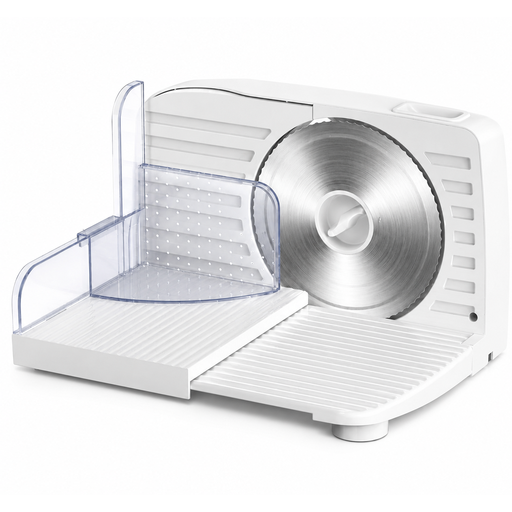
Why it suits this type of user: This model is designed for household use and has an adjustment range of 0-15 mm. It may suit anyone looking to try a multifunctional slicer for bread, cheese and cold meats.
The slicing thickness is listed as a range, so you don’t have to judge the machine by its wattage alone. Before buying, check which safety features and blade type are included.
250 W power, according to the product listing, and an adjustable slicing thickness of 0-15 mm.
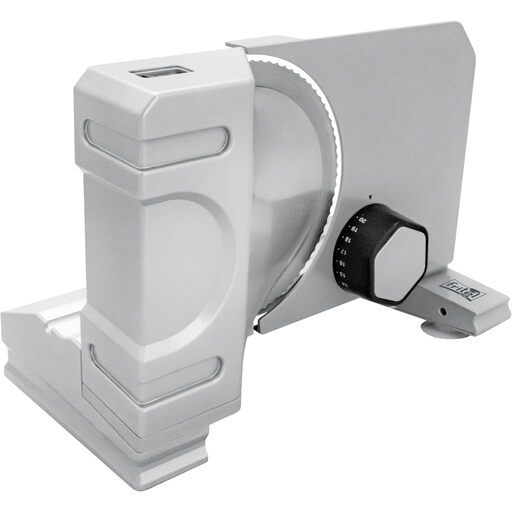
Why it suits this type of user: The Fritel slicer combines a 19 cm blade diameter with an adjustment range of 0-20 mm. It’s suited to users who want to slice different types of food to varying thicknesses.
The product specifications list a metal design, non-slip feet, an angled carriage and a food holder. This gives you important details to consider beyond the motor power alone.
0-20 mm slicing thickness, a 190 mm blade diameter, a metal housing and a collection tray included.
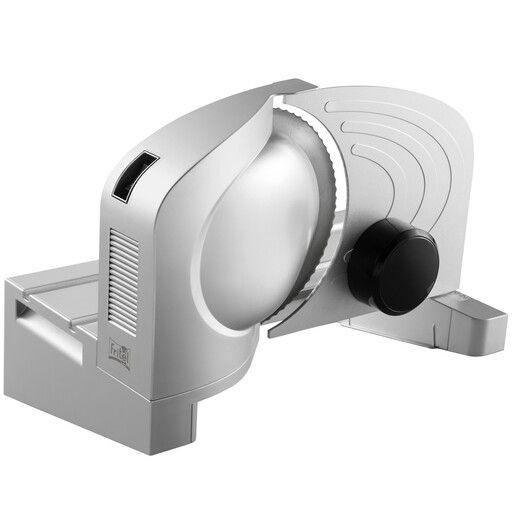
Why it suits this type of user: This model is designed for slicing bread, cheese, meat and vegetables using different settings. Its 15° angled carriage may be useful for longer slicing sessions in the kitchen.
The model features a serrated stainless steel blade, a metal housing and a geared drive. According to the product information, the blade can be removed for maintenance.
160 W, a 170 mm blade diameter, continuously adjustable from 0-20 mm and a 15° angled carriage.
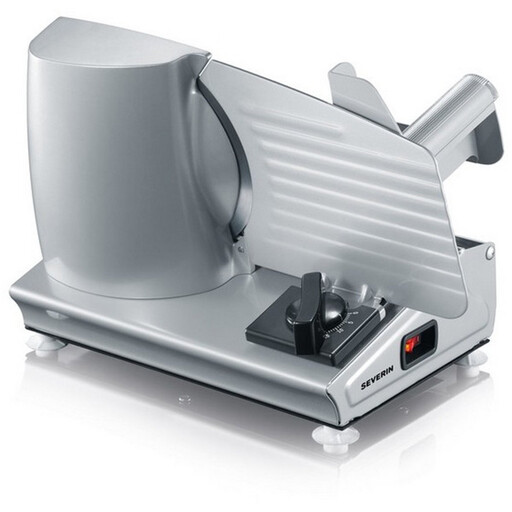
Why it suits this type of user: This Severin slicer comes with a smooth blade and a serrated blade. That’s practical if you want to slice both bread and finer cuts of meat.
Having two blades means you don’t have to use the same blade for every task. The product information also lists a stainless steel sliding plate and rubber feet.
180 W, an adjustable slicing thickness of 0-15 mm and two blades included for different tasks.
We’ve put together a complete, up-to-date list of products that meet these strict selection criteria and the applicable European safety requirements.
A mandoline or vegetable slicer is usually operated by hand and is mainly designed for slicing, cutting into strips and grating vegetables. Products such as a mandoline slicer aren’t automatically suitable for slicing bread or meat electrically. Check what the product is designed for before ordering.
For bread, cheese and cold meats, you’ll need a powered model with a carriage, blade and food holder. A manual vegetable slicer may be enough for cucumber, potato or carrot. If you want to do both, check whether the appliance is actually designed for both tasks.
Your statutory guarantee and conformity rights apply under the relevant EU and UK consumer rules. Some models have a guarantee period of at least two years listed on the product page; always check the seller’s current terms.
Not every model is suitable for this. Check the instructions and product specifications. A standard electric food slicer is generally designed for thawed bread, cold meats, cheese and similar foods. Don’t use hard-frozen food unless the manufacturer says it’s safe to do so.
Switch off the appliance, unplug it and only remove the blade if the instructions say you can. Clean the blade and carriage separately with a suitable cloth or washing-up liquid. Keep the motor housing dry and never immerse the appliance in water.
Energy use depends on the motor power and how long you use the machine. A 160 W model used for a few minutes will use relatively little energy. Calculate the exact amount by dividing the power in watts by 1,000, then multiplying by the number of hours used. Also check the recommended maximum operating time per session.
