
Vandaag of morgen in huis

Kwaliteit gegarandeerd

Welkomstaanbiedingen ontgrendelen: GRATIS bezorging | Tot 80% korting | Gratis 30 dagen JoyPlus-proefperiode
Download de app
An electric food slicer can be useful for slicing fresh bread, charcuterie, cheese and vegetables. However, not every model is suitable for everyday use. Some machines look versatile but have a limited slice thickness, a small blade or little support for feeding food through. The results can be disappointing, leaving the appliance unused in a kitchen cupboard.
Use these points to compare food slicers based on practical features rather than marketing claims.
A higher wattage doesn’t automatically mean a machine will slice every food more easily. The blade, drive mechanism, construction and the way food is fed through the machine all matter too. For example, a powered meat slicer with a metal drive may perform differently from a compact model with a lighter housing.
So don’t focus on motor power alone. Check the blade diameter, blade type and recommended operating time too.
“Adjustable slice thickness” doesn’t tell you much without specific measurements in millimetres. Thin slices of meat or cheese call for a fine setting. For bread and firm vegetables, a thicker slice may be more practical.
A slicer with a range of 0-20 mm gives you more flexibility than one that goes up to 15 mm. Also check whether the thickness adjusts continuously or only has a few fixed settings.
A food slicer has a sharp, fast-spinning blade. A missing food pusher, slippery feet or a blade that’s difficult to remove can make it less pleasant to use. Check whether the appliance has:
Always unplug the machine before removing the blade or cleaning it. Use the food pusher as the piece of food gets smaller, and keep children away from the appliance.
When choosing a slicer for bread and meat, it’s important to consider both the slice thickness and the blade diameter. A 17 cm blade is suitable for many standard foods. A larger 19 cm blade gives you more room for larger loaves, cuts of meat or blocks of cheese.
A range of 0-15 mm suits everyday use in an average household. If you often slice thick sandwiches, firm vegetables or generous portions of charcuterie, consider a model with a 0-20 mm range.
A slicer with a stainless steel blade is practical because it resists corrosion and is relatively easy to maintain. A serrated blade usually works well for bread with a hard crust. A smooth blade is particularly useful for meat, ham and thin slices of cheese.
Some appliances come with two blades. This lets you choose the blade that best suits the food, but check how easy they are to change and clean in practice.
A metal housing and a geared drive can help the machine run more steadily. That doesn’t mean every metal model can be used continuously without a break. Check the instructions for the maximum operating time and how long the machine needs to cool down.
A carriage tilted at, for example, 15 degrees can make it easier to feed food through. Non-slip feet are particularly important on smooth kitchen worktops.
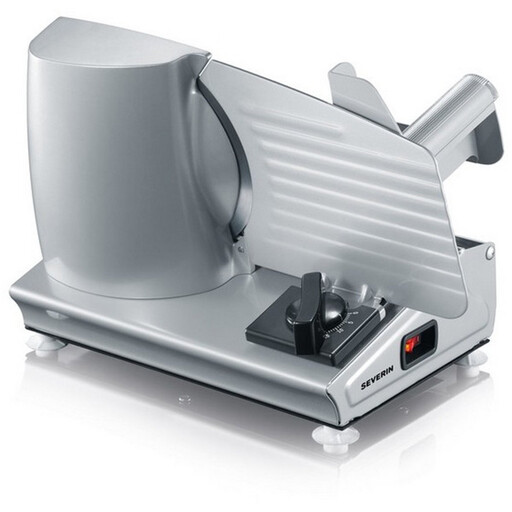
Why it suits this profile: This model offers a straightforward set of features for households that occasionally want to slice bread, cheese, cold meats or vegetables. The thickness adjusts continuously from 0 to 15 mm.
The product specifications list two blades: a smooth blade for cold meats and a serrated blade for bread. It also has a stainless steel carriage and a finger guard.
180 watts, adjustable slice thickness from 0-15 mm, two blades and rubber feet.
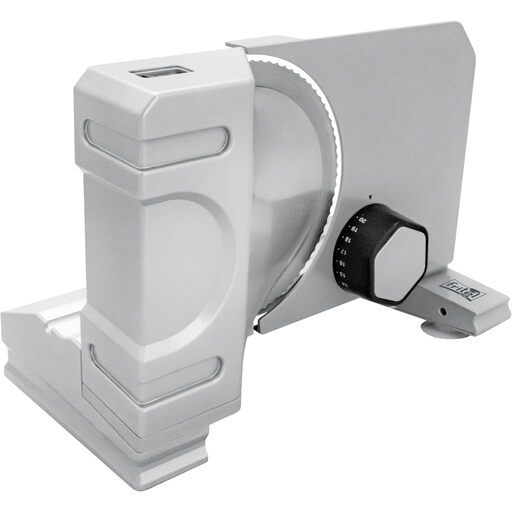
Why it suits this profile: A suitable option if you regularly want to slice bread, charcuterie, cheese, vegetables and meat to different thicknesses.
The 0-20 mm range means you’re not limited to thin slices. The product information also lists a food holder, non-slip feet and a 19 cm blade.
0-20 mm slice thickness, 190 mm blade, carriage tilted at 15°, geared drive and removable carriage.
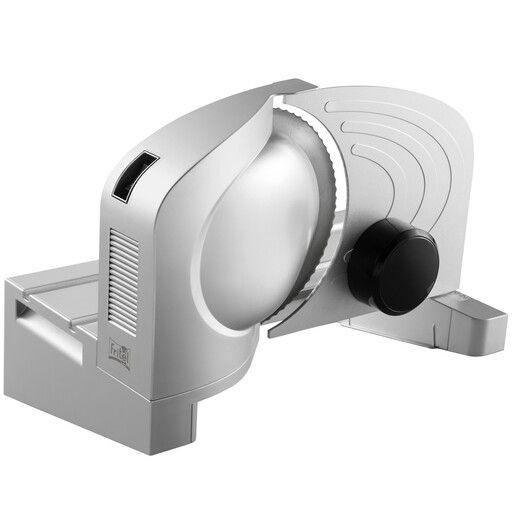
Why it suits this profile: This model is a good fit for families and home cooks who regularly prepare larger quantities of bread, cheese, cold meats or vegetables.
The angled carriage, set at 15°, and metal stop plate are designed to help you feed food through in a controlled way. According to the product specifications, the serrated stainless steel blade is suitable for bread and firm charcuterie.
0-20 mm slice thickness, 170 mm blade, metal housing, geared drive and a choice of continuous or intermittent operation.
We’ve put together a complete, up-to-date list of products that meet these strict selection criteria and the applicable European safety regulations.
Energy consumption depends on the motor power and how long you use the machine. An appliance rated at 150 to 180 watts uses relatively little electricity during short slicing sessions. Running the machine for a long time without actually slicing anything has the biggest impact on running costs.
Switch off the machine after use, turn the thickness setting back to zero if instructed in the manual, and clean off food residue straight away. Don’t get water on the motor housing. Also check whether the blade can be cleaned by hand or is dishwasher-safe.
It mainly depends on the blade. A serrated blade is practical for bread, while a smooth blade is better suited to cold meats and some types of cheese. A model with two interchangeable blades offers more flexibility.
A low setting is useful for thinly sliced meat and cheese. You may prefer thicker slices for bread and vegetables. A range of 0-15 mm is enough for many households, while 0-20 mm gives you more choice.
Its lifespan depends on the materials, maintenance, how often you use it and how hard you push the machine. Let the motor cool according to the manual, don’t force hard foods through, and always use the food holder. In the European Union, consumer purchases are generally covered by a legal guarantee of at least two years; additional rights may apply.
