
Vandaag of morgen in huis

Kwaliteit gegarandeerd

Welkomstaanbiedingen ontgrendelen: GRATIS bezorging | Tot 80% korting | Gratis 30 dagen JoyPlus-proefperiode
Download de app
An electric food slicer can slice bread, meat, cheese and vegetables more quickly and evenly than an ordinary kitchen knife. However, not every model is suited to the same tasks. An electric meat slicer with a large carriage works differently from an electric knife for roasts or bread. If you only consider wattage or a low price, you could end up with an appliance that is difficult to clean, takes up a lot of space or does not offer enough control.
A higher wattage does not automatically mean a model will slice more easily. The type of blade, drive mechanism, stability and how the food is held in place all matter too. A 100 W electric bread slicer may be powerful enough for everyday bread, while a compact electric slicer with a different blade may be better suited to roasts or frozen foods.
For thin cold cuts, cheese or carpaccio-style slices, a slicer with adjustable thickness is useful. Always check the range. Models with a 0–15 mm setting are designed for light domestic use; a range of up to 20 mm gives you more flexibility for thicker slices of bread, vegetables or meat.
An electric knife usually does not have a dial for setting a fixed slice thickness. The thickness depends on how you move the knife and how thick the food is.
A blade can remain sharp even when the motor is off. Look for a finger guard, food holder, non-slip feet, safety switch and a blade that can be removed without complicated steps. Also check whether removable parts are dishwasher-safe. The motor housing should generally not be submerged in water.
An electric knife, sometimes called an electric carving knife, has two blades that move back and forth. This type is handy for bread, roasts, poultry and some frozen foods. It takes up relatively little space and is usually quick to put away.
A food slicer has a rotating circular blade, a carriage and often a thickness setting. This design is better suited to slicing bread, cheese, cold cuts and vegetables repeatedly. However, the machine needs more space and must be cleaned after use.
For an electric food slicer or slicer for firm foods, the blade diameter indicates the maximum cutting area. The Fritel SL 3110, for example, has a 170 mm blade, while the Fritel SL 3710 uses a 190 mm blade. A larger blade can be useful for wider loaves or larger pieces of food, but it does not automatically make the appliance suitable for every task.
Stainless steel is commonly used for blades and cutting surfaces. Also check whether the blade is serrated or smooth. A serrated blade is often suited to bread and foods with a firmer outer layer. Always follow the product manual when using the appliance with frozen food.
The stated power rating is only one factor to consider. Check the recommended maximum operating time too. According to the product information, the Fritel SL 3710 should not be used continuously for more than 10 minutes and must then be allowed to cool down. This is worth bearing in mind if you want to slice several loaves or a large quantity of meat in one go for a big family.
A heavy housing, non-slip feet and a stable carriage help keep the appliance in place while you use it. For small kitchens, a foldable model may be more appealing than a heavier machine.

Why it suits this type of user: This model is designed for home use and combines an adjustable slice thickness of 0–15 mm with a foldable design. It is a practical choice for bread, cheese and cold cuts in a kitchen with limited storage space.
The specifications include the slice thickness, a removable carriage and a food holder. That means you do not have to rely on the motor power rating alone.
Adjustable thickness of 0–15 mm, 170 mm serrated stainless steel blade, foldable design and child-safe on/off switch.

Why it suits this type of user: The metal support frame, glass base plate and removable carriage will appeal to anyone looking for a dedicated electric kitchen slicer who values the materials used.
The product description covers more than just the appearance: it also specifies a removable carriage, an 18 cm cutting path and a slice thickness of up to 20 mm.
Metal construction, glass base plate, removable carriage and a range from thin slices up to 20 mm, according to the product information.
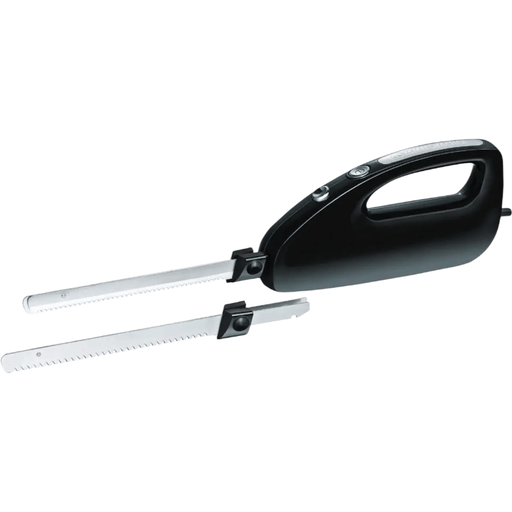
Why it suits this type of user: This electric knife is ideal if you mainly want to slice bread, meat, poultry, cakes or partially defrosted frozen foods, without taking up worktop space with a large carriage.
The set includes two blades with finger guards. The blades are removable and, according to the product information, dishwasher-safe.
120 W power, two sets of 15 cm stainless steel blades, ergonomic handle and a weight of approximately 0.75 kg.
We’ve put together a complete, up-to-date list of products that meet these strict selection criteria and the applicable European safety regulations.
Yes, many models are designed for both. However, check the type of blade, maximum slice thickness and carriage size. An electric knife is handy for roasts and bread, while an electric meat slicer with a circular blade gives you more control over a consistent slice thickness.
Its lifespan depends on how often you use it, how you clean and store it, and how hard you push it. Do not exceed the recommended operating time or force the blade through hard foods. A removable blade and replaceable parts can make maintenance easier.
Electricity use per slicing session is usually limited, as the appliance typically runs for just a few minutes. The exact amount depends on its power rating and how long it runs. A 100 W model running for ten minutes theoretically uses around 0.017 kWh; in practice, motor load and pauses can affect this.
