
Vandaag of morgen in huis

Kwaliteit gegarandeerd

Welkomstaanbiedingen ontgrendelen: GRATIS bezorging | Tot 80% korting | Gratis 30 dagen JoyPlus-proefperiode
Download de app
An electric food slicer can be useful for fresh bread, cold meats, cheese, vegetables and fruit. However, not every model is suited to the same tasks. A compact bread slicer for occasional use has different requirements from an electric meat slicer for larger quantities.
The main pitfalls often have less to do with the wattage on the box and more to do with details such as slice thickness, the blade, stability and how easy the appliance is to clean.
A higher wattage doesn’t automatically mean a kitchen slicer will be easier to use. The motor gearing, carriage design and blade all affect how evenly you can slice. A 100 to 150-watt appliance may be enough for bread and cold meats in a typical home. For longer sessions, motor load and the recommended operating time matter more than the number on the box alone.
A serrated-blade slicer is practical for bread and foods with a firm outer layer. For soft cold meats or cheese, a smooth blade may give a more even result. So check whether the blade is interchangeable and whether a second blade is included.
An electric meat slicer and an electric food slicer aren’t always the same type of product. Some appliances are designed mainly for bread, while others are also suitable for charcuterie, cheese and vegetables.
A sharp, rotating blade needs a stable surface, a well-functioning food holder and a safe switch. A removable carriage and blade make cleaning easier. Before you buy, also check whether the appliance can be stored compactly after use.
Never use a slicer without the supplied food holder when the piece of food gets small. Unplug the appliance before removing the blade or any parts around the cutting area.
Adjustable slice thickness determines whether you can make thin slices of cold meats, medium-thick slices of bread or thicker pieces of cheese. Check the range:
A wide adjustment dial with a clear scale is more practical than a setting that’s difficult to read. After use, return the setting to zero if the manual recommends doing so.
A larger blade diameter gives you more cutting space, but usually makes the appliance bigger too. A 170 mm blade may be enough for a compact kitchen. A 190 mm blade is worth considering if you want to slice larger pieces of bread or meat.
A serrated blade is generally well suited to cutting through bread crusts. A smooth blade can be useful for meat and cheese. Also check how the blade is removed. This affects how much effort maintenance takes and how safely you can clean the appliance.
Non-slip feet, a sturdy carriage and a food holder help you guide food past the blade in a controlled way. An angled design can make feeding food into the slicer easier. If you’ll use it intensively, check whether the manufacturer specifies a maximum continuous operating time. For example, the Fritel SL 3710 should not run continuously for more than 10 minutes, followed by a cooling period.
A metal housing can add weight and stability, while plastic models are often easier to move. Choose based on your kitchen space and how often you’ll use it, not just its appearance.

Why it suits this type of user: This compact electric food slicer is designed for bread, cheese, cold meats, vegetables and fruit. Its foldable design is practical in a smaller kitchen.
The slice thickness is adjustable from 0 to 15 mm. The removable carriage, food holder and removable serrated blade make maintenance easier and support safe use.
100 watts, 170 mm blade diameter, foldable design and a child-safe on/off switch, according to the product description.

Why it suits this type of user: The metal design, angled position and variable speed settings make it a good fit for home cooks who regularly slice bread, meat, cheese and other foods.
The product description lists a serrated blade for bread and a smooth blade for meat and cheese. This means you don’t have to use one blade for every task.
Slice thickness up to 23 mm, metal construction, removable carriage and electronic speed control, according to the product information.
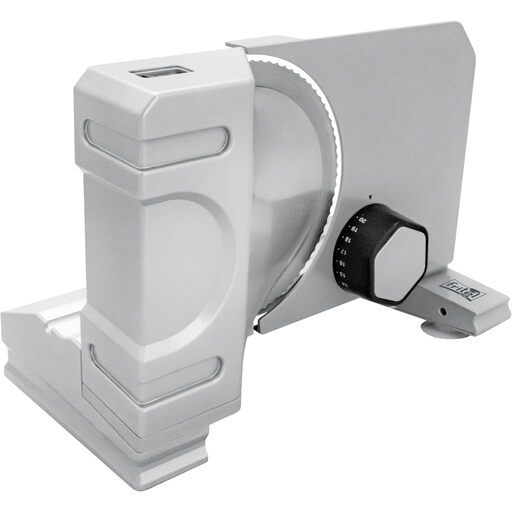
Why it suits this type of user: This Fritel slicer is designed for a range of ingredients and offers extra adjustment options for families or anyone who slices food several times a week.
This model has a 0-20 mm setting, a serrated food holder and non-slip feet. Its stated maximum continuous operating time helps prevent overloading.
150 watts, 190 mm blade diameter, 15-degree angled design and a supplied collection tray, according to the product specifications.
We’ve put together a complete, up-to-date list of products that meet these strict selection criteria and current European safety requirements.
You can if the product description lists both uses and the appliance has a suitable blade. A serrated blade is practical for bread; a smooth blade may be preferable for cold meats and cheese. Clean the blade and carriage between different types of food.
Switch off the appliance, unplug it and wait for the blade to stop moving. Only remove parts that the manual says are removable. Keep water away from the motor housing. Wipe the outside with a slightly damp cloth and dry any loose parts carefully before putting them back.
Its lifespan depends on the materials, maintenance, frequency of use and workload. An appliance used on a stable surface and not run for longer than recommended is less likely to suffer unnecessary wear. Also check the statutory guarantee and whether replacement blades or other parts are available.
