
Vandaag of morgen in huis

Kwaliteit gegarandeerd

Welkomstaanbiedingen ontgrendelen: GRATIS bezorging | Tot 80% korting | Gratis 30 dagen JoyPlus-proefperiode
Download de app
An electric food slicer can be useful for fresh bread, cheese, cold meats and some vegetables. However, models vary considerably in their construction, blade and controls. A low price doesn’t automatically mean a machine is easy to use, while a higher wattage doesn’t always make it right for your kitchen.
Look out for these three common pitfalls:
An adjustable slice thickness is useful for bread and cold meats. Thin slices work well for ham or cheese, while thicker slices of bread often hold together better. A range of 0 to 15 mm is sufficient for many household tasks. Models with a range of up to 20 mm give you more room for thicker slices.
Also check the position of the carriage. An angled position, such as 15 degrees, can guide food towards the blade more effectively. This is particularly useful for bread crusts and larger pieces of meat. A metal stop plate or carriage generally provides a stable base, but check the appliance’s dimensions too. An electric food slicer takes up more worktop space than a manual vegetable slicer.
A serrated stainless steel blade is suitable for crusty bread and firm cold meats. For finely sliced meat, cheese or very smooth cuts, a straight blade may be more useful. A slicer supplied with multiple blades therefore offers greater flexibility, provided they’re safe to change and clean.
A metal housing can provide extra stability while slicing. Look out for rubber non-slip feet and a sturdy food holder too. A plastic component isn’t automatically unsuitable, but it should provide enough grip and keep food safely away from the blade.
A food holder with finger guard is essential for safe use. Use it even when the last piece of food gets small. A pulse setting is suitable for a few slices; a continuous setting can be more convenient when slicing several items one after another.
Always follow the instructions. Return the slice thickness setting to zero after use, unplug the appliance before cleaning or changing the blade, and never immerse the machine in water. The Fritel SL 3710 manual also states that the motor shouldn’t be used continuously for more than 10 minutes, followed by a cooling period. This kind of information is more useful than a general claim about “professional performance”.
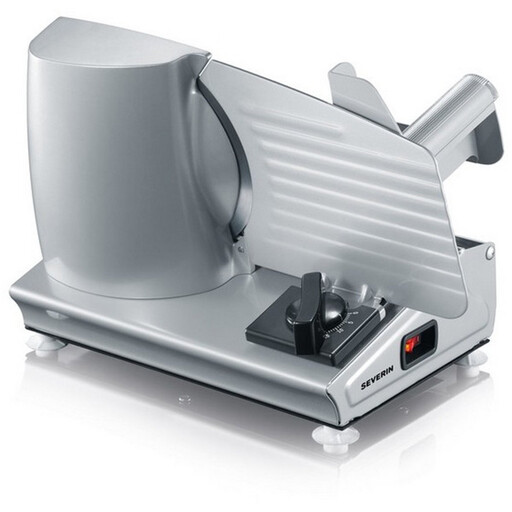
Why it suits this profile: This model is suitable for households looking to slice bread, cheese, cold meats and vegetables without stepping up to a larger appliance. The controls are straightforward, and the slice thickness adjusts continuously from 0 to 15 mm.
The machine has a food holder for finger protection, rubber feet and a stainless steel sliding plate. It comes with both a straight and a serrated blade.
180 watts, 0–15 mm slice thickness, two blade options and a tilting carriage for bread and cold meats.

Why it suits this profile: Its construction and finish make it a good fit for anyone looking for a permanent kitchen slicer for regular use, with an easy-to-clean design.
The removable carriage makes cleaning easier. The safety switches offer pulse and continuous settings, so you’re not limited to just one operating mode.
Slice thickness up to 20 mm, metal construction, glass base plate and a carriage with an 18 cm cutting path.
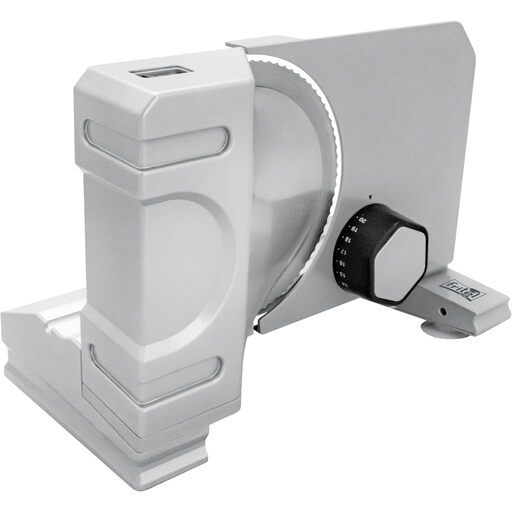
Why it suits this profile: This model is a good fit for keen home cooks who slice larger loaves, charcuterie, cheese or vegetables and need a relatively large blade and cutting range.
The metal construction, non-slip feet and food holder help keep the machine steady while slicing. The manufacturer also specifies a limit for continuous use, so plan breaks when preparing larger quantities.
190 mm blade, 0–20 mm slice thickness, a 15-degree angled carriage and a geared motor drive.
We’ve put together a complete, up-to-date list of products that meet these strict selection criteria and the applicable European safety regulations.
First, decide whether you’re looking for a bread slicer, a meat slicer or a multifunctional model. A serrated blade is well suited to bread, while a straight blade can be a useful addition for finely sliced cold meats. If you mainly want to slice vegetables, check whether the product is designed for that purpose. An electric slicer won’t necessarily replace a dedicated vegetable slicer or mandoline.
Next, measure your worktop. Models with a metal housing and a larger carriage are more stable, but take up more space. Check whether the carriage, blade and collection tray are removable too. Clean the parts according to the instructions, and take care around sharp edges when removing them.
For consumers in the European Union, new products are generally covered by a statutory guarantee of conformity. The models mentioned come with a stated statutory guarantee period of at least two years. Keep your proof of purchase and contact the seller if a fault develops.
That depends on the blade. A serrated blade works well for bread and hard crusts. A straight blade may be more suitable for cold meats and cheese. A bread and meat slicer with two blade options gives you more choice.
Wattage is only one factor. The models in this selection, for example, have 150, 160 or 180 watts, while other versions are listed at 250 watts. Also consider the drive system, blade diameter, stability and recommended operating time.
Its lifespan depends on use, maintenance and storage. Always use the food holder, don’t force hard or oversized items through the machine, and clean the blade according to the instructions. A metal housing and replaceable or removable parts can be useful for regular use.
