Choose a food slicer with an adjustable cutting thickness, a carriage that can accommodate your piece of cheese and a blade that the manufacturer says is suitable for the thickness of slice you want. For thicker slices, a serrated universal blade is a well-founded option. A smooth blade gives you more choice for very thin slices, but it is not automatically better suited to firm cheese. Also compare cleaning requirements, operating time, storage space and which blades are included with the exact model.
Who is an electric food slicer suitable for?
Family cooks who want evenly sliced cheese
If you’re slicing cheese for several people, an adjustable thickness, a suitable blade and enough space on the carriage are important considerations. Manufacturers describe possible settings and uses, but these don’t guarantee the same result with every type of cheese.
Home cooks who want to work safely and hygienically
A food holder and finger guard can help guide smaller pieces. Check which parts are included with the exact model and follow the instructions. The Netherlands Nutrition Centre advises keeping raw and ready-to-eat foods separate, and cleaning kitchen utensils thoroughly between uses.
Cooks with limited kitchen space
If you want to put the machine away after use, compare a foldable model with the worktop space taken up by a compact machine. Easy storage alone doesn’t tell you whether it’s suitable for a large piece of firm cheese.
What should you look for when buying?
Serrated and smooth blades
A good fit if: you want to slice very thin sandwich fillings as well as firm cheese, and both blades are included with the model you choose.
Bear in mind: you’ll need to change the blade safely and do some extra cleaning. A smooth blade is not automatically better suited to firm cheese.
One serrated universal blade
A good fit if: you mainly want to slice regular or thicker pieces of cheese and don’t need an extra blade.
Bear in mind: there’s less choice for very thin sandwich fillings; ritter states that the E 16 has an operating time of 5 minutes per session.
Foldable model
A good fit if: storage space is your main practical constraint. SEVERIN says the AS 3912 has a foldable base plate.
Bear in mind: check the carriage, the dimensions when in use and the included blade before slicing a large piece of cheese.
| What to consider |
What should you check? |
Who should consider this? |
| Even slice thickness |
Check the adjustable thickness, included blade, carriage and space for the piece of cheese. Treat a stated thickness as a setting, not as a measured slicing result. |
If you want slices of a particular thickness for a family meal, being able to set it consistently is important. Around 36% of consumers put slice thickness first. |
| Safe operation |
Check the carriage, food holder, finger guard and switch on the exact model, and read the instruction manual. |
If you want to stay in control as the piece of cheese gets smaller, pay particular attention to the guiding mechanism and the protective parts included. Around 29% of consumers give safe operation top priority. |
| Cleaning and hygiene |
Check which parts can be removed and follow the cleaning instructions. Unplug the machine before cleaning. Keep utensils used for raw meat separate from those used for ready-to-eat cheese, or wash them thoroughly between uses, as advised by the Netherlands Nutrition Centre. |
If you use the machine for cheese and other foods, you’ll want to know how to clean the food-contact parts and keep foods separate. Around 21% of consumers put cleaning first. |
| Worktop space and storage |
Compare the dimensions in use and in storage, and check that the piece of cheese fits properly on the carriage. |
If you have limited cupboard or worktop space, weigh up the storage design against the room needed to operate the machine. Around 14% of consumers put storage space first. |
Common buying mistakes
-
Assuming an extra smooth blade is automatically the best one for cheese
Manufacturers describe different uses for smooth and serrated blades; Graef also recommends a serrated blade for thicker slices of cheese.
Choose based on the slice thickness you want, and check which blades are actually included with the exact model.
-
Looking only at the maximum cutting thickness
A setting won’t tell you whether your piece of cheese fits properly on the carriage or how long the machine can run continuously.
Also check the carriage, food holder, dimensions and any operating time limit in the instruction manual.
-
Confusing a two-year manufacturer’s warranty with the end of all your rights
According to ACM ConsuWijzer, statutory rights are separate from a manufacturer’s warranty with a fixed term. What you can reasonably expect from a product in a particular situation depends on the circumstances.
Keep your proof of purchase and contact the retailer if a fault develops during normal use.
Brands to compare
Severin
The AS 3915 and AS 3912 differ in their storage design and blade options; they are not identical models.
- According to Severin, the AS 3915 has a metal housing, a carriage with a finger guard and food holder, and an adjustable thickness of 0–15 mm.
- The AS 3912 is foldable; that feature alone doesn’t show that it delivers the same slicing performance with firm cheese.
Graef
The G52 TWIN is a compact food slicer with two blade options.
- Graef lists a serrated blade, an extra smooth blade, stepless thickness adjustment and a lockable carriage. In its blade guide, Graef also recommends the serrated blade for thicker slices of cheese.
- Check which blades are included with the exact model and whether it has the required CE marking. The slicing uses described are the manufacturer’s recommendations, not the result of an independent cheese test.
ritter
The E 16 is a metal food slicer with one serrated universal blade.
- ritter lists a 17 cm blade, adjustable cutting thickness up to around 20 mm and a removable carriage.
- ritter specifies an operating time of 5 minutes per session for the E 16. Bear this in mind if you want to slice continuously for longer. These are the manufacturer’s specifications, not the result of an independent comparison.
Joybuy product picks
This selection includes electric food slicers with adjustable cutting thickness. For each model, check whether the included blades and carriage are suitable for your cheese and intended use.
 No image available
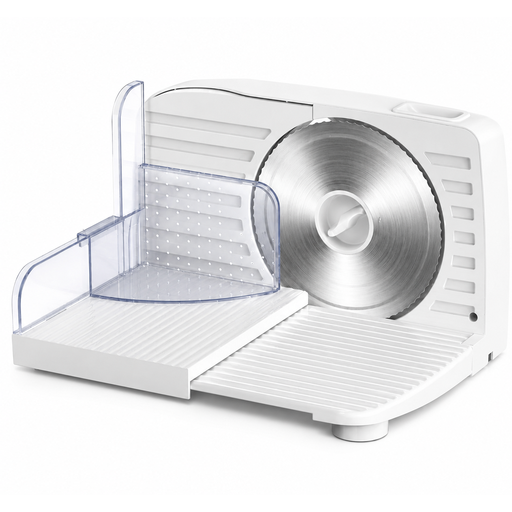
Electric food slicer, 0–15 mm, 2 blades
An option if you want to adjust the slice thickness and choose between two included blades.
Power: 250 W. Adjustable thickness: 0–15 mm. Two blades.
View at Joybuy
 No image available
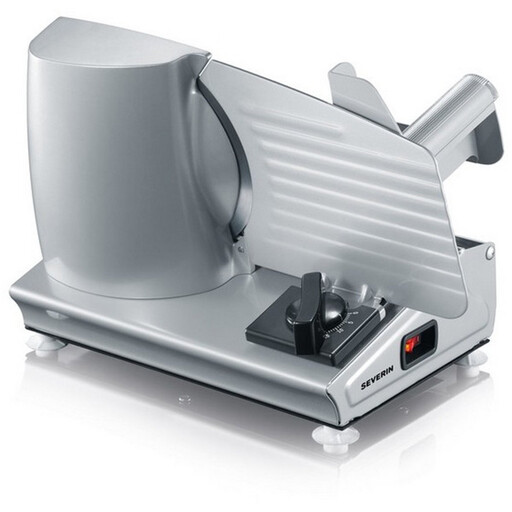
Severin AS 3915
An option if you want to slice cheese and other foods with adjustable slice thickness and a finger guard on the sliding plate.
Adjustable thickness: 0–15 mm. Two blades. Stainless steel sliding plate with finger guard. Unplug the machine before changing blades or cleaning; do not immerse it in water.
View at Joybuy
Frequently asked questions
Which blade should you choose for firm cheese?
For regular or thicker slices of cheese, Graef also recommends a serrated universal blade. A smooth blade may be an option for very thin slices or soft foods; check which blade comes with your exact model. This is the manufacturer’s recommendation, not an independent comparison using your cheese.
How should you clean the slicer after using it for cheese or raw meat?
Unplug the machine before taking it apart or cleaning it, and follow the instructions for the blade and removable parts. Don’t use utensils with raw meat residue on ready-to-eat cheese: keep them separate or wash them thoroughly between uses.
Does a two-year manufacturer’s warranty mean you have no rights after that?
No. According to ACM ConsuWijzer, statutory consumer rights in the Netherlands are separate from a manufacturer’s warranty with a fixed term. If a fault develops during normal use, contact the retailer. What you could reasonably expect from the product in a particular situation depends on the circumstances.
Which product marking is relevant for an electric food slicer in the Netherlands?
According to the Dutch government, electrical appliances placed on the market in the EU must meet the applicable safety requirements and carry the required CE marking. Check the marking and product information for the exact model. The European Commission points out that the marking alone is not a complete guarantee of safety.


