
Host serving firm cheese in slices
Looking for a suitable blade and adjustable slice thickness for the cheese being served. Graef specifically mentions firmer cheese for the SKS110.


Start with a model whose manufacturer specifically mentions firm cheese, and check that your piece of cheese will fit on the carriage. If you’re slicing several portions, ease of use and the permitted operating time matter. For occasional slicing, compact storage and easy cleaning may be more important. Manufacturer specifications describe capabilities; they are not independently measured slicing results.
Looking for a suitable blade and adjustable slice thickness for the cheese being served. Graef specifically mentions firmer cheese for the SKS110.
Want to work efficiently, so ease of use, a food holder and the chosen model’s operating time are worth considering. ritterwerk states that the serano⁷ has a short-time operating period of 10 minutes.
Looking for a machine for occasional cheese slicing that can be stored compactly and has parts that are easy to access for cleaning. DOMO describes the DO523S as foldable.
First, check whether the manufacturer mentions firm cheese and whether your piece of cheese will fit on the carriage. Then consider the slice thickness you want, how the machine operates and how much storage space you have for your preparation.
| What to consider | What should you check? | Who should pay extra attention? |
|---|---|---|
| Slicing firm cheese | Check whether the manufacturer mentions firm cheese, which blade is included and whether your piece of cheese will fit on the carriage. | If I want to serve firm cheese in slices at dinner, I focus on the stated use and the blade. Around 40% of consumers prioritise slicing results for firm cheese. |
| Operation and cleaning | Check the switch, food holder and removable parts; follow the model’s instructions for cleaning. | If you’re slicing a lot for guests, you’ll want to operate the machine with control and remove any scraps easily. Around 30% of consumers give ease of use and cleaning top priority. |
| Using and storing the machine | Compare the space needed while the machine is in use with its dimensions when stored away. | If I have limited cupboard space, compact storage matters, as well as the space the machine takes up while slicing. Limited storage space is the top priority for around 20% of consumers. |
| Slicing other foods too | Check which uses the manufacturer lists and which blades are included with that version. | If I want to use the machine for other slicing tasks after dinner, I check its stated uses and the blades included. Around 10% of consumers prioritise versatility. |
Manufacturer information varies, from specifically mentioning firmer cheese to referring to cheese in general. That description does not guarantee a particular result with every type of cheese.
Check the uses listed for that exact model, the blade and the dimensions of your piece of cheese. Don’t treat a manufacturer’s claim as an independent performance test.
On its own, an adjustment range or power rating says nothing about cleaning, operation or how long the machine can run continuously.
Also check the blade, food holder, cleaning instructions and the model’s specified operating time.
Brand and model names can look alike without confirming that a machine is the same model or version.
Before buying, check the full brand and model name, the specifications and the parts included.
The SKS110 is a more compact model option whose manufacturer specifically mentions firm cheese.
The SL 3710 is a metal multipurpose food slicer for anyone who wants to prepare cheese and other foods with one machine.
The AS 3915 offers adjustable slice thickness and comes with a cold-cut blade.
The serano⁷ is worth considering if operating time and adjustable speed matter when you have a lot of slicing to do.
The DO523S is a foldable option for occasional cheese slicing and compact storage.
These models are suitable for slicing cheese and adjusting slice thickness, with different features for operation, storage and other uses.
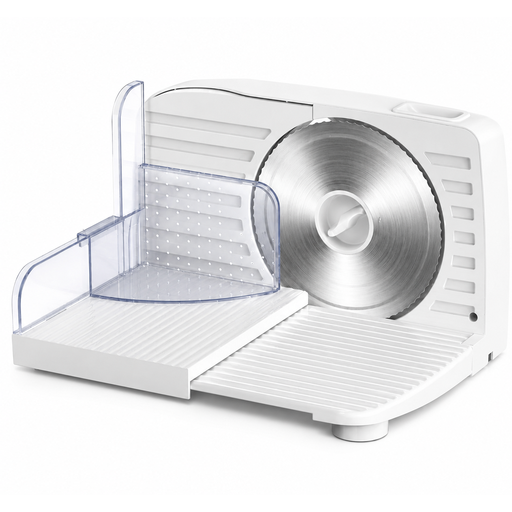 No image available
An option if you want to adjust the slice thickness before slicing.
The product lists two blades and an adjustment range of 0–15 mm.
 No image available
An option if you want a serrated blade and adjustable slice thickness for a range of slicing tasks.
The description lists an 18 cm cutting path, a removable carriage and adjustable slice thickness of up to 20 mm.
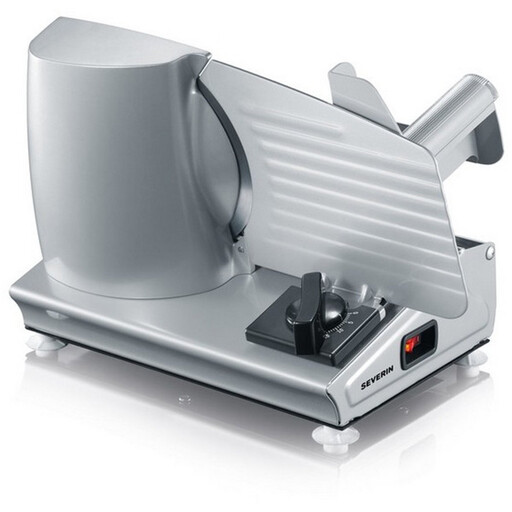 No image available
An option if you want to slice cheese and other foods and value adjustable slice thickness.
The product title lists two blades and a range of 0–15 mm. The description mentions a tilting carriage for changing blades and cleaning.
 No image available
An option if you want to slice cheese and are looking for a foldable design for storage.
The product information lists a 17 cm serrated blade, a range of 0–15 mm, 100 W and cord storage.
 No image available
An option if you want to slice cheese and other foods and use a food holder.
The product information lists a 190 mm universal blade, a slice thickness of 0–20 mm and a food holder.
Don’t rely on the category name alone: not every manufacturer specifically mentions firm cheese for every model. Graef mentions firmer cheese for the standard blade on the SKS110; for your machine, check the blade, the size of the cheese and the manual.
Follow the cleaning instructions for your model, and never work on a machine that is still plugged in. Graef for the SKS110, Fritel for the SL 3710 and DOMO for the DO523S all mention a removable blade; that does not mean the motor housing is dishwasher-safe.
Store cheese in a sealed container in the fridge. The Netherlands Nutrition Centre says that slices of the processed hard 40+ cheese covered in its guidance can be kept in the fridge for four days. For other types of cheese, check the label and storage advice.
For an online purchase, you generally have a statutory cooling-off period of up to 14 days after delivery, subject to legal exceptions. ACM ConsuWijzer also states that you’re entitled to a product that meets legal requirements and that the seller is responsible for providing a solution if a fault is covered by the statutory guarantee. A manufacturer’s guarantee does not replace this right.