
Vandaag of morgen in huis

Kwaliteit gegarandeerd

Welkomstaanbiedingen ontgrendelen: GRATIS bezorging | Tot 80% korting | Gratis 30 dagen JoyPlus-proefperiode
Download de app
An electric food slicer can be useful for bread, cold meats, cheese, vegetables and charcuterie. However, the range often looks simpler than it really is. A low price says little about stability, while a high wattage does not automatically mean an appliance is better suited to your kitchen.
Pay particular attention to the construction, adjustable slicing thickness and how safely the appliance can be cleaned. Below, you’ll find out which specifications really matter and which models suit different uses.
The motor power is often displayed prominently in the product title. A higher wattage can be useful for regular use, but it does not tell you everything. The drive system, blade, guides and maximum operating time also play a part.
A compact bread slicer with adequate guidance may be more practical for normal household use than a heavier model that takes up a lot of space. Always check the full product specifications rather than just the wattage.
An appliance that can slice very thinly is not automatically suitable for every ingredient. Different blade shapes may be better suited to soft bread, hard crusts, cheese and cold meats. Product information often associates a serrated blade with bread and firmer foods, while a smooth blade may be intended for fine slices of meat or cheese.
If you’re looking for a meat and bread slicer, it’s worth checking which blade is included and whether it can be removed.
A rotating blade requires consistent safety practices. A finger guard or food holder is an essential accessory, not an unnecessary extra. Non-slip feet, a stable carriage and a switch for continuous or pulse operation also make a difference in everyday use.
Pay attention to cleaning as well. Always unplug the appliance before removing the blade. A model with a removable carriage or blade may be easier to keep clean, but check the instruction manual for the correct method.
Adjustable slicing thickness determines how many different tasks you can handle. A slightly thicker slice is often practical for sandwiches, while cold meats or cheese can be sliced more thinly. A setting of 0–20 mm offers plenty of flexibility for household use.
Pay attention to how the thickness is adjusted. A continuously variable dial gives you more freedom than a limited number of fixed settings. Return the dial to zero after use if this is required by the product instructions.
A larger blade can accommodate bigger pieces of bread or meat, but it also makes the appliance more bulky. A diameter of 17 to 19 cm is found on various household models. Also check the available cutting path and the dimensions of the carriage.
An all-purpose slicer sounds versatile, but its suitability depends on the included accessories and the product description. Check whether the model is explicitly marketed for bread, cheese, charcuterie, vegetables and meat.
Non-slip feet help keep the appliance in place. An angled carriage of, for example, 15 degrees can make it easier to position food and move the carriage. This is a design feature, not a guarantee of a particular slicing result.
Also check the controls. A momentary setting is useful for short tasks, while a continuous setting may suit several consecutive slices. For example, the Fritel SL 3710 is specified for a maximum of ten minutes of continuous use, after which the motor must cool down. Such limits are important if you regularly process large quantities.
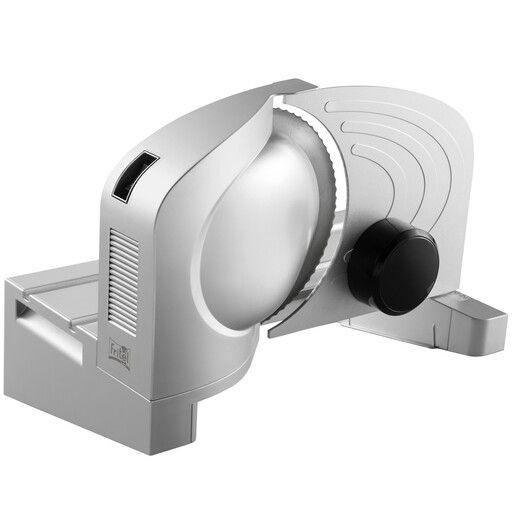
Why it suits this profile: This model offers a wide range of settings without requiring you to move straight to a large professional appliance. It suits households that occasionally want to slice bread, cheese, cold meats and vegetables evenly.
The product specifications list a continuously adjustable slicing thickness of 0–20 mm, a food holder and rubber stability elements. This means you’re looking beyond motor power alone.
160 watts, a 17 cm serrated blade, metal stop plate and a carriage angled at 15 degrees.

Why it suits this profile: The construction and finish suit users who have a permanent place for their household slicer and value easy maintenance and an attractive design.
The product information mentions a removable carriage, a safety switch for momentary and continuous operation, and a slicing thickness of up to 20 mm.
Metal suspended construction, shatter-resistant glass base plate, removable carriage and an 18 cm cutting path.
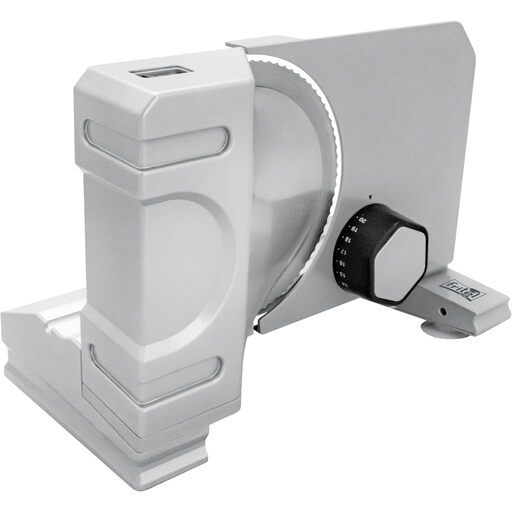
Why it suits this profile: This model is designed for users who process several types of food and frequently want to adjust the slicing width, for example for bread, cheese, charcuterie and meat.
The product specifications list a food holder, serrated food holder, non-slip feet and a 0–20 mm dial. The stated cooling period helps you plan longer sessions.
150 watts, a 19 cm blade diameter, a 15-degree angled carriage, and both pulse and continuous operation.
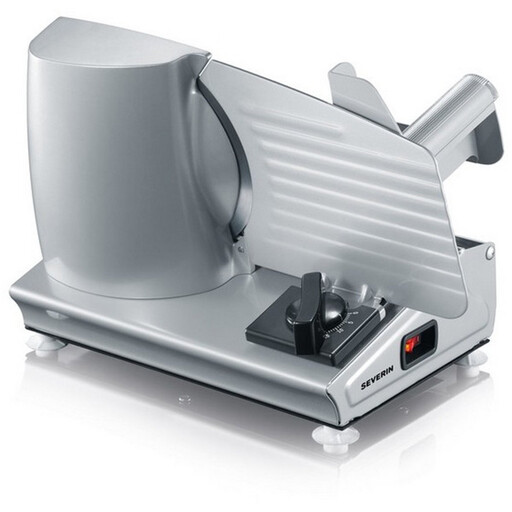
Why it suits this profile: This is a practical option for anyone who alternates between bread and cold meats and wants to use two different blade types.
The listed set includes a serrated blade and a smooth blade. The product information also includes a finger guard, rubber feet and a metal sliding plate.
180 watts, adjustable from 0 to 15 mm, a 131 cm cable and a tilting carriage for changing the blade and cleaning.
Always use an electric bread or meat slicer on a flat, dry surface. Push the food towards the stop plate using the food holder and keep your fingers away from the blade. Small leftover pieces are precisely when extra care is needed.
After use, follow these steps:
Statutory guarantees are covered by European consumer protection rules. Keep your proof of purchase and contact the seller first if there is a fault.
We’ve compiled a complete, up-to-date list of products that fully meet these strict selection criteria and the applicable European safety regulations.
It can be, but check the blade and product description. A serrated blade is generally specified for bread and firm foods. A smooth blade may be included for finely slicing cold meats or cheese. A model with two blades, such as the Severin AS 3915, offers more choice for different uses on paper.
That depends on the dish and your preference. An adjustable range of 0–20 mm gives you plenty of flexibility for both thin cold meats and thicker slices of bread. Also consider the size of the carriage: a limited cutting path can be awkward when slicing large loaves or wide pieces of meat.
Power consumption depends on the wattage and operating time. An appliance rated at 150 to 180 watts uses relatively little energy during short periods of use. The main saving comes from using it correctly: slice in short sessions, follow the stated cooling time and avoid leaving the motor running unnecessarily.
