
Livraison le jour même et le lendemain

Qualité garantie

Débloquez vos offres de bienvenue: Livraison GRATUITE | Jusqu'à -80 % | 30 jours d'essai gratuits à JoyPlus
Téléchargez l'application
An electric food slicer can quickly cut bread, cheese, cold meats and vegetables into even slices. But it’s not a good idea to choose one based only on its wattage or an attractive product photo. A machine that looks versatile on paper may offer too little control over slice thickness, be difficult to clean or lack stability in practice.
The most common buying pitfalls are:
A slicer with adjustable thickness gives you more control over the result. A range of 0-20 mm is useful if you want to switch between wafer-thin cold meats, slices of cheese and thicker slices of bread. Models with a range of 0-15 mm are more practical if you mainly slice everyday sandwich fillings, vegetables and cold meats.
A serrated blade is generally practical for crusty bread and firmer foods. A smooth blade may be better suited to finely slicing meat or cheese. Some models come with two blades. Always check whether the blade is removable and how the product information says it should be cleaned.
The blade diameter affects how much room you have for larger items. The Fritel SL 3710, for example, has a blade diameter of 190 mm, while the Fritel SL 3655 uses a 170 mm blade. That difference matters when slicing large loaves or wider cuts of meat.
A carriage angled at around 15 degrees can make it easier to feed food into the blade. Also look for:
A kitchen slicer may not always stay in the same place while you use it. Check in advance that its dimensions will fit your worktop and that you have enough room to move the carriage safely.
The stated power is just one factor to consider. According to the product specifications, a model with a gear drive may be designed for more stable operation, but wattage alone doesn’t tell you how quickly or evenly it will slice every type of food.
Check the recommended operating time too. The Fritel SL 3710, for example, is specified for a maximum of 10 minutes of continuous use, after which the motor must cool down. This makes it suitable for preparing portions in the kitchen, but less suited to long, uninterrupted sessions.
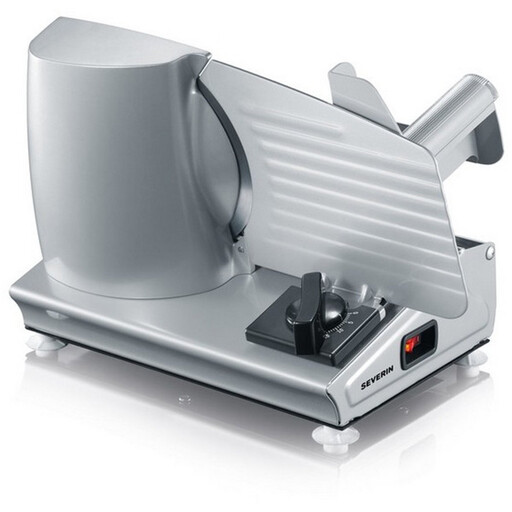
Why it suits this user: This model offers adjustable slice thickness from 0-15 mm, 180 watts of power and two blades for bread, cheese, meat and vegetables. It’s well suited to everyday use without having to opt for a larger model straight away.
Being able to choose between a smooth and a serrated blade means you don’t have to use the same blade for every type of food. The metal carriage and rubber feet help keep the machine stable.
Adjustable slice thickness from 0-15 mm, 180 watts and two blades included.

Why it suits this user: Its metal construction, adjustable speed control and slice thickness of up to 23 mm make it a good choice for people who regularly prepare a variety of foods.
The product description lists both a serrated and a smooth blade, so you can choose the right blade for bread or cold meats.
Slice thickness of up to 23 mm, all-metal construction and electronic speed control, according to the product description.
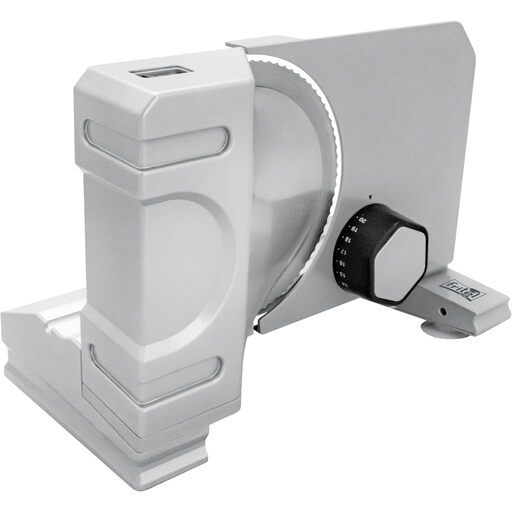
Why it suits this user: This multi-purpose food slicer has a 190 mm blade, adjustable slice thickness from 0-20 mm and a carriage angled at 15 degrees.
The product information lists a food pusher, non-slip feet and a thickness dial that turns back to 0. The recommended operating time is also clearly stated.
190 mm blade, adjustable from 0-20 mm and gear drive, according to the product specifications.
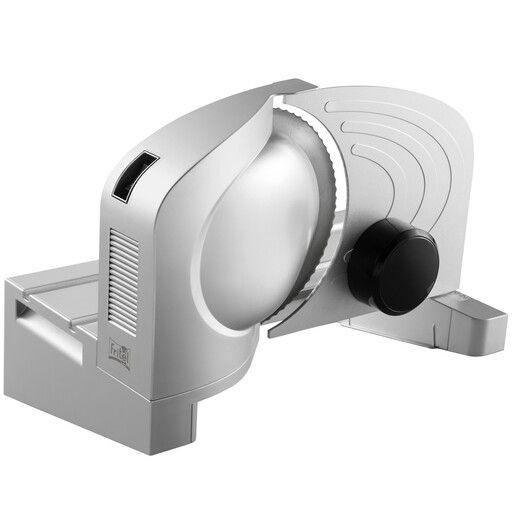
Why it suits this user: Its adjustable 0-20 mm thickness, 170 mm serrated stainless steel blade and metal stop plate make it well suited to bread, cheese and firm cold meats.
The removable blade and food holder make cleaning and feeding food into the machine easier to manage than with a basic manual slicer.
Serrated stainless steel blade, adjustable from 0-20 mm and a carriage angled at 15 degrees.
We’ve put together a complete, up-to-date list of products that meet these strict selection criteria and the applicable European safety requirements.
An electric meat slicer or electric bread slicer has a sharp blade that moves quickly. Always use the food pusher provided and keep your fingers away from the cutting area. After use, set the thickness dial to 0 if instructed to do so in the manual.
Also follow these basic rules:
According to their product information, the models mentioned are covered by the statutory consumer guarantee in the European Union. If a product develops a fault, you can contact the seller to request a repair, replacement or another appropriate solution under the applicable rules.
It depends on the model. A standard food slicer is not automatically designed for frozen products. Check the manual and product specifications before slicing frozen meat. For some uses, a separate electric knife with a blade designed for frozen food may be more suitable.
There’s no set wattage that’s right for every kitchen. The range includes models rated at 150 to 180 watts, while other models have a higher stated power. As well as wattage, consider the drive system, blade diameter, stability and permitted operating time.
Switch off the appliance, unplug it and follow the manufacturer’s instructions. Remove the blade only if it’s safe to do so and the manual allows it. Wipe the housing with a slightly damp cloth and keep water away from the motor.
