
Vandaag of morgen in huis

Kwaliteit gegarandeerd

Welkomstaanbiedingen ontgrendelen: GRATIS bezorging | Tot 80% korting | Gratis 30 dagen JoyPlus-proefperiode
Download de app
An electric food slicer can be useful for fresh bread, cheese, cold meats and vegetables. You can cut evenly sized slices more quickly and use less force than with an ordinary kitchen knife. However, not every model is suitable for every task. A compact bread slicer, for example, is not automatically a good meat slicer.
If you only consider wattage or a low price, you may encounter practical problems later on. Below, we cover the most important points to consider, along with several models suited to different households.
A higher wattage may sound appealing, but it does not tell you everything about the slicing results. The drive system, blade, carriage and maximum operating time also play a part. A 100-watt model may be suitable for slicing bread regularly, while more intensive use calls for a sturdier construction.
Always check:
A serrated blade works well for bread and certain soft foods. For cold meats, cheese and vegetables, a smooth blade may provide more even results. Some models come with several blades, while others have one universal blade.
Pay attention to the material, too. A stainless-steel blade is easy to clean and designed to withstand everyday contact with food, but it still needs to be cleaned and dried according to the instructions.
A compact kitchen slicer will not always remain permanently on the worktop. Check the dimensions, weight and whether the appliance can be folded away. A folding food slicer takes up less space in a Dutch kitchen, but it must be fully unfolded and placed securely during use.
The thickness setting is just as important. A range of 0 to 15 mm is suitable for thin bread, cheese and cold meats. For thicker slices or larger pieces, a range of up to 20 or 23 mm may be more practical.
The adjustable slice thickness determines how much control you have over the result. A larger blade diameter can help with taller loaves or larger pieces of food, but it also often makes the appliance more substantial.
A good carriage provides enough room for the food and includes a food holder. This keeps the food in place without bringing your fingers too close to the blade. When slicing small pieces, using this holder is not an optional extra but an essential part of working safely.
A food slicer should remain firmly in place as you move the carriage backwards and forwards. Non-slip feet, a stable base and a properly locked carriage help prevent movement during slicing.
A metal housing may feel heavier and more robust than a plastic model. That does not automatically make plastic unsuitable. For occasional bread slicing, a lighter model may actually be more convenient. Choose the construction based on how often you intend to use the appliance and how much storage space you have.
Check whether the blade and carriage can be removed. Otherwise, crumbs, grease and food residue can easily collect around the slicing area. Always unplug the appliance before cleaning it and follow the instructions.
Useful safety features include:
A sharp blade remains a hazard even with these features. Never leave an electric food slicer plugged in unattended, and store it out of the reach of children.
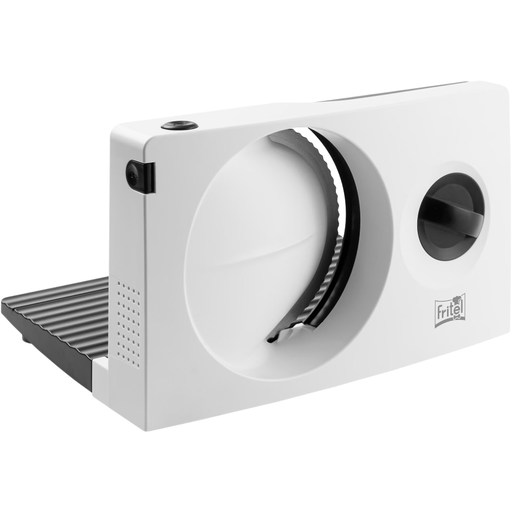
Why it suits this profile: This compact model is designed for slicing bread and takes up very little storage space thanks to its folding design. The slice thickness can be adjusted from 0 to 15 mm.
The specifications make it clear that this is primarily a bread slicer, so you will not buy it expecting to slice large pieces of meat.
100 watts, serrated stainless-steel blade, crumb tray, child-safe on/off switch and folding design.

Why it suits this profile: If you want greater control when slicing bread, cold meats, cheese and other ingredients, this model offers a metal construction, angled setup and electronic speed control.
The product comes with a serrated blade for bread and a smooth blade for foods including meat and cheese. This makes its intended uses clearer than those of a model with one fixed blade.
Slice thickness of up to 23 mm, 24 cm cutting path, variable electronic speed control and a removable carriage.

Why it suits this profile: This multi-purpose slicer is designed for bread, cheese, charcuterie, vegetables and meat. Its 15° angled design supports a comfortable slicing motion.
The instructions specify a maximum continuous operating time of 10 minutes followed by a cooling period. This helps intensive users plan their use more realistically.
150 watts, 190 mm blade diameter, slice thickness from 0 to 20 mm, collection tray and removable carriage.
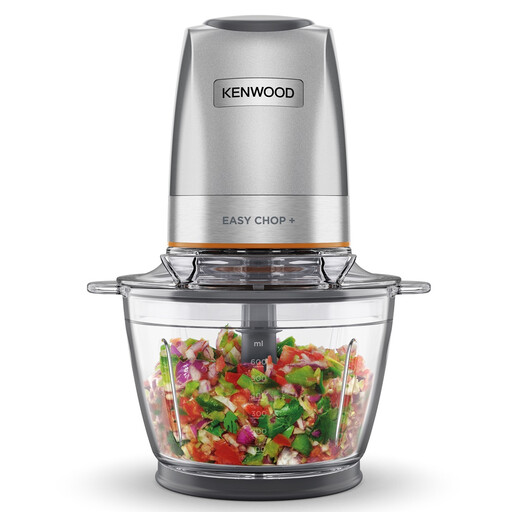
Why it suits this profile: This is not a traditional slicer for bread and meat, but an electric food processor for chopping, mixing and processing ingredients in a bowl.
By making the difference between chopping and slicing clear, you will not expect a multi-purpose slicer when what you actually need is a way to finely chop ingredients.
500 watts, 600 ml bowl, two speeds, four-part stainless-steel blades and a non-slip ring.
We have put together a complete, up-to-date list of products that fully meet these strict selection criteria and the applicable European safety regulations.
Place the appliance on a stable, dry surface and set the thickness before you begin. Use the carriage and food holder with every item, especially as the piece becomes smaller. Do not press hard against the blade; let the motor do the work.
A bread slicer works best with bread that has cooled down. For cold meats and cheese, it is best to make sure the product is firm and a suitable size for the carriage. Take account of the maximum operating time for your chosen model and allow the motor to cool down whenever the instructions require it.
That depends on the blade and the product description. A model with a serrated blade is often intended for bread. For a bread and meat slicer, an interchangeable or universal blade is more practical. Also check which ingredients are permitted and the dimensions of the carriage.
Consumption depends on the power rating and operating time. In theory, a 100-watt appliance uses 0.1 kWh per hour when the motor runs continuously. In the kitchen, the motor is usually switched on for only short periods. As a result, the difference in electricity costs between models is often smaller than the difference in how frequently they are used.
The lifespan is affected by the materials, maintenance, workload and storage conditions. Clean the blade according to the instructions, avoid overloading the appliance and do not use it for longer periods at a time than specified. Store a folding food slicer in a dry place, fully folded away, with the blade out of the reach of children.
