
Host serving crusty bread
You want to slice a loaf with a firm crust neatly for dinner. The type of blade and the support provided while slicing are important things to consider.


For crusty bread, a serrated or scalloped blade is a sensible starting point; then check whether the slicing thickness and capacity suit your loaf. A foldable model can be handy for occasional use and limited cupboard space. Bear in mind, though, that claims about suitability for hard crusts come from manufacturers and are not based on independent slicing tests.
You want to slice a loaf with a firm crust neatly for dinner. The type of blade and the support provided while slicing are important things to consider.
You slice different types of bread and want to choose between thin and thicker slices. Compare the adjustment range with the thicknesses you actually use.
You use the slicer occasionally and want to be able to store it compactly and clean it after a meal.
| What to consider | What should you check? | Who is this important for? |
|---|---|---|
| Slicing through a hard crust | Check which blade is included and whether the manufacturer specifically mentions hard crusts. | If I’m slicing bread with a firm crust for guests, I want to know whether the blade is suitable for bread. Around 40% of consumers put the crust first. |
| Slices at your preferred thickness | Compare the thickness range with your preferred slice thickness and check that the loaf fits on the carriage. | When I want to choose the slice thickness myself for dinner, I also consider the space available for the loaf. Around 30% of consumers prioritise adjustable thickness. |
| Safe handling and cleaning | Check the food holder, switch and instructions for removing and cleaning the blade. | After slicing, I want to handle leftover pieces safely and know how to clean the blade. Around 20% of consumers see safe use and maintenance as their main concern. |
| Storage between meals | Compare whether the slicer folds away and its dimensions with the available storage and worktop space. | If I only use the machine occasionally, it needs to be easy to put away afterwards. Around 10% of consumers consider storage space the most important factor. |
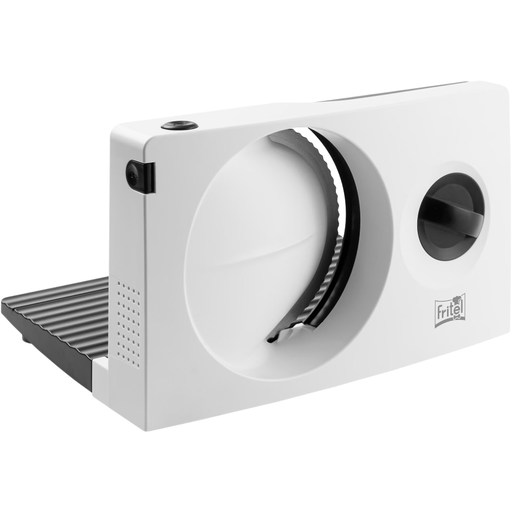
The blade supplied varies by model. An official Graef dealer describes a smooth blade as less suitable for bread; FRITEL lists a universal blade for the SL 3710 and a serrated blade for the SL 3110.
Check the exact blade supplied with the version you’re considering, especially if you mainly want to slice bread with a hard crust.
The loaf also needs to fit on the carriage. DOMO gives the maximum height of the food to be sliced on the DO523S as 15 cm.
If necessary, measure your loaf and compare both its height and your preferred slice thickness with the model’s specifications.
A manufacturer’s guarantee does not, by itself, determine how long your statutory rights in the Netherlands apply. ACM ConsuWijzer explains that statutory guarantees exist alongside any seller’s guarantee.
Keep your proof of purchase and, if something goes wrong, contact the seller to discuss the rights that apply to your situation.
The SKS110 is an example of a model for anyone looking for a scalloped blade and adjustable slicing thickness.
The SL 3110 and SL 3710 illustrate the different blade types and settings available in the range.
The metal E 16 is an example of a model with a scalloped blade and adjustable slicing thickness.
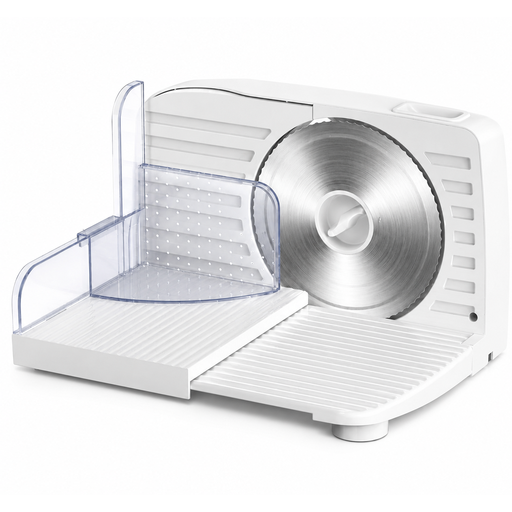
The foldable DO523S is an example of a model for occasional bread slicing and compact storage.
These electric food slicers are designed for slicing bread at an adjustable thickness; check the blade and capacity for your loaf for each model. The NVWA states that CE marking is mandatory for electrical consumer products. Check the marking and safety information for the specific appliance. CE marking does not mean that an independent body has tested that particular item.
 No image available
An option for slicing bread to your preferred thickness; check which of the two blades is right for your loaf.
The Joybuy product listing gives a power rating of 250 W and an adjustment range of 0–15 mm.
 No image available
A model for slicing bread and other foods; check whether this version suits the other foods you want to slice as well as bread.
The product description lists a serrated blade, a slicing thickness of up to 20 mm, a metal construction and a removable carriage.
 No image available
A foldable model for slicing bread and storing the machine compactly between meals.
The product listing gives a serrated blade, an adjustment range of 0–15 mm, a blade diameter of 17 cm and a power rating of 100 W.
 No image available
A foldable bread slicer for anyone who wants adjustable slices and a machine that can be put away after use.
The product listing gives a serrated blade, an adjustment range of 0–15 mm, a blade diameter of 17 cm and a power rating of 100 W.
First decide whether you want thin or thicker slices, then compare the stated adjustment range. DOMO lists an adjustment range of up to 15 mm for the DO523S; Ritter gives an adjustment range of up to around 20 mm for the E 16. Also check that your loaf fits on the carriage.
Follow the instructions for your specific model. The DOMO manual says to unplug the appliance before fitting, removing or cleaning any parts. FRITEL lists a removable blade for the SL 3110.
In the Netherlands, you have statutory rights in addition to any manufacturer’s guarantee. ACM ConsuWijzer explains that the seller must put things right if a product has been used normally but does not meet what you could reasonably expect; there is no automatic fixed two-year period. Online purchases also generally come with a 14-day cooling-off period after delivery, subject to statutory exceptions.
According to the Netherlands Food and Consumer Product Safety Authority, CE marking is mandatory for electrical consumer products; independent testing by an external body is not compulsory for this product group. Check the marking and safety instructions for the specific appliance. CE marking does not prove that an independent body has tested that particular item.